
CTS: Bridging Emotion and Causality for Smarter Cognitive Tutoring
The Combination of a Causal and Emotional Learning Mechanism for an Improved Cognitive Tutoring Agent
The paper introduces a Conscious Tutoring System (CTS) that integrates Causal Learning and Emotional Learning mechanisms to enhance cognitive tutoring. Applied to a Canadarm2 simulator for astronaut training, the system utilizes sequential pattern mining and association rules to infer the causes of learner mistakes and optimize pedagogical interventions in real-time.
TL;DR
Researchers have developed a Conscious Tutoring System (CTS) that doesn't just watch what students do—it understands why they fail. By combining Emotional Learning with a unique Causal Learning Mechanism (CLM) based on sequential pattern mining, the agent can predict astronaut mistakes in robotic arm simulations and optimize its teaching strategy by skipping redundant pedagogical steps.
Background Positioning
In the landscape of Intelligent Tutoring Systems (ITS), most agents act as reactive scripts. This paper elevates the tutoring agent to a Cognitive Agent level, utilizing the LIDA architecture and "Global Workspace Theory" to simulate human-like consciousness cycles. It moves beyond simple error detection into the realm of Inductive Reasoning.
Problem & Motivation: The "Why" Gap
Existing architectures like ACT-R or CLARION often treat learning as a purely symbolic or sub-symbolic process, frequently ignoring the interplay between emotional state and logical cause. Furthermore, the standard tool for causality—Bayesian Networks—is often impractical for real-time systems because:
- They require experts to pre-assign probability values.
- They suffer from combinatory explosion when dealing with the massive data streams generated by simulators like the Canadarm2.
The authors argue that a system must perceive a "failure," feel an "emotional valence" (urgency/danger), and then mined previous experiences to find the specific causal link that led to that failure.
Methodology: The Causal Learning Loop
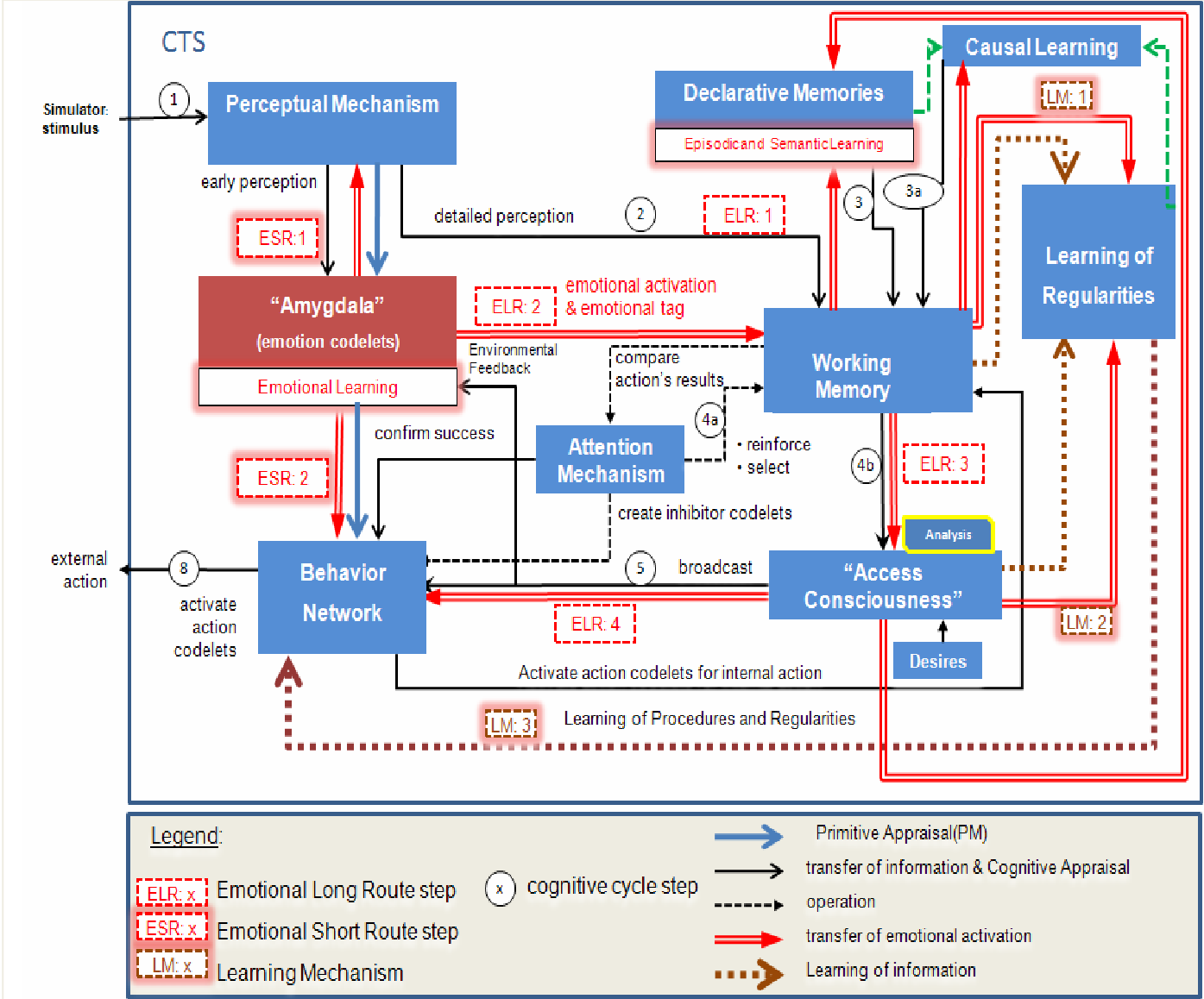
The heart of this paper is the integration of the Causal Learning Mechanism (CLM) into the LIDA cognitive cycle (typically 5 cycles per second).
1. The Architecture of "Consciousness"
The system operates through a cycle of perception, memory probing, coalition formation (attention), and action selection.
2. Rule Mining over Bayesian Graphs
Instead of pre-defined probabilities, the CLM uses:
- Data Mining: It records "coalitions" of information broadcasted to the system's "consciousness."
- CMRULES Algorithm: It extracts association rules (e.g., Selection of Wrong Joint Imminent Collision) and filters them based on temporal precedence to ensure the "cause" actually precedes the "effect."
3. Procedural Learning in the Behavior Network (BN)
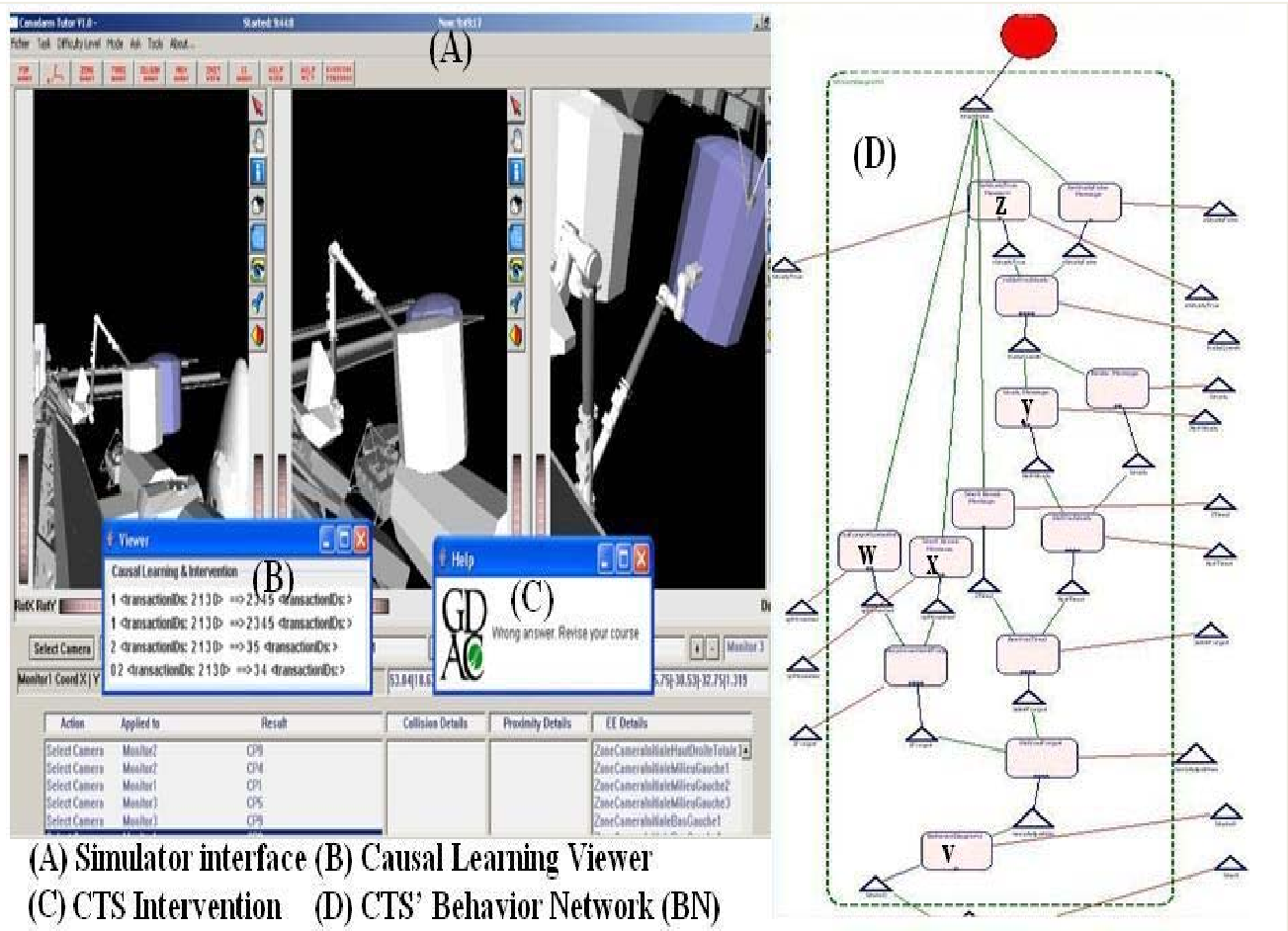
Once a rule is learned (e.g., 60% of errors are caused by "user is tired"), the CLM allows the agent's Behavior Network to "jump" or use shortcuts. If the system knows the root cause, it can skip 5 minutes of diagnostic questions and provide the specific corrective hint immediately.
Experimental Insights
The system was tested on a Canadarm2 simulator—the robotic telemanipulator on the International Space Station. This is a high-stakes environment with 7-joint movements and complex camera adjustments.
Key Findings:
- Clarity in Diagnosis: The system successfully identified that 60% of camera adjustment errors were linked to "user fatigue," while 30% were due to "forgetting the course."
- Efficiency Gains: Initial tutoring scenarios required 4 to 8 behavioral nodes (interactions). With Causal Learning, the system could "jump" directly to the solution, often using 0 to 4 rules to bypass unnecessary dialogue.
- Performance Stability: As shown in the performance charts, mining time remained under 10 seconds even as the number of recorded sequences grew to 250, proving the scalability of the association rule approach over Bayesian methods.
Critical Analysis & Takeaway
The Core Contribution: This paper provides a viable alternative to Bayesian causality in cognitive agents. By using sequential pattern mining, the agent learns in an incremental, real-time manner.
Limitations: The "shortcuts" in behavior (jumping from V to Z in the network) can sometimes be too fast. The authors had to implement "important node tagging" to ensure the tutor doesn't skip critical pedagogical steps that the student needs to see for long-term retention.
Future Outlook: This approach paves the way for "Autodidactic Tutors" that grow smarter with every student they encounter. By bridging the gap between Emotional Valence (what matters) and Causal Inference (why it happened), we move closer to AI mentors that truly understand the human learning process.