
CAUTE: Leveraging Dual-Encoder Residuals for Early Social Media Hijack Detection
You have been CAUTE! Early Detection of Compromised Accounts on Social Media
This paper introduces CAUTE (Compromised Account User Tweet Encoder), a deep learning framework designed to detect hijacked social media accounts by jointly learning nonlinear embeddings for users and their posts. CAUTE achieves SOTA performance on Twitter datasets, reaching an AUC of 0.7014, significantly outperforming traditional methods like COMPA and PCA in balanced accuracy and early detection reliability.
TL;DR
Social media account hijacking is a pervasive threat that can trigger financial panic or public unrest. CAUTE (Compromised Account User Tweet Encoder) is a sophisticated deep learning framework that treats account security as a signal-to-noise problem. By training two neural networks to "predict" a user from their tweet and vice-versa, the system flags any tweet that creates a "prediction glitch" (high residual error) as a potential hack. CAUTE achieves a 70% AUC, outperforming the industry-standard COMPA while drastically reducing the "false alarm" rate that plagues security systems.
Problem & Motivation: The Identity Mimicry Challenge
Why is it so hard to tell if a tweet was written by a hacker or the account owner?
- Contextual Overlap: A hacker's post about a specific topic might look perfectly normal for someone, just not for this user.
- Data Sparsity: Tweets are short, messy, and filled with slang. Building a reliable digital fingerprint (profile) usually requires thousands of posts—delaying detection until long after the damage is done.
- The False Positive Trap: Most current systems are "trigger-happy," flagging genuine but slightly unusual posts as hacks, leading users to ignore security alerts altogether.
The authors' insight is brilliant in its simplicity: If a user truly authored a tweet, the link between the user's history and that tweet's metadata should be mathematically consistent.
Methodology: The Core Dual-Encoder Architecture
CAUTE abandons simple linear comparisons in favor of three interconnected neural components:
1. tweet2user Encoder
This module takes the content (hashtags, mentions, text) and meta-features (time, device, language) of a tweet and attempts to map them to a latent user embedding. It essentially asks: "Given this specific message, which user is most likely to have sent it?"
2. user2tweet Encoder
This performs the inverse. Using a user's historical profile and the current meta-features (e.g., "User X is posting from an iPhone at 2 AM"), it predicts the likely content representation.
3. res2class Classifier (The Evaluator)
The system calculates the Residual Error—the distance between the prediction and reality. If the tweet2user encoder predicts "User A" but the account belongs to "User B," the residual is high. These residuals are fed into a final classification layer (res2class) to produce a definitive "Compromised" or "Genuine" verdict.
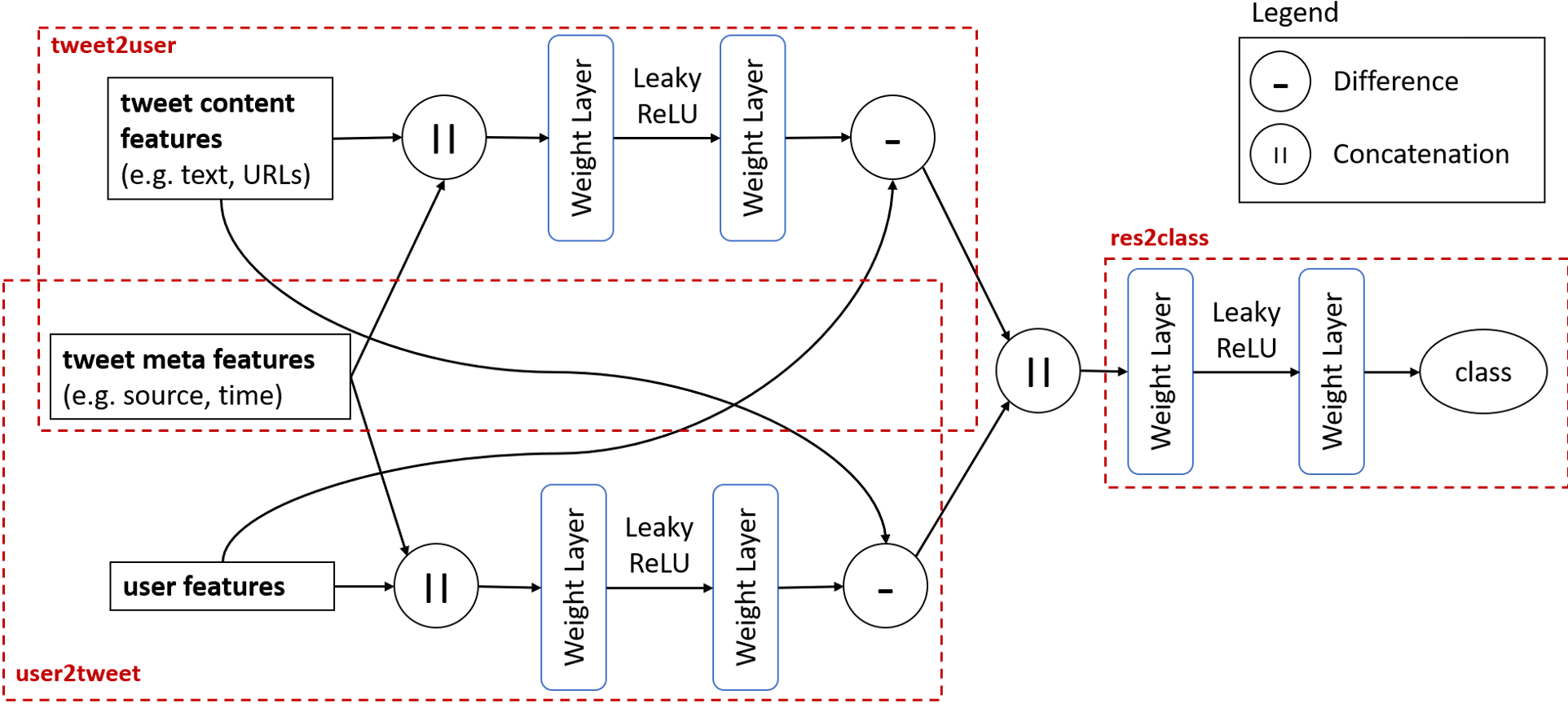 Figure 1: The CAUTE Architecture showing the dual encoder streams and the residual classification layer.
Experiments & Results: Precision Over Panic
The researchers tested CAUTE against a massive dataset of 1.9 million (user, tweet) pairs.
SOTA Comparison
As shown in the table below, CAUTE (utilizing 10% of user history) reaches a 70.14% AUC, beating the COMPA baseline (67.79%) and trouncing unsupervised PCA methods.
| Algorithm | 5% History (AUC) | 10% History (AUC) |
|---|---|---|
| COMPA | 0.6415 | 0.6779 |
| PCA | 0.5064 | 0.5088 |
| CAUTE | 0.6707 | 0.7014 |
The "False Alarm" Breakthrough
The most significant advancement isn't just accuracy—it's trust. In the security world, a system that cries wolf constantly is useless.
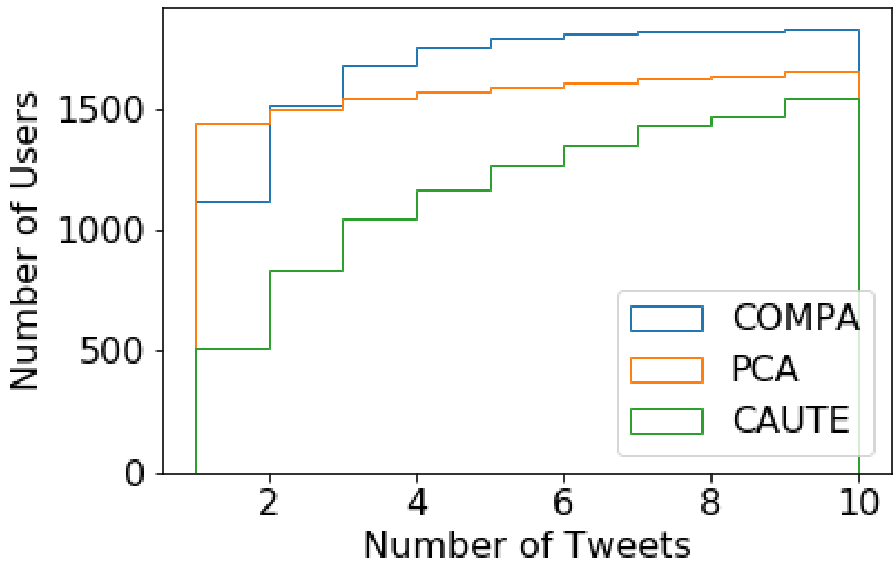 Figure 2: Performance comparison showing CAUTE's vastly lower False Positive Rate (b) compared to COMPA and PCA.
While COMPA was slightly faster at flagging the very first hacker tweet, it also incorrectly flagged over 1,100 genuine users as "hacked" on their first post. CAUTE, by contrast, is more conservative. It usually catches the hacker by the 3rd or 4th tweet but maintains a much higher level of accuracy for genuine users, ensuring that when an alert is sent, it is actually meaningful.
Critical Insight & Conclusion
The success of CAUTE lies in its use of Meta-features (device, time, language) as a bridge between user identity and lexical content. By formalizing this relationship through nonlinear neural encoders rather than simple word counts, CAUTE captures the "vibe" of a user's account usage.
Takeaway: This work proves that successful anomaly detection in social media isn't just about analyzing what was said, but modeling the structural tension between the user and the message. Future work expanding this to "suspicious following" or "pattern-based" browsing could finally put an end to the era of the social media heist.