
CCFS: Bridging the Gap Between Accuracy and Acquisition Cost in Healthcare AI
CCFS: A Confidence-Based Cost-Effective Feature Selection Scheme for Healthcare Data Classification
The paper introduces CCFS (Confidence-based and Cost-effective Feature Selection), a novel Binary Particle Swarm Optimization (BPSO) framework tailored for healthcare data. It integrates a fine-grained feature confidence updating mechanism and a multi-objective fitness function to achieve SOTA classification accuracy while minimizing feature acquisition costs.
TL;DR
In the healthcare domain, not all data is created equal—some features are expensive to obtain, while others are redundant. CCFS (Confidence-based and Cost-effective Feature Selection) is a refined BPSO framework that optimizes for both diagnostic accuracy and economic efficiency. By introducing "Feature Confidence," it guides the search process more intelligently than traditional "black-box" wrapper methods.
Background: The Cost of Information
In high-stakes environments like healthcare, the "Curse of Dimensionality" isn't just a computational hurdle; it's a financial and logistical one. While standard Feature Selection (FS) aims to boost accuracy by removing noise, it rarely asks: “Is this feature worth the price?”
Prior works in Binary Particle Swarm Optimization (BPSO) often suffer from two fatal flaws:
- Coarse Updates: They update particles based on global fitness, potentially discarding "winning" individual dimensions that haven't yet reached a global consensus.
- Cost Blindness: They treat a 5 blood pressure check as equal inputs.
Methodology: The CCFS Framework
The researchers proposed a dual-layered optimization strategy.
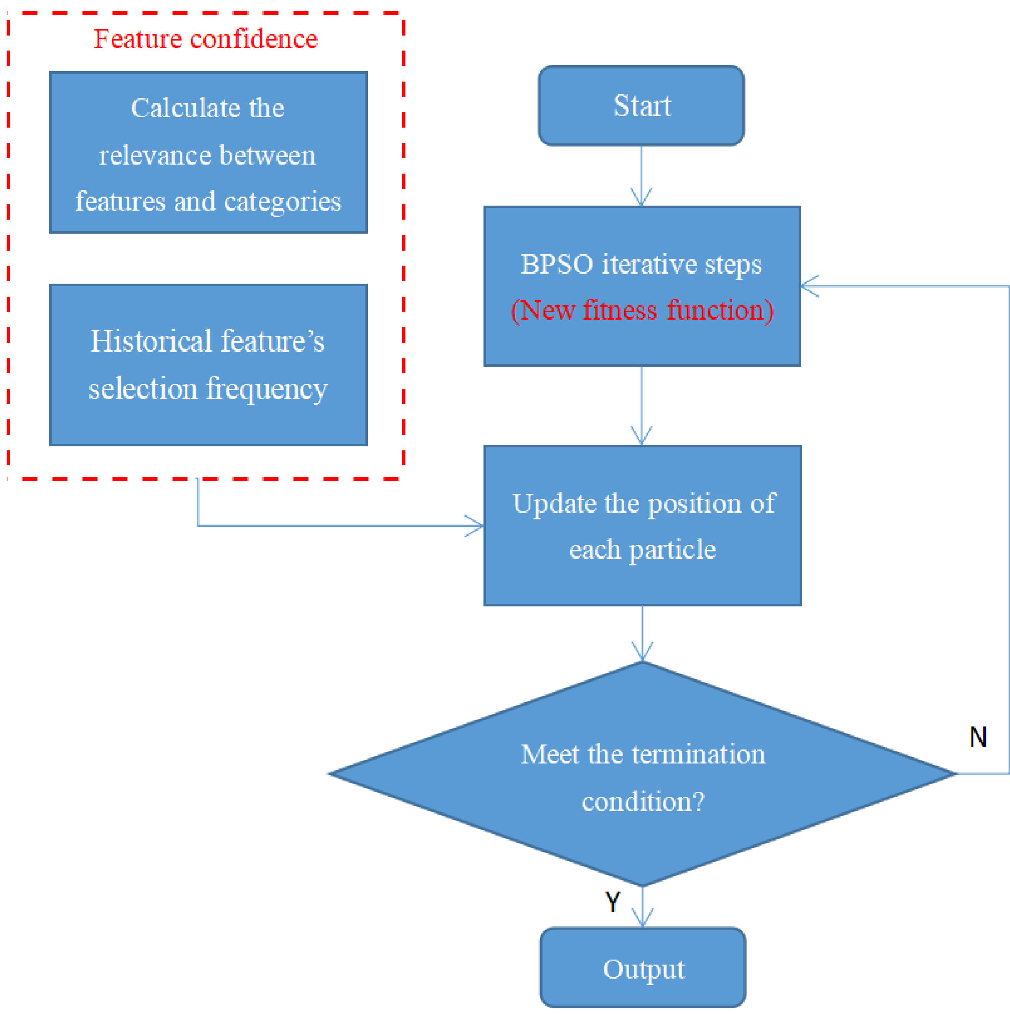
1. Fine-Grained Feature Confidence
Instead of relying solely on pbest and gbest, CCFS calculates a Confidence Score for each feature. This score is a hybrid of:
- Relevance (ReliefF): A measurement of how well a feature distinguishes between categories.
- Historical Frequency: How often a feature appeared in successful global solutions (
gbest) during previous iterations.
This confidence acts as a "nudge" in the Sigmoid update function, ensuring that high-value features aren't accidentally dropped during the stochastic search.
2. The Cost-Aware Fitness Function
The authors redefined the optimization objective as: This formula forces the swarm to find the "Pareto Front" where classification error is minimized without ballooning the number of features or their associated costs.
Experimental Results: High Stakes, High Gains
The CCFS method was tested against standard BPSO, Genetic Algorithms (GA), and greedy wrapper methods across various dimensionality levels.
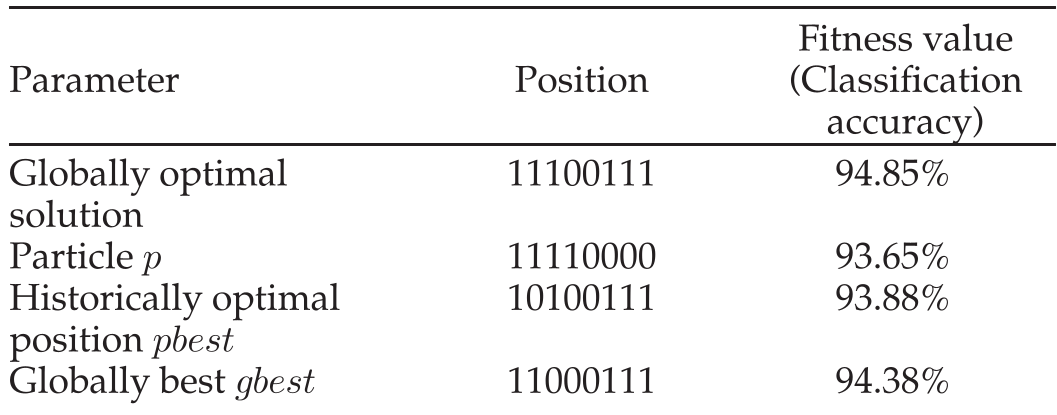
- Accuracy Breakthroughs: In the "Lung" dataset—notorious for poor data quality—CCFS increased accuracy by nearly 50% over the full feature set.
- Efficiency: In the "Wine" dataset, CCFS achieved the same 98.8% accuracy as standard BPSO but with a 18.94% improved cost-performance ratio.
- Scalability: Whether on low-dimensional (13 features) or high-dimensional (60 features) data, CCFS consistently selected smaller, cheaper, yet more effective subsets.
Deep Insight: Why It Works
The brilliance of CCFS lies in its Inductive Bias. By injecting ReliefF (a filter-based metric) into the BPSO (a wrapper-based search), it combines the speed of statistical correlation with the precision of model-specific evaluation. This prevents the swarm from getting trapped in local optima while ensuring that the "search direction" is grounded in the physical reality of the data's relevance.
Conclusion & Limitations
CCFS represents a transition from "Accuracy-at-all-costs" to "Pragmatic AI." While the paper uses randomized costs for its UCI experiments, the framework is ready-made for real-world medical billing data.
Limitations: The coefficient currently requires manual tuning. Future iterations could benefit from an automated, adaptive that adjusts based on the specific constraints of the healthcare budget in real-time.
Senior Editor Review: This paper is a significant contribution to "Green AI" and Healthcare Informatics, providing a mathematically grounded way to integrate economic constraints into the feature selection pipeline.