
Harmonizing Social Locality with Network Architecture: A CCN Approach to OSNs
A CCN-based Social Network application optimising network proximity
This paper proposes a CCN-based (Content-Centric Networking) architecture for Online Social Networks (OSNs), specifically modeled after Twitter. By introducing a locality-aware naming and routing scheme, the authors transition OSNs from a centralized US-hosted IP model to a semi-distributed framework that optimizes content delivery.
TL;DR
Despite the global nature of the internet, social media interactions are surprisingly local. Most of your "likes" and "retweets" come from people in your own region. However, current OSN architectures (like Twitter) force every single interaction to travel thousands of miles to centralized US servers. This paper proposes a Content-Centric Networking (CCN) architecture that routes local content locally, significantly reducing network strain and improving user experience.
The "Centralization" Paradox
Through a detailed packet analysis of Twitter using Firebug and Wireshark, the authors discovered a glaring inefficiency: even if you follow your next-door neighbor on Twitter, your request for their tweet travels to a 199.59.x.x subnet in the USA.
The study reveals:
- Fixed Polling: Clients check for updates every 30 seconds (increasing to 1200s during inactivity), creating constant background noise.
- Geographic Ignorance: Users in Japan, Australia, or France all communicate with the same US-based server clusters.
This architecture ignores a fundamental truth of human behavior: Locality Matters. Research shows that the majority of OSN users interact with people in their same city or region.
Methodology: Naming as Routing
The core innovation lies in a dual-path naming convention tailored to user behavior. Instead of routing by IP addresses (where am I?), CCN routes by name (what do I want?).
1. Naming Scheme
The system categorizes users into two types:
- Non-Local (Popular): Named
/Twitter/NonLocal/UserXXX/TweetYYY. These are high-profile accounts (e.g., news outlets) whose content is cached at the edge and served globally. - Local (Private): Named
/Twitter/Local/UserAAA/TweetBBB. These are average users whose content primarily remains within their geographic vicinity.
2. Sporadic Reachability
To prevent the network routers' Forwarding Information Bases (FIB) from exploding in size, the authors suggest "on-demand" publishing. Local users only announce their presence to nearby routers for a limited time (e.g., 5 minutes) when they have new content, or every few hours to allow offline followers to sync.
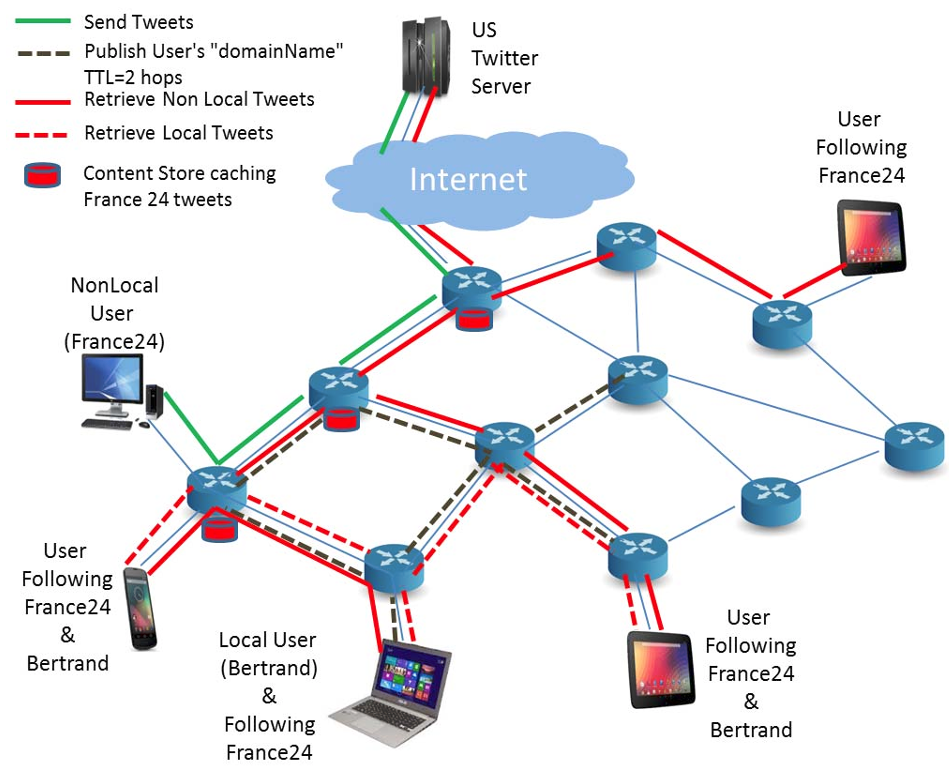 Fig 1: The CCN-based architecture showing the interaction between local and non-local content paths.
Call Flows: The Mechanism of Interest
The paper redefines the "Tweet" process. Instead of a simple POST request, it uses a handshake:
- The user signals an intent to post.
- The server (or local network) sends an Interest for the specific tweet number.
- The user's device responds with the Data packet containing the tweet.
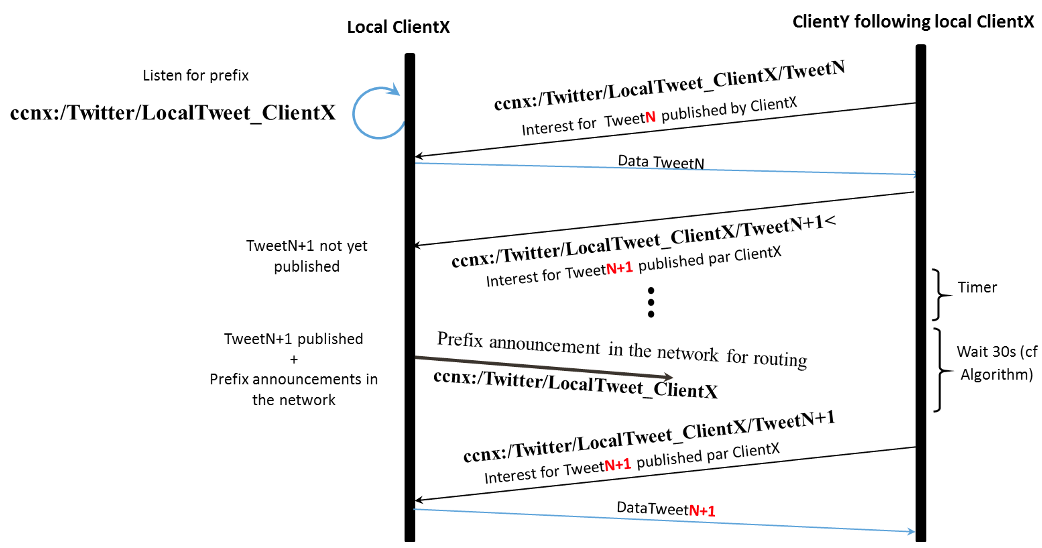 Fig 2: Protocol flow for publishing a tweet in a name-based environment.
Experimental Validation
Using the CCNx library, the authors built a functional prototype and tested it across a representative network topology provided by Orange, featuring ADSL, FTTH, and core interconnection layers.
While this paper focuses on functional proof (verifying that the naming and routing logic actually works), it sets the stage for a massive shift in how ISPs manage social traffic. By allowing CCN routers to cache "Non-Local" tweets and route "Local" tweets directly, the overall load on the core network is drastically reduced.
Critical Analysis & Future Outlook
The primary strength of this work is its Business-Awareness. Unlike some academic proposals that ignore cost, this model allows the OSN provider (Twitter) to maintain control over the social graph and advertising metrics via the "Non-Local" path, while offloading the "Local" heavy lifting to the network layer.
Limitations:
- The scalability of FIB updates for millions of "On-Demand" local users remains a challenge.
- The paper does not yet provide full-scale load-testing data.
Future Work: The authors plan to integrate video sharing. If CCN can optimize small text tweets, its impact on heavy video traffic (where caching and multicast are even more critical) could be revolutionary for mobile network capacity.
Summary Takeaway
By aligning the network's logical architecture with the user's social reality, CCN-based OSNs can achieve what IP-based networks cannot: efficient, locality-aware content dissemination that scales with the "Big Data" explosion of social media.