
The Invisible Barrier: Why Sociocultural Context is the "Missing Link" in Online Sarcasm
CCS Concepts: • Human-centered computing → Empirical studies in collaborative and social computing; Social network analysis; Social media
This paper investigates the impact of sociocultural variables on sarcasm perception in Online Social Networks (OSNs). By analyzing a custom dataset of tweets labeled by their original authors (intended sarcasm) and third-party annotators (perceived sarcasm), the authors demonstrate that shared sociocultural backgrounds significantly increase the effectiveness of sarcastic communication.
TL;DR
Sarcasm is more than just "saying the opposite of what you mean"—it is a social dance that requires a shared background to be understood. This research by Silviu Vlad Oprea and Walid Magdy proves that variables like Age, Gender, and Language Nativeness significantly dictate whether a sarcastic tweet is accurately perceived or lost in translation. Even with access to a user's full Twitter history, age-related gaps in understanding persist, challenging the "one-size-fits-all" approach of current AI sentiment tools.
Problem & Motivation: The Failure of Purely Lexical AI
Most automated systems treat sarcasm as a linguistic puzzle to be solved through word patterns (e.g., "I love being stuck in traffic"). However, psycholinguistic theory suggests that sarcasm is a social act. If the listener doesn't share the speaker's "common ground" or "social norms," the irony fails.
The authors argue that we cannot build robust social media analysis tools without understanding the "Socio-ecologies" of the users. They seek to answer: Does being "like" the speaker make you better at spotting their sarcasm?
Methodology: Bridging Intent and Perception
The researchers constructed a unique dataset from Twitter by asking authors to submit their own sarcastic tweets (ensuring ground truth through "Intended Sarcasm") and then recruited diverse annotators to provide "Perceived Sarcasm" labels.
The Experimental Matrix
The study isolated variables by creating specific treatment groups:
- Shared Background: Annotators matched the speaker's age, gender, and country.
- Flipped Variables: Annotators matched everything except one specific trait (e.g., same gender/country, but different age).
- The Context Variable: A separate setting where annotators could click through to the speaker's Twitter profile to see their "vibe" and previous posts.
Key Findings: Age and Nativeness are King
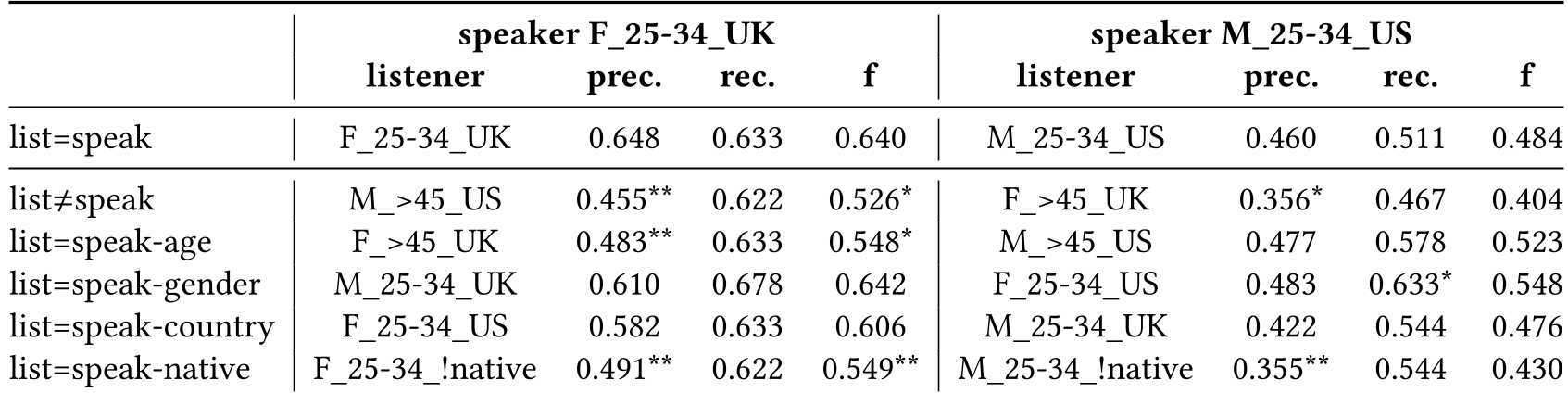
The results confirm that similarity fosters understanding. When sociocultural backgrounds were disjoint (different age, gender, and country), there was a very significant drop in precision.
- Age Matters: In the UK female group, shifting the age from young (25-34) to old (45+) caused a massive drop in precision (0.648 to 0.483).
- Nativeness: Non-native but fluent English speakers struggled significantly more to identify intended sarcasm, confirming that sarcasm relies on deep "conversational implicatures."
- The Power of the Timeline: Providing context (links to profiles) improved overall recall, but it did not fix the age gap. Older listeners still struggled to understand the "sarcastic flavor" of younger users, even when looking at their history.
Deep Insight: Prototypical Sarcasm
An intriguing finding was that UK females seem to be "Sarcasm Professionals." Their sarcastic tweets were understood better by almost all groups compared to US males. The authors suggest this supports Implicit Display Theory: some groups use a "prototypical" form of sarcasm that is more universally recognizable, while others (like US males) utilize more subtle, context-dependent irony.
Critical Analysis & Conclusion
Takeaway
This paper is a wakeup call for the CSCW and NLP communities. High-accuracy sarcasm detection isn't just about better transformers; it's about User Modeling. If a model doesn't know who is talking and who is listening, it will likely misinterpret a significant portion of human communication.
Limitations
- Narrow Scopes: The study primarily looked at two backgrounds (UK Female / US Male). Sarcasm in non-Western cultures or different digital subcultures (like Reddit or TikTok) might follow entirely different rules.
- Binary Labels: The study uses Sarcastic vs. Non-Sarcastic, but sarcasm exists on a spectrum of "severity" and "intent" (humor vs. malice).
Future Outlook
The next generation of "Socially-Aware AI" should incorporate embedding representations of user traits. By encoding the "social persona" of a user, we can move closer to an AI that doesn't just read the text, but understands the subtext.