
CDP-UA: Tackling the Chaos of IoMT Data Uncertainty with Cognitive Learning
CDP-UA: Cognitive Data Processing Method Wearable Sensor Data Uncertainty Analysis in the Internet of Things Assisted Smart Medical Healthcare Systems
This paper presents CDP-UA (Cognitive Data Processing for Uncertainty Analysis), a novel framework for managing wearable sensor data in Internet of Medical Things (IoMT). It utilizes machine learning (CART and regression) paired with conditional sigmoid functions to synchronize data aggregation and dissemination, effectively mitigating processing latencies and overloading uncertainties in smart healthcare environments.
TL;DR
The Internet of Medical Things (IoMT) is a "noisy" frontier where transmission delays can be life-threatening. The CDP-UA (Cognitive Data Processing for Uncertainty Analysis) framework introduces a sophisticated synchronization method using classification and regression learning. By predicting overloaded intervals and using a conditional sigmoid function to maintain data delivery linearity, it slashes latency by over 10% and ensures a high-reliability delivery ratio for vital health signs.
Background: The Invisible Bottleneck in Smart Healthcare
In the world of IoMT, wearable sensors (WS) like smart patches and EEG headbands generate a continuous stream of physiological data. However, the path from a patient’s wrist to a doctor’s screen is plagued by uncertainty. Heterogeneous devices, varying sensing intervals, and network congestion create "overloaded intervals" where data gets stuck. Prior SOTA works like REDPF or ESEDT struggled to balance data freshness with the chaotic nature of sensor synchronization.
The Core Insight: Why CDP-UA Works
The authors realized that uncertainty isn't just "noise"; it's a structural mismatch between how data is aggregated (collected from sensors) and disseminated (transmitted to the cloud).
The breakthrough here is the Joint Learning Process:
- Level 1 (Aggregation): Uses CART (Classification and Regression Trees) to map sensor instances to available slots, calculating a probability of improper mapping ().
- Level 2 (Dissemination): Uses regression and a conditional sigmoid function as an activation mechanism to identify where the network will "choke" (the stopping point).
System Architecture
The framework operates as an interoperable medium bridging the gap between hardware and clinical diagnosis.

Methodology: The Math of Synchronization
The paper formalizes the problem as a maximization of the delivery ratio () while minimizing the overloaded intervals ().
A critical component is the Conditional Sigmoid Function: This function isn't just for classification; it's used to detect the "stopping point" where data delivery starts to drop linearly. By calculating the derivative of this function relative to time, the system can pause or reallocate slots before a failure occurs.
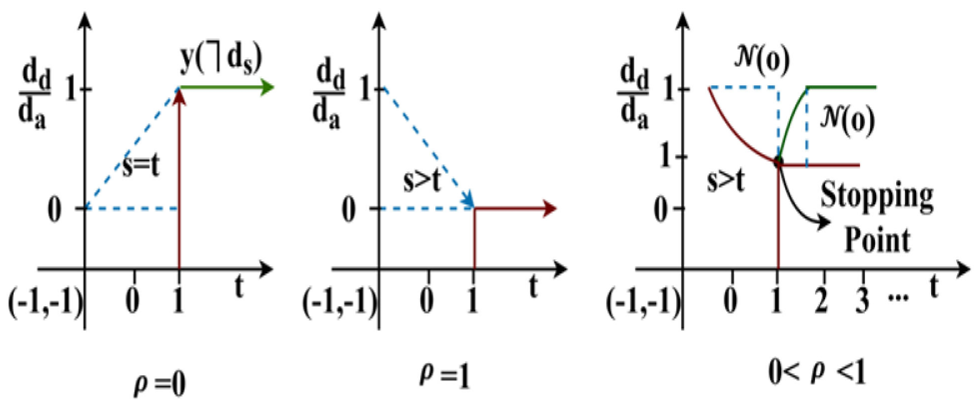 Figure: The sigmoid function outputs provide a clear "stopping point" for 0 < ρ < 1 conditions, allowing for proactive slot management.
Experimental Results: Slicing Through Latency
The CDP-UA was pitted against three heavyweights: REDPF, ES-EDT, and MSSDF.
- Latency: CDP-UA maintained a latency of ~91ms, whereas REDPF spiked to nearly 148ms under the same conditions. This represents a massive efficiency gain for time-critical emergency alerts.
- Delivery Ratio: Even as sensing intervals fluctuated, CDP-UA stayed consistently above 96%, showcasing its robustness against "non-unity" matrix conditions (where ).
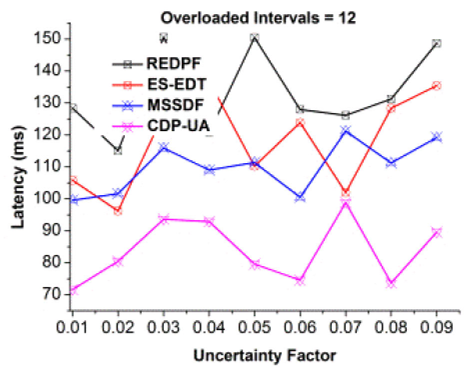 Figure: Comparative analysis shows that as intervals become more overloaded, CDP-UA's cognitive approach keeps latency flat compared to the exponential growth in existing methods.
Critical Insight & Future Outlook
The true value of CDP-UA lies in its Inductive Bias toward synchronization. By treating the IoMT network as a cognitive entity that "learns" its own congestion patterns, the authors have moved away from static queuing theory toward dynamic, adaptive intelligence.
Limitations: The current model assumes a relatively stable number of infrastructure units (8 in the study). Future work should explore how this scales in "Massive IoT" scenarios with thousands of concurrent wearable devices.
Takeaway: For developers and researchers in smart healthcare, CDP-UA proves that Cognitive Data Processing is no longer a luxury—it is a necessity for achieving the sub-100ms latency required for clinical-grade remote monitoring.