
Celebrity Watch: Decoding Social Intelligence through Automated News Mining
Celebrity Watch: Browsing News Content by Exploiting Social Intelligence
Celebrity Watch is an autonomous web system that monitors millions of news articles to identify "trending" individuals using statistical pattern analysis. It leverages entity matching and social network extraction to provide a condensed, real-time digest of entertainment news.
TL;DR
Celebrity Watch is a fully autonomous software pipeline that transforms a "sea of data"—over 15 million news articles—into a condensed, human-centric web portal. By tracking 36,000+ entities and calculating their "trending" velocity using statistical inference, it identifies the most relevant people in entertainment news without any human intervention.
Background Positioning
In the landscape of news aggregators (like early Google News), Celebrity Watch represents a shift from Topic-Centric to Entity-Centric discovery. It isn't just a search engine; it is a trend-detection engine that uses social intelligence—who is being talked about and who they are with—as the primary filter for relevance.
Problem & Motivation: The Data Overload Dilemma
The digital age has created an information "barrage." For users, the challenge is no longer finding information, but filtering it. Conventional methods rely on:
- Manual Curation: Too slow for the 24/7 news cycle.
- Simple Keyword Matching: Lacks the context of "importance" or "recency."
The authors' insight was that news is fundamentally about people. By shifting the focus to how people appear and co-appear in media, we can map information to our "socially-oriented brains," making complex data streams more digestible.
Methodology: The Core Engine
The system's "intelligence" comes from a multi-stage pipeline:
1. Entity Resolution & Tracking
Using the GATE framework, the system extracts names and resolves them (ensuring "Brad Pitt" refers to the same entity across different stories). The core innovation is the use of Exponentially Weighted Moving Averages (EWMA).
- Fast Decay (1 day/1 week): Captures "Breaking News" and sudden spikes.
- Slow Decay (1 month/1 year): Captures "Long-term Popularity."
By comparing these averages via Odds Ratios, the system identifies "movers"—people whose media presence is suddenly deviating from their historical baseline.
2. Social Network Generation
Beyond individual tracking, the system builds a "Social Map." It records co-occurrences (people mentioned in the same article) and applies a (Chi-squared) test of independence. This statistical filter ensures that a connection between two people is genuine and not just a random coincidence.
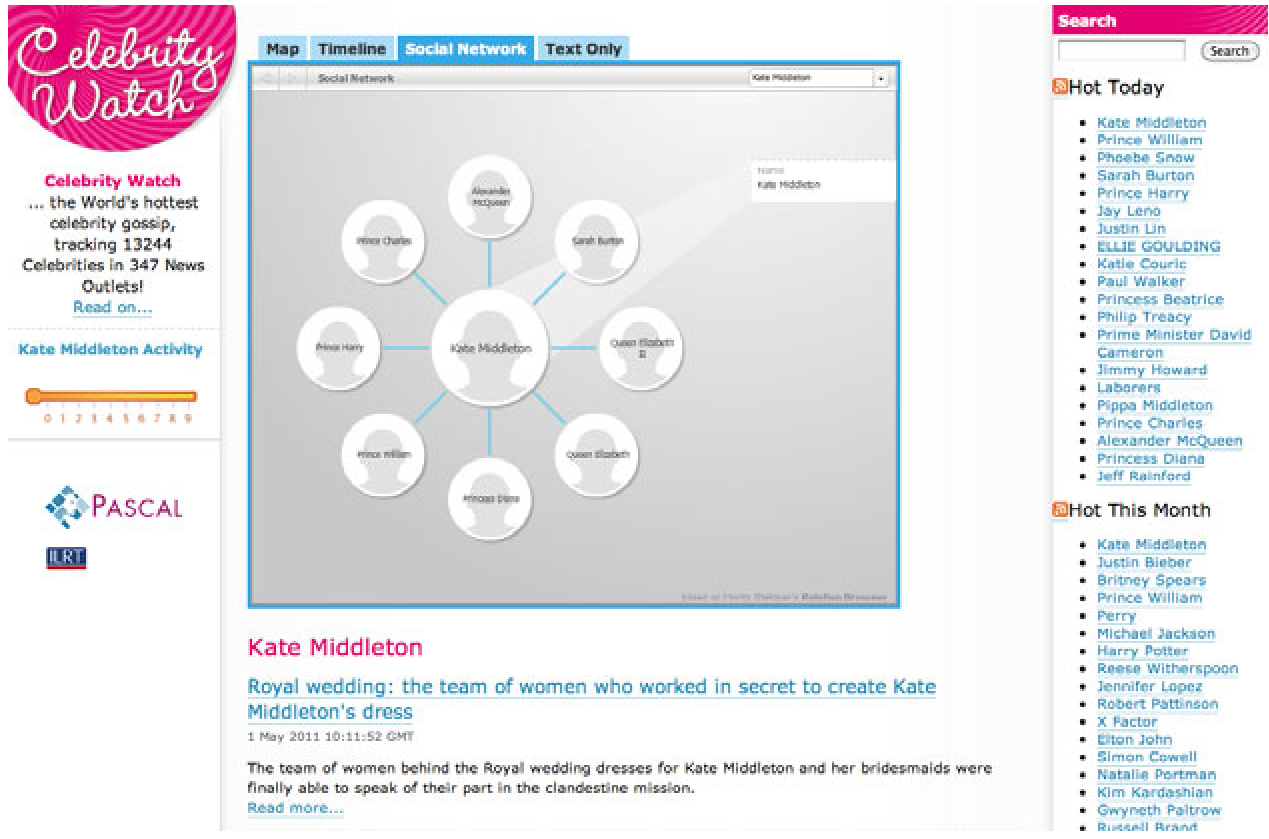 Figure 1: The Celebrity Watch interface, showcasing trending entities and their calculated relevance.
Experiments & Results: Real-time Precision
The authors demonstrate a massive scale of operation:
- Volume: 15 million+ articles processed.
- Breadth: 36,000+ distinct people tracked.
- Efficiency: Top movers can be calculated across any topic (Sport, Business, Entertainment) in under a few seconds.
- Filtering: The pipeline successfully distills millions of mentions into the Top 40 most significant actors in the current media landscape, representing a massive reduction in noise.
Critical Analysis & Conclusion
The Takeaway
Celebrity Watch proves that Social Intelligence is a powerful heuristic for data mining. By monitoring the "pulse" of entity mentions, the system provides a snapshot of global attention that feels more natural than a list of headlines.
Limitations
While robust, the system relies heavily on co-occurrence as a proxy for social connection. This "black-box" association doesn't specify the nature of the relationship (e.g., are they rivals or collaborators?). Furthermore, the accuracy of the system is contingent on the performance of the underlying Named Entity Recognition (NER) models, which can struggle with ambiguous names.
Future Perspectives
The authors suggest adding Emotional Analysis (Sentiment Mining) to the social graph. Imagine not just seeing who is trending, but how the world feels about them in real-time. Moving forward, this framework could easily be adapted for competitive intelligence in business or tracking geopolitical shifts in international relations.