
CelebrityNet: Decoding Social Intelligence from 8 Million Images
CelebrityNet: A Social Network Constructed from Large-Scale Online Celebrity Images
This paper introduces CelebrityNet, a large-scale social network constructed from the implicit co-occurrence of celebrities in over 8 million online news images. By leveraging a Multi-Kernel Multi-Label (MKML) collective classification model, the authors integrate visual content, semantic tags, and social structures to achieve state-of-the-art performance in image annotation and community classification.
TL;DR
Researchers from Yahoo Labs have developed CelebrityNet, a massive social network inferred not from "follows" or "likes," but from the implicit co-occurrence of people in professional news photos. By treating visual co-presence as a social link, they've built a system that understands human relationships well enough to significantly boost the accuracy of AI image tagging and community identification.
Background: The Power of Implicit Links
In the digital age, we often define social networks through explicit actions: adding a friend on Facebook or following someone on X (Twitter). However, a massive amount of social data is "hidden" in the images we share. Professional photographers capture celebrities at events, galas, and political summits. If two people are constantly photographed together, there is a high statistical probability of a professional or personal bond.
The authors argue that this implicit relationship is a neglected goldmine for computer vision. Most AI models try to label a photo of Barack Obama by looking at his face; CelebrityNet tries to label it by looking at who else is in the room.
Why Standard Vision Systems Fail
Modern vision systems (like CNNs or early Transformers) are excellent at identifying "what" is in a photo (e.g., a suit, a podium) but struggle with the "who" and "why" in a social context. For instance, distinguishing between a "Political Summit" and a "Corporate Gala" is difficult if you only look at the visual features. The breakthrough here is using the Social Network as a Knowledge Base.
Methodology: The MKML Architecture
The researchers didn't just build a graph; they designed a sophisticated Multi-Kernel Multi-Label (MKML) model. This model doesn't just look at pixels; it balances three distinct types of information:
- Content Kernel: The raw visual features (pixels/Bag-of-Words).
- Label Set Kernel: The logical correlation between tags (e.g., if "NBA" is present, "Basketball" is likely).
- Network Kernel: The "guilt by association" principle—if your social neighbors are tagged with "Healthcare," you likely should be too.
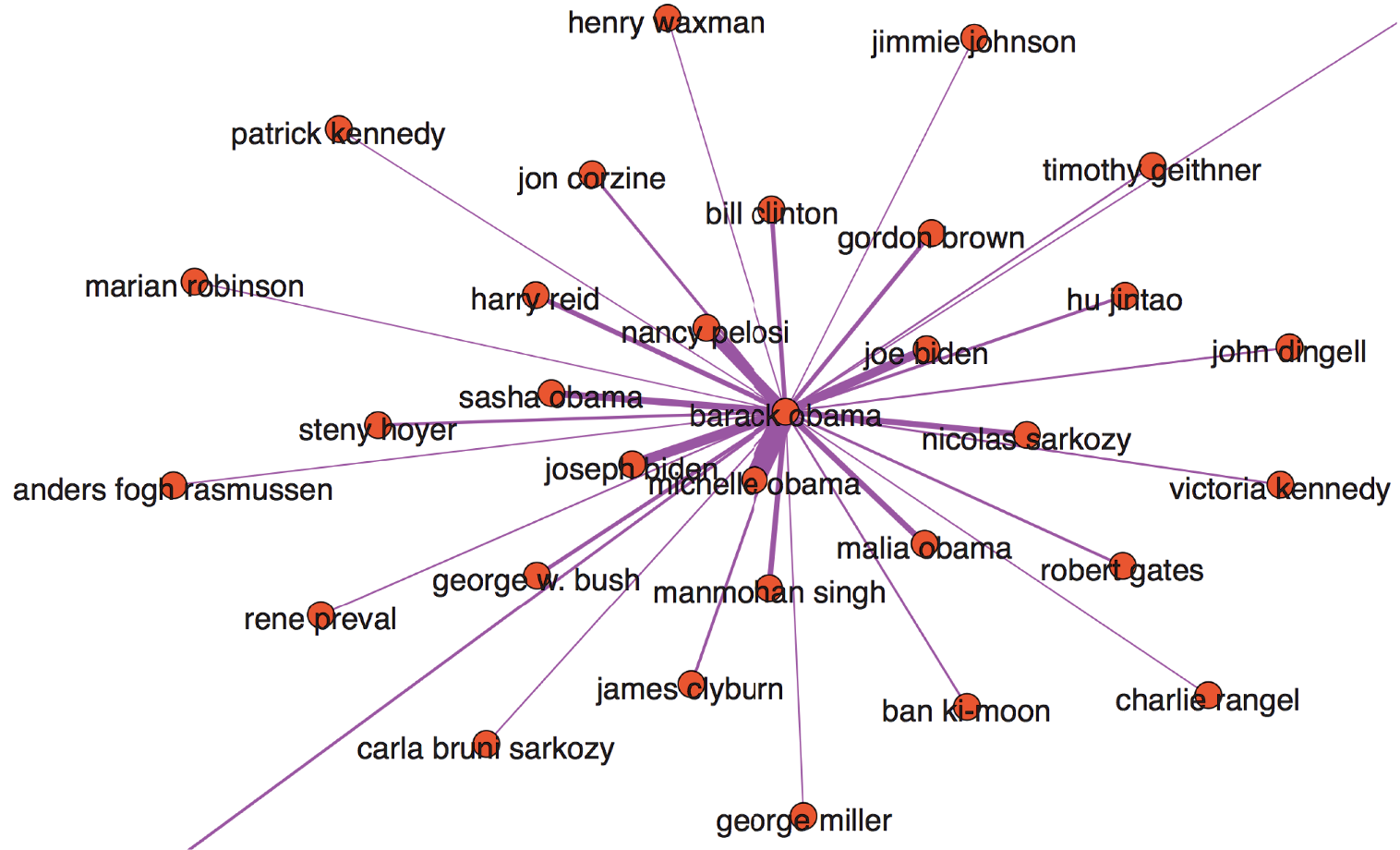 Figure 1: The ego network of Barack Obama (left), showing overlapping social circles like family and politicians.
The model uses an iterative inference procedure (inspired by the Iterative Classification Algorithm). It starts with a visual "guess" and then refines that guess by looking at the social ties until the labels stabilize.
Experimental Results: Humanity in the Machine
To test if the AI "understood" the social structure, the authors compared the AI-detected communities against manual groupings by 12 human editors.
- Human Alignment: The AI’s community detection was found to be almost as consistent with humans as humans were with each other.
- Tagging Performance: On specific tags like "Spanish Royalty" or "British Culture," the social-aware model (MKML) crushed the vision-only baseline.
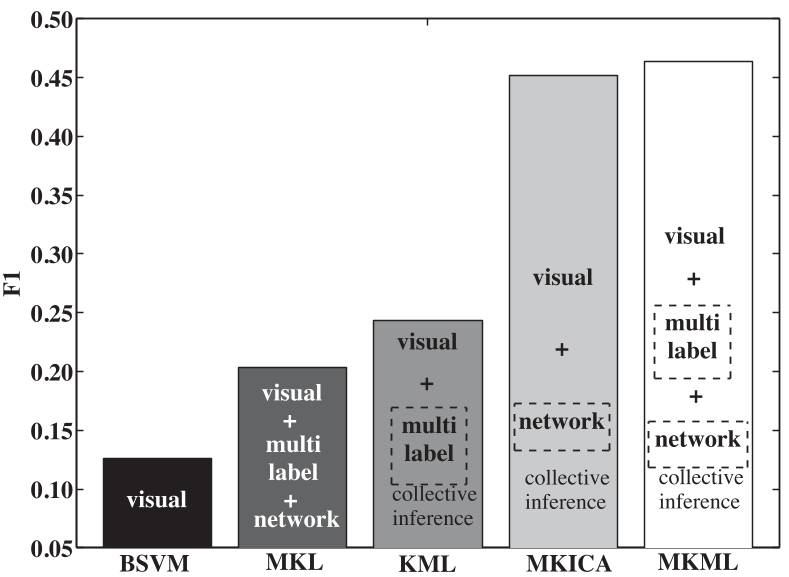 Figure 2: Performance metrics showing MKML outperforming standard visual baselines (BSVM) and classic Multi-Kernel Learning.
The visual evidence in the paper is striking: in images where visual features are ambiguous (e.g., two men in suits shaking hands), CelebrityNet correctly identifies the context as "Diplomacy" or "International Landmark" because it knows the identities and typical social circles of the subjects.
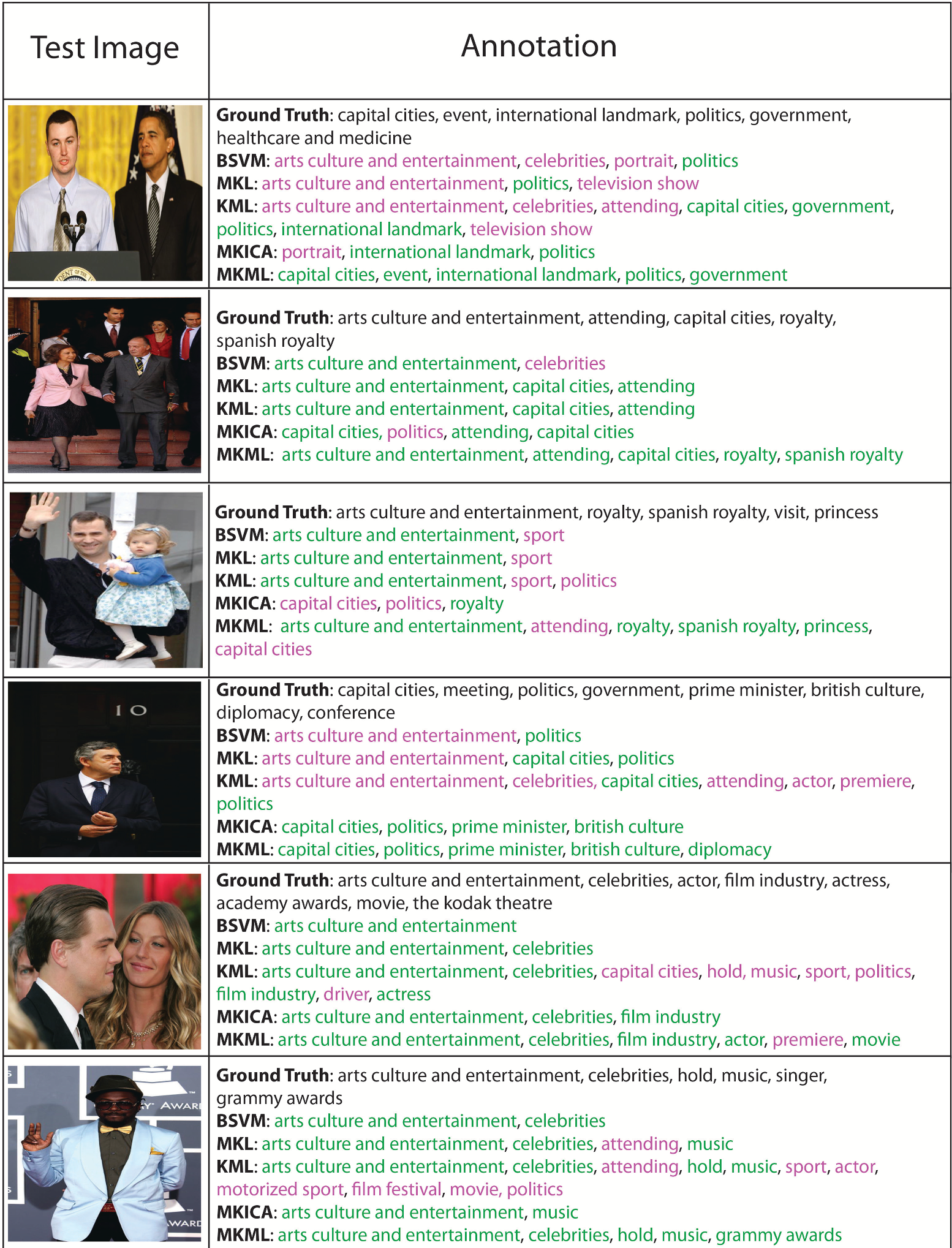 Table 1: Comparison of annotations. Note how MKML correctly identifies categories like "Royalty" that simple vision models miss.
Critical Insight & Future Outlook
The genius of CelebrityNet lies in its recognition that identity is social. The paper moves the needle from "Object Recognition" toward "Social Recognition."
While this study focused on celebrities (due to the availability of data), the principles are universal. Imagine a future where your personal photo gallery uses similar implicit networks to automatically distinguish your "High School Friends" from your "Work Colleagues" without a single manual tag.
However, the model relies on having a "pre-linked" network. A potential limitation is its performance on "lone wolf" nodes—individuals who are rarely photographed with others. For the next generation of researchers, the challenge will be combining this graph-based approach with Deep Learning (like CLIP or more modern LLMs) to handle even more sparse data environments.
Conclusion
CelebrityNet proves that the "social signal" inherited from image co-occurrence is a powerful feature for high-level machine learning. By merging graph theory with computer vision, we move one step closer to AI that understands the human world the way we do—through our connections.