
Beyond the Seed: Robust 3D Plant Cell Tracking with IMM Filters and Local Graph Matching
Cell Population Tracking in a Honeycomb Structure Using an IMM Filter Based 3D Local Graph Matching Model
This paper introduces an Interacting Multi-Model (IMM) filter combined with a 3D local graph matching framework for automated tracking of plant cell populations in Shoot Apical Meristems (SAM). By leveraging 3D spatiotemporal context and multiple motion models, the approach achieves state-of-the-art accuracy in tracking densely packed cells undergoing frequent division.
TL;DR
Tracking cells in the Shoot Apical Meristem (SAM) is a daunting task due to the "honeycomb" density and constant divisions. This paper presents a breakthrough by replacing traditional sequential tracking with a simultaneous 3D Local Graph Matching model powered by an Interacting Multi-Model (IMM) filter. The result? A massive 18% jump in accuracy and the ability to track cells in the high-curvature regions where previous SOTA methods failed.
The Challenge: Why Honeycombs are Hard
Plant cells in the SAM are not just "objects" in space; they share boundaries, form tight honeycomb patterns, and exist in 3D stacks. Existing methods faced three "walls":
- Geometric Ambiguity: Cells look remarkably similar, making features like "area" or "intensity" insufficient.
- The Seed Problem: Older 2D local graph methods started with a "seed pair" and grew the correspondence. If the seed was wrong, the entire track collapsed.
- Dynamics: Biological motion isn't linear. Cells accelerate and shift patterns, which a simple Kalman filter cannot capture.
Methodology: Spatiotemporal Context in 3D
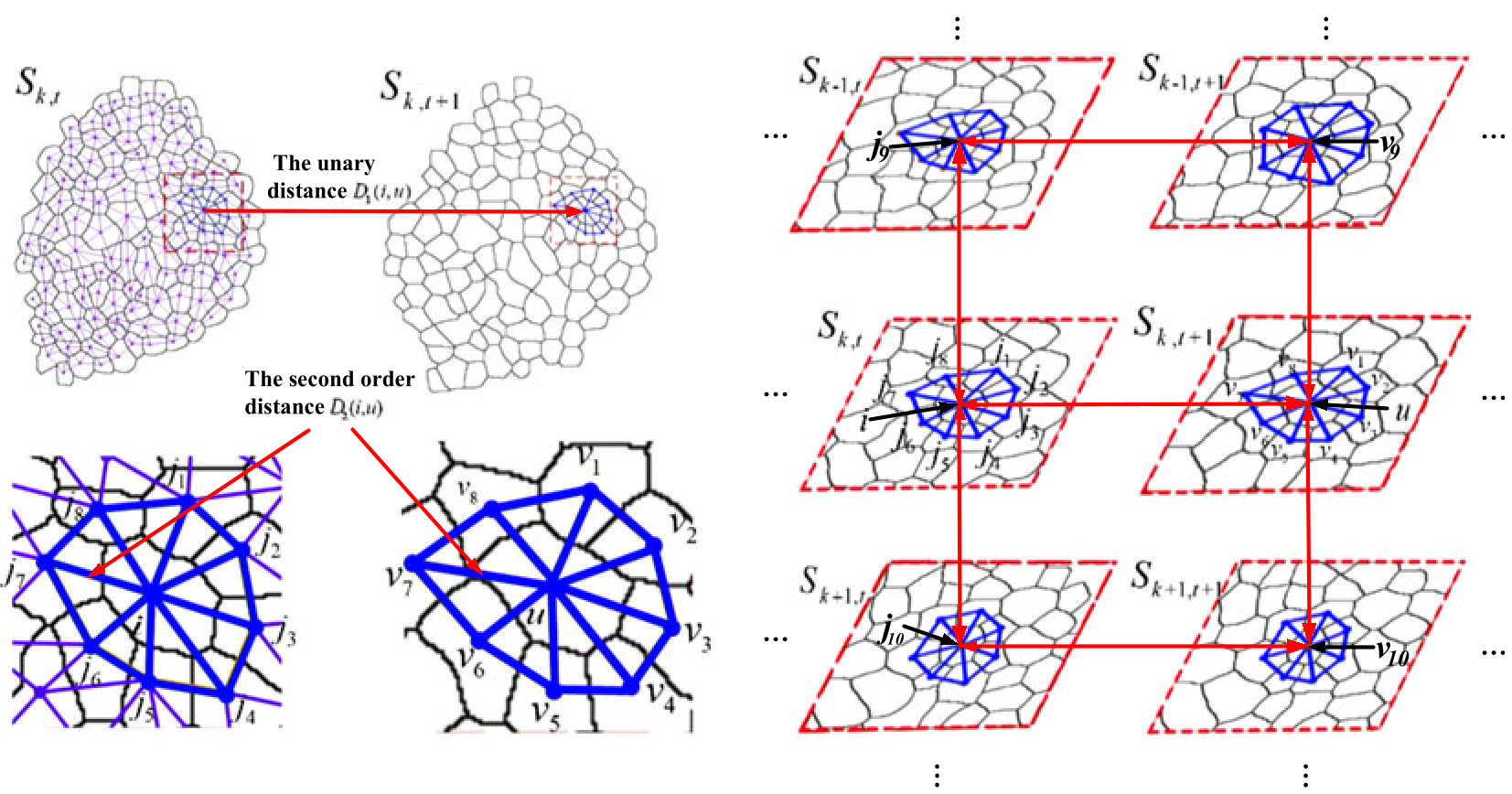
Building on the intuition that a cell is defined by its social circle (its neighbors), the authors constructed a 3D Local Graph.
1. 3D Graph Construction
While 2D graphs only look at neighbors in the same plane, this model identifies neighbors across the Z-axis (adjacent slices). This ensures that even if a cell shifts slightly out of its original focal plane, its structural context remains intact.
2. The IMM Filter: Dynamic Adaptation
Instead of betting on one motion model, the IMM filter runs three in parallel:
- Random Walk (RW)
- Constant Velocity (CV)
- Constant Acceleration (CA)
The filter dynamically weighs these models based on real-time observations. This allows the system to predict a cell's next position accurately, reducing the search space for the graph matching algorithm and eliminating the need for a "seed pair."
Experimental Results: SOTA Performance
The proposed method was tested against Conditional Random Fields (CRF), 2D matching, and even CNN-based approaches.
Performance Boost
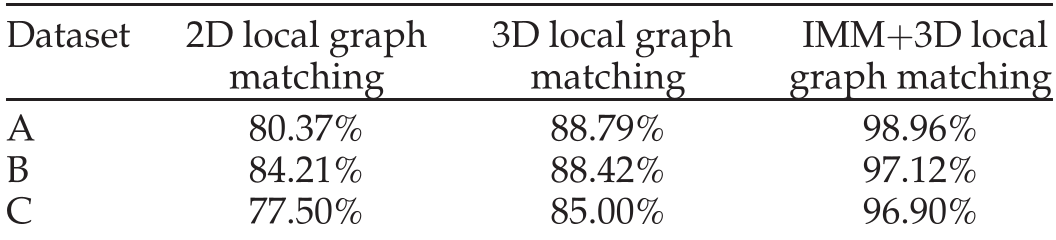
As shown in the table below, the combination of IMM and 3D context (IMM+3D) achieved near-perfect accuracy (up to 98.96%), significantly outperforming the 3D matching without the predictive filter.
Visualizing Curvature Handling
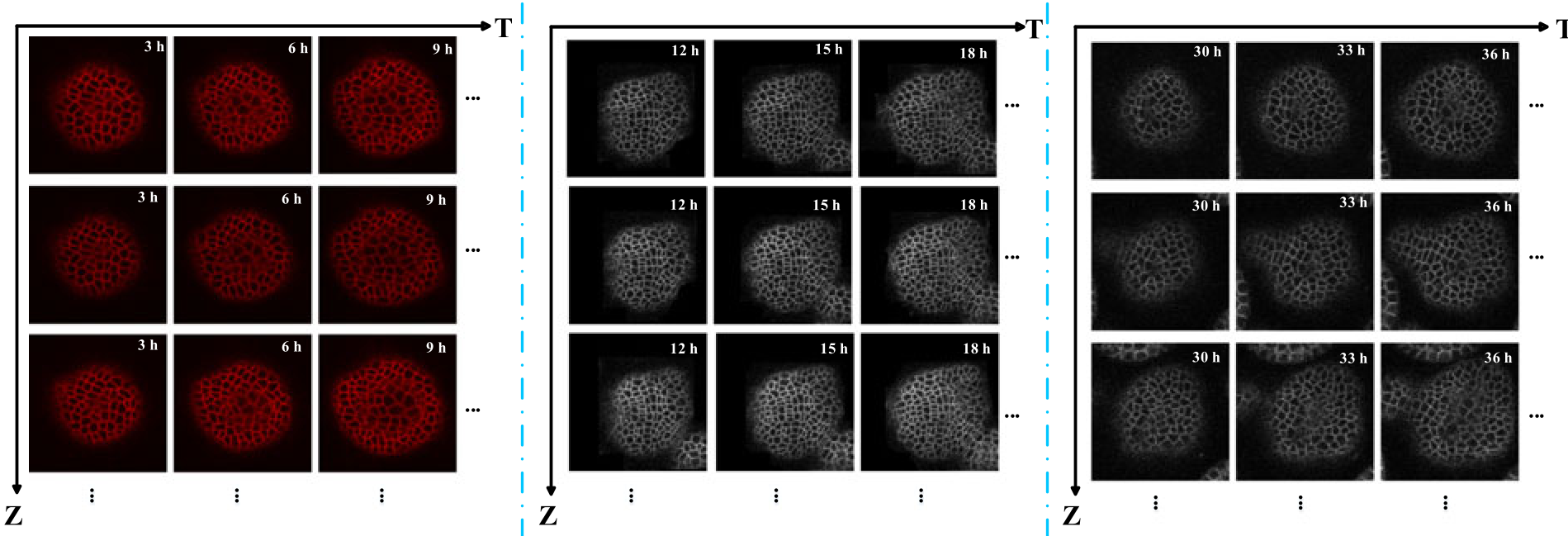
One of the most impressive feats was tracking in the primordial regions—areas of high curvature where organs start to develop. Sequential methods often "break" here because of segmentation noise, but the IMM-based approach’s simultaneous nature keeps it on track.
Critical Insight: Why This Logic Works
The core "Aha!" moment of this paper is the synergy between Structural Context (Graph) and Temporal Prediction (IMM).
- The Graph handles the "Who are you?" by looking at the neighborhood.
- The IMM handles the "Where are you going?" by looking at the physics. By using the IMM output to define a search window for the Graph Matching, the authors effectively "tethered" the tracking, preventing the accumulation of errors that plague sequential growing methods.
Conclusion & Future Work
The paper successfully demonstrates that 3D spatial awareness and adaptive motion modeling are essential for biological tracking. While the watershed segmentation step remains a potential bottleneck for extremely low-contrast images, the tracking framework itself is robust. This method holds high potential for application in other densely packed tissues, such as Drosophila embryos or HeLa cell cultures, providing a pathway toward fully automated 4D lineage modeling in developmental biology.