
CAND Model: Accelerating Viral Marketing with Cellular Automata
A Cellular Automaton based Network Diffusion model: Preparation for more scalable Viral Marketing
This paper introduces the Cellular Automaton based Network Diffusion (CAND) model, a novel approach designed to enhance the scalability of viral marketing in large-scale social networks. By mapping social entities to cellular automata and introducing a "dormant" state (-1), the method accelerates influence propagation simulation, achieving equivalence with the Linear Threshold (LT) model while significantly reducing computational overhead.
TL;DR
Researchers from Harbin Engineering University have proposed the CAND (Cellular Automaton based Network Diffusion) model to solve the scalability bottleneck in viral marketing. By introducing a new state for "completed" nodes and a time-decay forget function, they achieved a 61% speedup compared to the classical Linear Threshold (LT) model on large citation networks.
Motivation: The Efficiency Wall of Viral Marketing
In the world of social media, "Word of Mouth" is the most powerful marketing tool. However, identifying the most influential "seed" users is an NP-hard problem. Classic algorithms like the Greedy approach or even optimized versions like CELF require running a diffusion simulation thousands of times.
The pain point lies in the Linear Threshold (LT) model's execution. In every time step, traditional algorithms scan all nodes to check if their influence threshold has been met. For a network with millions of edges, this leads to a "Computational Wall" where finding a few dozen seeds can take weeks.
Methodology: The CAND Approach
The authors re-imagined the social network as a Cellular Automaton (CA). Unlike standard models that only describe nodes as "Active" or "Inactive," the CAND model introduces a more nuanced state machine:
- State 0 (Inactive): The user hasn't adopted the product yet.
- State 1 (Active): The user has adopted the product and is currently influencing neighbors.
- State -1 (Finished): The user is active, and all their neighbors have already been reached.
The Secret Sauce: Node Pruning
The most profound insight is the transition to State -1. In a standard LT model, an active node is processed repeatedly until the simulation ends. In the CAND model, once a node's "job" is done (it has no more inactive neighbors to influence), it is shifted to State -1 and effectively removed from the active calculation queue.
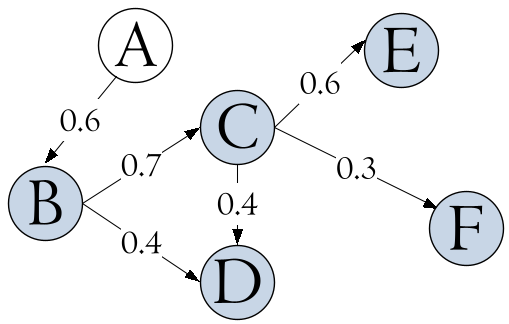 Figure 1: Initial state (Step 0) where node A is the seed.
Furthermore, the model integrates a Forget Function , acknowledging that influence isn't eternal—it decays if friends don't react quickly.
Experiments & Results
The researchers tested CAND on four diverse datasets, including Reddit-like web communities (Robots.net) and massive citation networks (Cit-HepPH).
Performance Gains
The results were clear: as the network size grows, the advantage of CAND becomes more pronounced.
- Speedup: On the largest dataset, CAND completed the diffusion in nearly 1/3 of the time required by the LT model.
- Scalability: The "speedup method" (using state -1) effectively reduces the average degree complexity to a lower effective value , making the model more robust for billion-edge graphs.
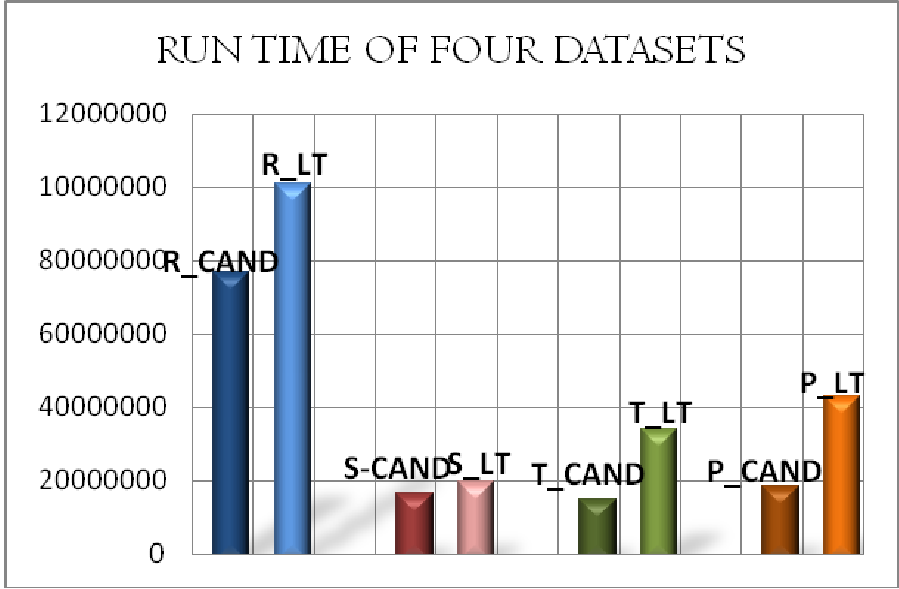 Figure 2: Total running time comparison. CAND (left bar) consistently outperforms LT (right bar).
The Phase Shift
Interestingly, the study found that CAND is most effective in the later phases of diffusion. Once the "influence peak" is reached and many nodes enter State -1, the computational workload drops significantly compared to the LT model, which must keep processing the entire graph.
Critical Insight & Conclusion
This paper provides a vital theoretical bridge, proving that CAND is mathematically equivalent to the Linear Threshold model under specific conditions, while being computationally superior.
Future Outlook: While the CAND model excels in speed, the authors admit that network structure (like clustering coefficients) heavily influences performance. The next frontier for this research involves applying this CA-based approach to dynamic networks where connections are constantly appearing and disappearing, further pushing the boundaries of real-time viral marketing.
Key Takeaway: Don't just scan the network—prune it. By tracking which nodes have exhausted their influence potential, we can turn a weeks-long simulation into a matter of hours.