
CenceMe: Injecting Sensing Presence into the Social Fabric
CenceMe – Injecting Sensing Presence into Social Networking Applications
The paper introduces CenceMe, a pioneering personal sensing system that automates the sharing of "sensing presence" (activity, disposition, habits, and surroundings) across social networks. By leveraging commodity sensor-enabled smartphones and a thin-client architecture, it bridges the gap between physical human context and digital social platforms like Facebook and Skype.
TL;DR
CenceMe is a landmark work in people-centric sensing that transforms mobile phones into "social sensors." By automatically inferring a user’s activity, environment, and habits, it injects a "sensing presence" into digital platforms like Facebook and Skype. This allows friends to see not just what you say, but how you are living in real-time—whether you're jogging, in a noisy meeting, or grabbing your usual afternoon coffee.
Problem & Motivation: The Missing Context in Social Media
Before the ubiquity of modern AI-driven status updates, social networking was a manual, text-heavy endeavor. The authors identified a significant gap: the loss of non-verbal communication in digital interactions. While we spend our lives surrounded by physical context—the weather, our movement, our social circles—our digital avatars remain static unless we manually intervene.
Existing research at the time often relied on "smart clothing" or specialized wearable rigs (like the Mithril project). CenceMe's core insight was that the smartphone, already a ubiquitous companion, possessed enough latent sensing power (accelerometers, microphones, GPS) to reconstruct a user's life patterns without the need for bespoke hardware.
Methodology: The Sense/Learn/Share Model
The CenceMe architecture is built on a tripartite workflow designed for efficiency and scalability.
1. Sensing (The Thin Client)
To preserve battery life and minimize data costs, CenceMe uses a "thin client" approach. It samples hardware sensors (accelerometers, cameras, microphones) and "virtual software sensors" (call logs, browser history, music choice).
- Edge Processing: Preliminary data analysis is moved to the phone (e.g., state-change detection) to avoid sending raw high-frequency data over 2G/3G networks.
2. Analysis (The Intelligence)
The back-end server acts as the brain, running classifiers trained on the WEKA workbench. Key inference modules include:
- Activity Classifier: Distinguishing between sitting, walking, and running using 3-axis accelerometer features.
- Environmental Context: Using the microphone to generate a "noise index" and the camera for a "brightness index."
- Social Interaction: A voice detection algorithm to determine if a user is currently engaged in a conversation.
3. Presentation (The Integration)
CenceMe doesn't try to build a new social network; it augments existing ones. It uses plugins for IM clients (Pidgin) and social sites (Facebook) to display "sensing presence" icons.
 Figure 1: The CenceMe architecture positioning the core between mobile sensing clients and social network consumers.
Experiments & Results: Turning Raw Raw Data into Human Truth
The researchers evaluated CenceMe through a series of real-world deployments involving lab members and commodity hardware (Nokia N95/5500).
Classification Rigor
The system proved remarkably robust for 2008-era technology:
- Activity Recognition: Correctly classified standing, walking, and running ~90% of the time.
- Conversation Detection: Achieved 84% accuracy, even with phones placed in pockets, though background noise remained a minor challenge.
Significant Places & Health
One of the most innovative features was the Significant Places service. By clustering GPS and WiFi data, the system could learn that a specific coordinate was "Home" or "Work," even sharing these semantic labels among "buddies" to provide context (e.g., "Homer is at Patty's House").
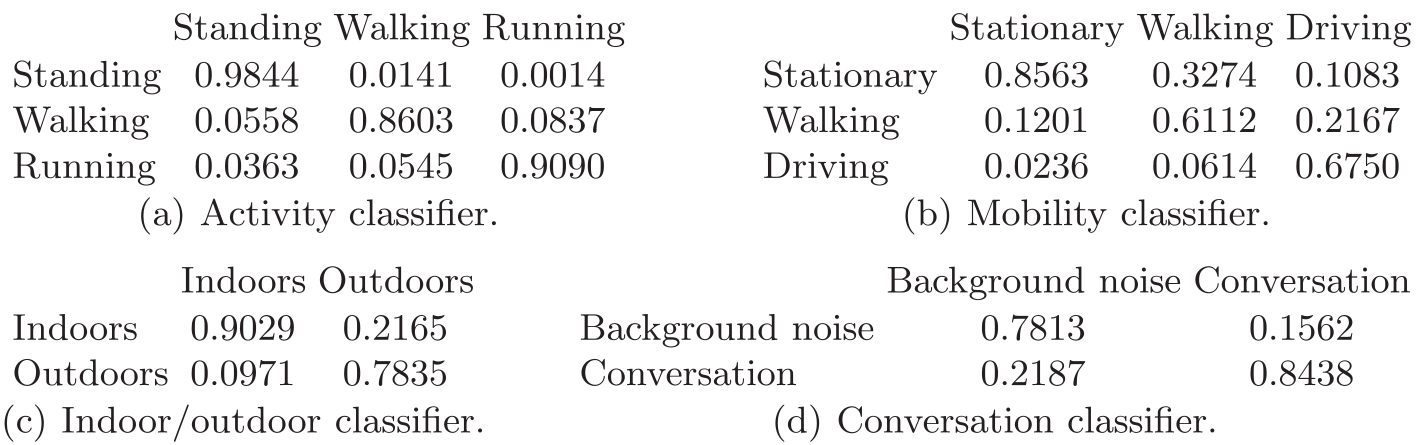 Figure 2: Confusion matrices for Activity, Mobility, and Indoor/Outdoor classifiers showing strong diagonal performance.
Critical Analysis & Conclusion
Takeaway
CenceMe successfully proved that people-centric sensing is a software and integration challenge, not just a hardware one. It anticipated the "Quantified Self" movement and the context-aware features we now take for granted in modern mobile OSs.
Limitations & Future Work
- Connectivity Fallback: The system's reliance on 802.11 and cellular data was ahead of its time; in 2008, data availability was less consistent than today.
- Privacy Nuance: While the "Virtual Walls" model is solid, the automation of "sensing presence" raises profound ethical questions about the "right to be invisible" in a social circle.
- Battery Consumption: Even with thin-client optimizations, continuous GPS and accelerometer polling remains a significant drain on mobile resources.
CenceMe remains a foundational text for anyone interested in how mobile devices can bridge the gap between our physical lives and our digital identities.