
Beyond the First Neighbor: Enhancing Influence Maximization via BRST and $\ell$-th Order Centrality
New Centrality Measure in Social Networks Based on Independent Cascade (IC) Model
This paper introduces the BRST Algorithm and the centrality measure to solve the Influence Maximization problem in social networks. By constructing a Balanced Rooted Spanning Tree (BRST) and evaluating the cumulative diffusion contribution of -th order neighbors under the Independent Cascade Model (ICM), the method achieves superior influence spread compared to the benchmark Diffusion Degree heuristic.
TL;DR
To tackle the NP-hard problem of finding the most influential nodes in a social network, this paper proposes the BRST Algorithm and a new centrality measure . By transforming complex graphs into Balanced Rooted Spanning Trees and considering the "ripple effect" of influence up to the -th neighbor, the researchers provide a scalable solution that outperforms existing state-of-the-art heuristics like Diffusion Degree.
Context & Positioning
Influence Maximization (IM) is a cornerstone of viral marketing and social network analysis. While the foundation was laid by Kempe et al. (2003) using submodular functions, the computational costs of their greedy approaches are often prohibitive. This work sits in the "Heuristic Improvement" category, aiming to bridge the gap between high-speed calculation and high-accuracy influence estimation by looking deeper into the network hierarchy.
The Core Challenge: Cycles and Local Limits
Most social networks are messy—filled with cycles and clusters that lead to "redundant" influence spread. If node A and node B are in a tight triangle with node C, selecting both as seeds is often wasteful. Furthermore, traditional heuristics are "nearsighted," usually only looking at a node's immediate neighbors (the 1st-degree connections).
The authors argue that true influence is a multi-hop phenomenon. A node's value isn't just who it knows, but who its friends' friends can reach.
Methodology: The BRST + Framework
1. Balanced Rooted Spanning Tree (BRST)
To clean up the network structure, the authors propose extracting a spanning tree. They use Closeness Centrality to find the most "central" node to act as the root. This ensures that information flows linearly and eliminates cycles that cause calculation feedback loops.
 Figure: The transformation of the Dolphins social network into a Balanced Rooted Spanning Tree.
2. High-Order Diffusion Degree ()
The breakthrough is in the formula for . Unlike standard degree centrality, it incorporates:
- Propagation Probability (): The likelihood of a node successfully activating its neighbor.
- -th Neighbor Contribution: A recursive summation of the influence potential of neighbors at distance 1, 2, ..., up to .
The mathematical intuition is: This formula captures the potential energy of a node to trigger a cascade across a larger radius of the network.
Experimental Validation
Using the Amazon co-purchase dataset (over 334k nodes) and the Dolphins social network, the authors compared their method against the Diffusion Degree benchmark.
Key Findings:
- Depth Matters: Increasing from 1 to 3 showed a clear upward trend in activation performance.
- Strategy Shift: For , the heuristic outperformed the benchmark as the number of seeds increased, suggesting that their seed selection strategy (which avoids selecting adjacent nodes) is more efficient.
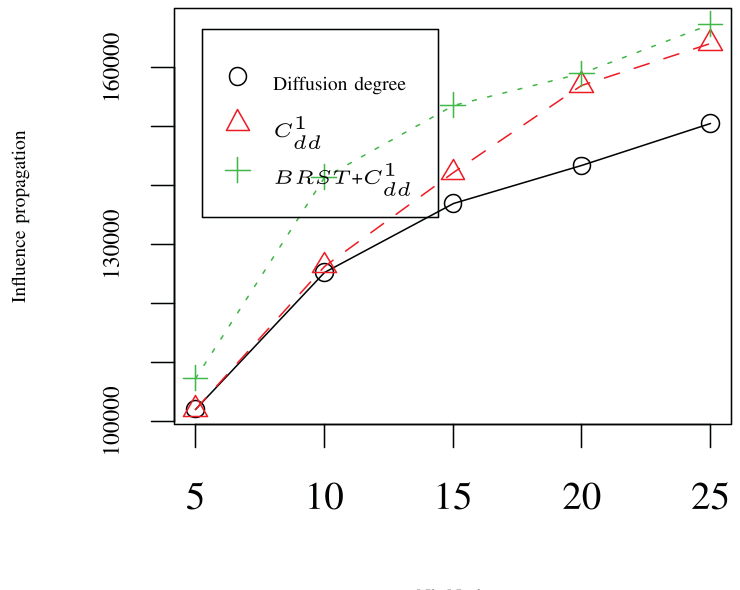 Figure: Comparison between , BRST-integrated models, and the Diffusion Degree benchmark.
Critical Insight & Conclusion
The elegance of this paper lies in its scalability. With a complexity of , it remains applicable to large-scale datasets like Amazon. The physical intuition that "influence is a tree-like cascade" allows the authors to simplify graph topology without losing the critical paths of information flow.
Takeaway: If you are designing a viral marketing campaign or a recommendation engine, don't just look at the most "popular" nodes (highest degree). Look at the nodes that sit at the root of a deep, high-probability reachability tree—the "hidden influencers" who can reach the 3rd and 4th degree neighbors most effectively.
Limitations: The BRST approach, while efficient, inherently discards edge information (the edges not in the tree). In highly dense graphs, this might lead to an underestimation of alternative influence paths. Future work should explore if "Weighted Spanning Forests" could better handle unconnected graph components.