
Beyond Connectivity: A Game-Theoretic Framework for Network Centrality
C entrality and power in social networks: a game theoretic approach b b b
This paper introduces a novel family of centrality measures for social networks by integrating cooperative game theory with graph theory. It leverages the Shapley value of "graph-restricted games" to quantify a node's power, proposing a unique decomposition into communicative ability and intermediary control.
TL;DR
This seminal work redefines how we calculate the "importance" of a node in a network. Instead of just counting edges or measuring distances, the authors treat the network as a cooperative game. By calculating the Shapley value of a graph-restricted game, they derive a family of centrality measures that are mathematically robust, fair, and capable of distinguishing between "active communicators" and "strategic brokers."
The Motivation: Why Geodesics Aren't Enough
Classic measures like Betweenness or Closeness are heavily dependent on "geodesic paths" (the shortest distance between two points). However, the authors argue that in real-world social or economic interactions, individuals don't always use the shortest path, nor are all interactions binary.
The core insight is that Power is the root of Centrality. If a node's presence significantly increases the potential value of the coalitions it can join (given the connectivity constraints), that node is central.
Methodology: The Graph-Restricted Game
The framework operates in three steps:
- Define a Base Game (): A symmetric game where rewards depend only on the size of the group.
- Apply Graph Restrictions (): A coalition only gets its value if it is connected via the graph. If a coalition is split into components, its value is the sum of the values of those components.
- Compute the Shapley Value: The centrality is the Shapley value of the player in this restricted game.
1. Mathematical Intuition
The measure uses Harsanyi dividends () to decompose the game. The centrality is the sum of dividends from every possible coalition, weighted by the node's contribution to making those coalitions "connected."
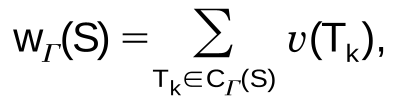
2. The Power of Decomposition
One of the most elegant contributions of this paper is the split of centrality into two components:
- (Communicative): Power derived from being an active member of a coalition.
- (Brokerage): Power derived from acting as a bridge for others, even if the node doesn't directly benefit from the specific transaction.
Key Properties and SOTA Comparison
The authors prove that their measure satisfies several "Axioms of Centrality" that traditional metrics often violate:
- Fairness: If an edge between node and is removed, the loss in centrality for both nodes is identical.
- Efficiency: The sum of centralities equals the total value of the network, allowing for direct comparison across different graphs without arbitrary normalization.
- Stability: Adding links never decreases the total power of the connected incident nodes.

Experiments: Star vs. Chain
In a Star Graph, the hub node's centrality grows quadratically with in a "Messages Game" (), reflecting its total control. In a Chain Graph, traditional Closeness and Information centralities often assign identical scores to middle nodes. In contrast, the game-theoretic measure correctly identifies the "Median" node as having significantly more power due to its role in a higher number of potential connected sub-coalitions.
| Graph Type | Key Finding |
|---|---|
| Star | Hub takes maximal power; peripheral nodes are equal. |
| Chain | Centrality strictly increases from ends toward the center. |
| Bow-tie | Correctly identifies the "bridge" node as the most vital. |
Critical Insight & Conclusion
The true value of this work lies in its flexibility. By changing the base game , a researcher can switch from a "Communication Hub" focus to a "Cost-sharing" focus.
Takeaway: Centrality is not a single number, but a reflection of the "interest" that motivates interaction. This paper provides the mathematical "toolkit" to build the right measure for the right game.
Limitations
- Computational Complexity: Calculating Shapley values for all coalitions is NP-hard. While the authors provide shortcuts for trees and specific symmetric games, applying this to massive graphs (e.g., Twitter's social graph) requires approximation methods.
- Sensitivity: The choice of the base function is crucial; a poorly chosen game can lead to counter-intuitive rankings.