
Predictive Influence: Mastering Node Centrality in MSNs via K-order Markov Chains
Centrality prediction based on K-order Markov chain in Mobile Social Networks
This paper proposes a centrality prediction method based on K-order Markov chains for Mobile Social Networks (MSNs). By leveraging information entropy to prove the predictability of node importance, the authors develop a state transition model that accurately forecasts future degree, betweenness, and closeness centrality, achieving optimal performance at K=2.
TL;DR
In the fluid world of Mobile Social Networks (MSNs), knowing which node will become "important" is the key to efficient data routing. This paper introduces a K-order Markov chain approach to predict future node centrality. By analyzing historical entropy and state transitions, the authors prove that a 2-order model captures enough "social memory" to outperform standard averaging methods significantly.
Background: The Predictability of Human Socializing
Mobile Social Networks are inherently dynamic—nodes (our devices) move, and edges (contacts) appear or disappear based on human behavior. However, human movement isn't random. Research suggests it is up to 93% predictable. The authors leverage this regularity to solve a core problem: Centrality Prediction. Specifically, they look at Degree, Betweenness, and Closeness centrality, which are markers of how influential a node is in spreading information.
The "Why": Why 1-order Markov Isn't Enough
Prior works often treated MSNs as static snapshots or used simple moving averages to guess future importance. The paper argues that a 1-order Markov chain (where the future depends only on the current state) is too restrictive. It ignores the "momentum" of social interactions. Conversely, going too high (K > 3) leads to the State Space Explosion problem, where the computation becomes too heavy for mobile environments without a proportional gain in accuracy.
Methodology: From Entropy to Transition Matrices
1. Proving Predictability via Entropy
Before predicting, the authors used Information Entropy to measure the uncertainty of node centrality. They found that Conditional Entropy is significantly lower than Marginal Entropy . This mathematical proof confirms that knowing past states reduces the uncertainty of future centrality, making prediction a viable task.
2. The K-order Model
The core innovation is the construction of a K-order state transition probability matrix.

By discretizing continuous centrality values into finite states, the model calculates the probability of moving to state given a sequence of previous states. The prediction is then the expected value based on these probabilities:
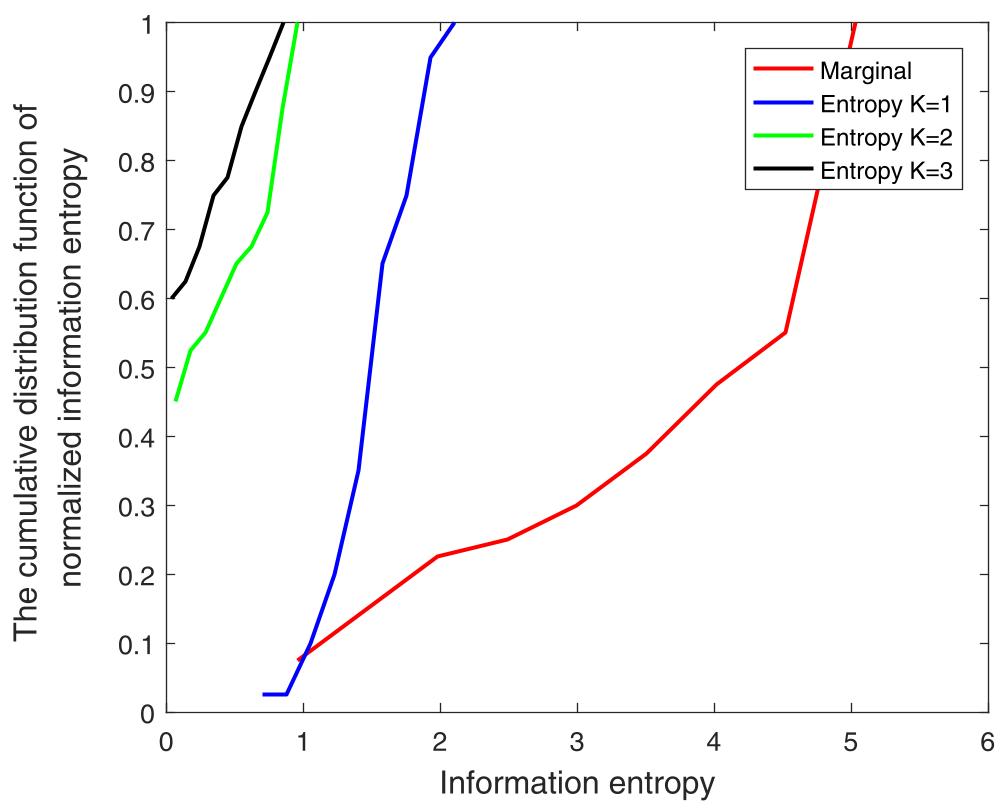 Figure 1: CDF of Information Entropy showing that as K increases, uncertainty (entropy) decreases.
Experimental Battleground: MIT vs. Infocom
The authors tested their hypothesis against two gold-standard datasets:
- MIT Reality Trace: Long-term data from 97 users.
- Infocom 06 Trace: Short-term, high-intensity contact data.
Finding the "Sweet Spot" (K=2)
The experiments (shown in Figure 3 of the paper) revealed that K=2 is the magic number. K=1 was too volatile, while K=3 increased computational complexity without offering significant error reduction.
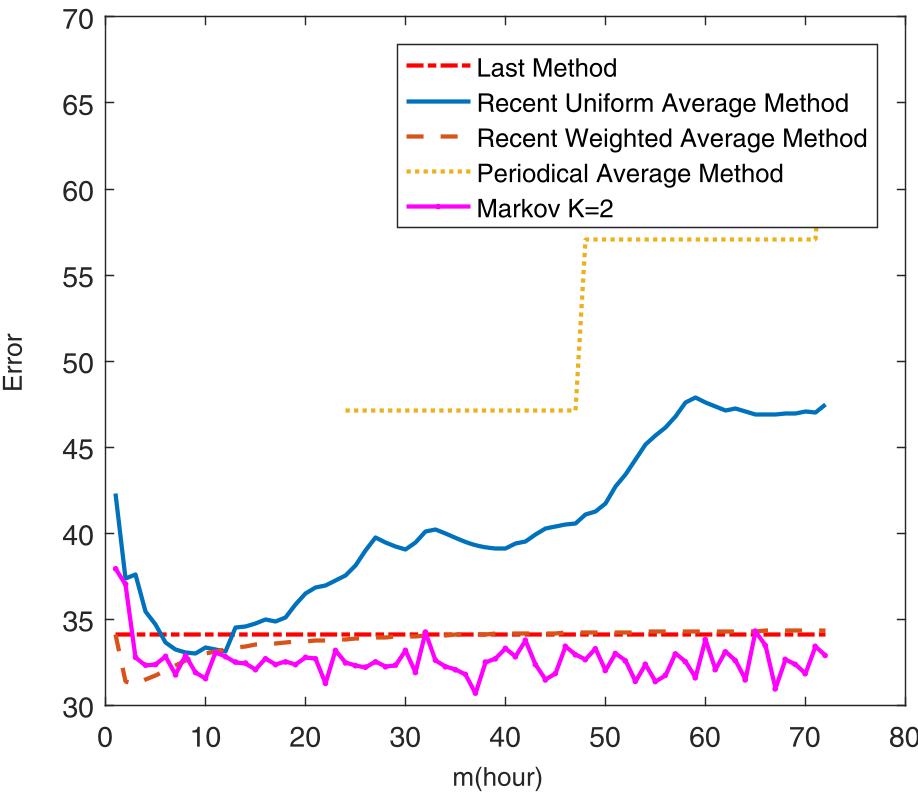 Figure 2: Prediction error comparison for Betweenness Centrality on the Infocom 06 trace.
Competitive Edge
Compared to the "Last Method" or "Weighted Average," the K-order Markov approach showed:
- Lower Absolute Error: More accurate proximity to the real centrality value.
- Higher Stability: Fewer "spikes" in error across different time windows.
- Metric Versatility: Success across Degree, Betweenness, and Closeness metrics.
Critical Insight & Conclusion
The true value of this work lies in its simplicity and grounding in social physics. By recognizing that social importance is a "state" with memory, the authors provide a lightweight yet robust way to forecast network topology.
Limitations: The discretization of centrality values (the "manual state division") is a bit of an art rather than a science in this paper. Future work could benefit from Automated State Clustering to handle the high precision of centrality values more naturally.
Takeaway: If you’re building a routing protocol for opportunistic networks, don't just look at where a node is—look at the "sequence" of where it's been. History matters.