
Cerebral Palsy and Online Social Networks: When "Innovation" Becomes a Barrier
Cerebral palsy and online social networks
This qualitative study explores the digital experiences of individuals with cerebral palsy (CP) using Online Social Networks (OSNs). Through 14 in-depth interviews, it identifies that while OSNs are vital for communication independence, frequent interface changes and accessibility barriers significantly hinder usability.
TL;DR
This seminal 2010 study by Makayla Lewis highlights a bittersweet reality: Online Social Networks (OSNs) are "like food" for individuals with cerebral palsy (CP), providing a vital lifeline for independence, yet they are often designed in ways that actively exclude them. The research uncovers how standard industry practices—like frequent UI "pivots"—can inadvertently strip away the digital autonomy of users with motor disabilities.
The Visibility Gap in HCI
By 2010, social media giants like Facebook and MySpace had already captured hundreds of millions of users. However, HCI (Human-Computer Interaction) research often treated "disability" as a monolith. This paper argues that users with Cerebral Palsy (CP) face a unique set of constraints—ranging from mobility and access to specific communication limitations—that general accessibility guidelines often miss. The goal was simple but profound: make this community visible in the eyes of designers.
Methodology: High-Touch Qualitative Insights
The researcher conducted 14 verbatim-transcribed interviews. This wasn't just about "can they click a button?" It was about the ecology of use:
- Assistive Hardware: The study documented the heavy reliance on large print keyboards, trackballs, and "sticky keys."
- Human-in-the-loop: It explored the uncomfortable reality that many users require "support individuals" to navigate social spaces, which ironically reduces the very privacy they seek.
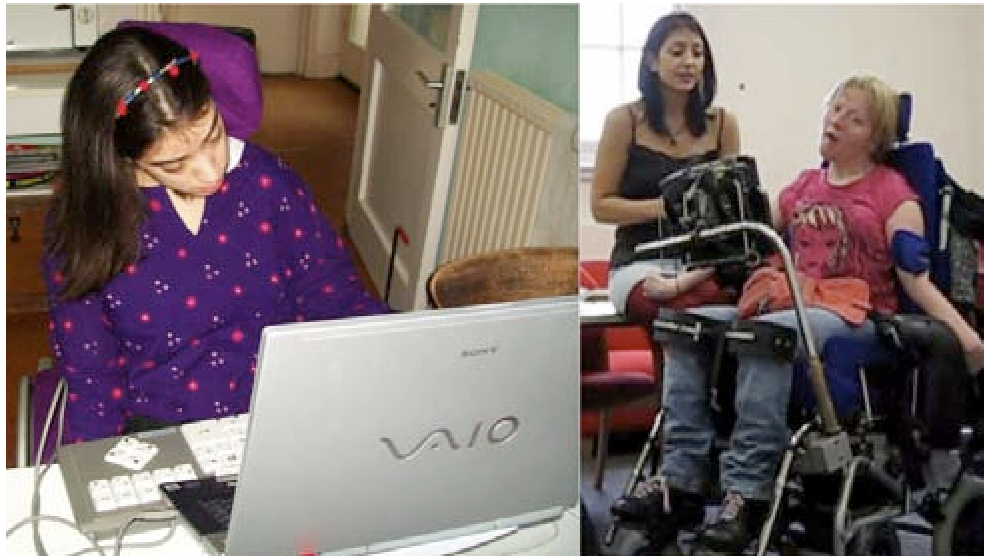 Figure 1: Users often utilize a mix of specialized hardware (large keyboards) and human assistance to bridge the accessibility gap.
The Hidden Tax of "Agile" Updates
The most striking finding of the paper is the concept of "Change" as a barrier. In modern software development, we praise "moving fast and breaking things." But for a user with CP:
- Motor Memory is Key: Many users with CP rely on counting the number of clicks or specific switch-presses to navigate.
- The Re-learning Curve: When Facebook changes a layout, it doesn't just mean a new aesthetic; it means the expensive and time-consuming process of re-learning physical navigation paths.
- Breaking Assistive Tech: UI shifts often break the compatibility of screen readers or word prediction software.
Core Challenges Identified
The study categorized five specific technical hurdles that hampered the experience:
- Slow Text Input: Traditional typing is a major bottleneck.
- Small Target Areas: Tiny "Like" buttons or "Close" icons create high error rates for users with motor tremors.
- Complex Workflows: Tasks that require multiple disparate clicks (like sending a private message) are disproportionately exhausting.
- Lack of Personalization: Hard-coded font sizes and colors prevent users with visual impairments from adjusting the space to their needs.
- Inadequate Help: Support systems are rarely optimized for the specific queries of the CP community.
Critical Analysis & Looking Forward
Looking at this work through a modern lens, it serves as a historical baseline for Adaptive Design. While we now have better AI-driven predictions and eye-tracking, the core problem remains: Platform Centricity.
Platforms are designed for the "average" user, and accessibility is often an afterthought (a "patch") rather than a core architectural requirement. The 2010 insight that OSNs are "vital, often the only, way to reduce isolation" is even more true today, yet the digital divide persists.
Final Takeaway
For developers and researchers, this paper is a reminder that Consistency is a Feature. For users who navigate with high effort, a stable UI is not "boring"—it is accessible. Future work in this space must focus on Personalizable Interfaces that allow the UI to remain static for the user even as the backend evolves.
Reference: Lewis, M. (2010). Cerebral palsy and online social networks. ASSETS '10.