
Enhancing Automatic Crowdsourcing: Solving the Persistence-Power Paradox in Transit Tracking
Challenges in Implementing Crowdsourcing on automatic real-time transit tracking system
This paper identifies and addresses major challenges in implementing automatic real-time crowdsourcing for transit tracking, specifically for the Chao Phraya Express Boat system. By leveraging smartphone sensors (GPS, Wi-Fi, accelerometer, and microphone) without manual user input, the authors propose strategies to optimize performance and ensure data continuity.
TL;DR
Crowdsourcing transit data usually fails due to user fatigue (manual input) or dead batteries (automatic sensing). This paper presents an automatic detection system for boat transit that uses a "Scoring and Backup" mechanism. It solves the continuity problem when users disembark and achieves a 30% reduction in battery consumption while maintaining 100% detection accuracy by coordinating multiple users on the same vehicle.
Context: Beyond Manual Reports
Traditional apps like Moovit or Tiramitsu rely on users actively reporting their status. However, people are forgetful or may provide false data. The shift toward Automatic Crowdsourcing (background sensing) removes the "human-in-the-loop" friction but creates a technical bottleneck: how do you maintain a stable track of a boat or bus when individual users (sensors) are constantly entering and exiting the system?
The "Automatic" Challenges
The authors categorize the hurdles into three dimensions:
- Tracking Performance: Balancing the accuracy of multiple sensors versus the energy cost.
- Tracking Consistency: Managing the handovers when the primary data source (the passenger) gets off the boat.
- Tracking Continuity: Recovering a "lost" vehicle when there is a gap between the last user leaving and a new user joining.
Methodology: Smart Handovers and Scoring
The core innovation lies in treating passengers as a dynamic sensor network.
1. The Scoring Technique
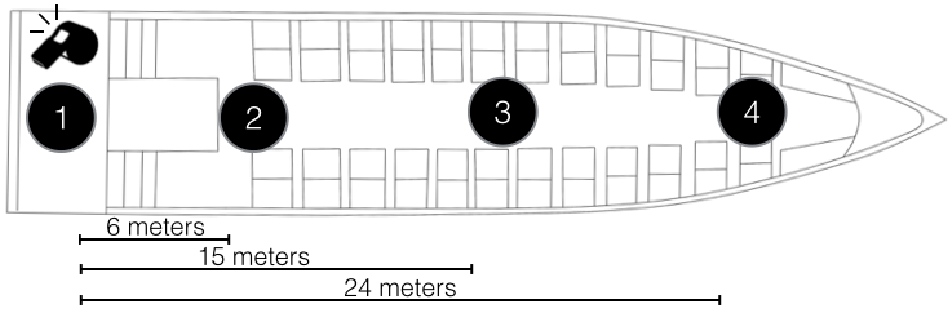
Not all smartphones are equal. A phone in a pocket at the back of a boat is less reliable than one near the conductor’s whistle. The system uses Fast Fourier Transform (FFT) to measure the decibel level and frequency of the boat's whistle/conductor sound.
- High dB = Closer to conductor = Better accuracy.
- Outcome: Only the "Best User" becomes the Sharing User, while others stay in a low-power Backup state.
2. The Multi-Scenario Handover
To ensure the tracking doesn't die when a user leaves, the system employs three logic paths:
- Scenario A (Backup Available): Immediate swap.
- Scenario B (No Backup, Immediate New User): Identify the same boat via direction detection.
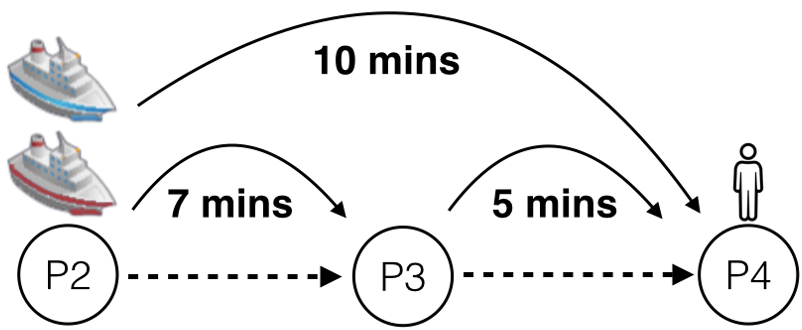
- Scenario C (The Gap): If a boat is "lost" for several piers, the server keeps a "lost track" list. When a new user appears later, the system matches them to the lost boat by comparing the travel time and direction against predicted models.
Experimental Results
The researchers tested the system on the Chao Phraya Express Boat in Bangkok using Nexus One devices.
- Battery Efficiency: Backup users, who only perform "Disembark-Detection" using Wi-Fi and accelerometers, consumed 30% less battery than active sharing users (14% vs 20% per hour). This pushes battery life from 5 hours to 7 hours.
- Accuracy: By selecting the user with the best acoustic visibility (location No. 1 or 2 in Fig 1), the system maintained 100% accuracy in detecting boat stops at piers.

The Overtake Problem
A fascinating edge case identified is the "Overtake Situation." This occurs when a faster boat type (e.g., Green Flag) passes a slower one (Orange Flag). The system handles this by "carrying" both possibilities in the data until the vehicle hits a pier unique to one specific boat type, effectively using future data to correct past identity gaps.
Critical Insight & Conclusion
The significance of this work is its Resource-Aware Orchestration. It moves away from the "collect everything from everyone" mentality of typical participatory sensing. By introducing a hierarchy (Sharing vs. Backup) and temporal-spatial matching for continuity, it proves that automatic tracking can be both persistent and battery-friendly. While tested on boats, these logical "handovers" are highly applicable to bus networks in dense urban areas where GPS often fails due to urban canyons.