
Personalised Patient Analytics: Architecting the Future of Evidence-Based Medicine
Challenges in designing an online healthcare platform for personalised patient analytics
The paper outlines a strategic framework for an online healthcare platform focused on "personalised patient analytics" using Clinical Medical Records (CMRs). It introduces a secure architecture integrating database management, an analytic engine, and machine learning to move beyond guideline-led treatments toward evidence-based, individualised patient care.
TL;DR
The explosion of Clinical Medical Records (CMRs) presents a "Big Data" paradox: there is too much data for clinicians to process, yet not enough specific insight for individual patients. This paper proposes a secure, multi-layered platform architecture designed to transition from generic medical guidelines to Personalised Patient Analytics. By utilizing machine learning strategies like model adaptation and patient similarity, the system transforms raw data into tailored clinical decision support.
The "One-Size-Fits-All" Bottleneck
In modern medicine, guideline-led treatments are the norm. However, these guidelines often ignore the massive between-subject variation found in clinical labs. A measurement that is "normal" for the general population might be "alarming" for a specific individual based on their baseline history.
The authors argue that the industry faces three fundamental hurdles:
- Complexity of Representation: Clinical data is 3D—spanning patients, time, and clinical concepts (SNOMED-CT codes).
- Irregular Temporality: Unlike audio or sensor data, medical check-ups happen at irregular intervals, creating "gaps" that break traditional time-series models.
- The Privacy-Utility Tradeoff: How do you run complex ML models on sensitive data without risking a catastrophic breach?
Methodology: The Core Architecture
The proposed platform relies on a three-tier architecture designed to keep data secure while remaining accessible for analysis.
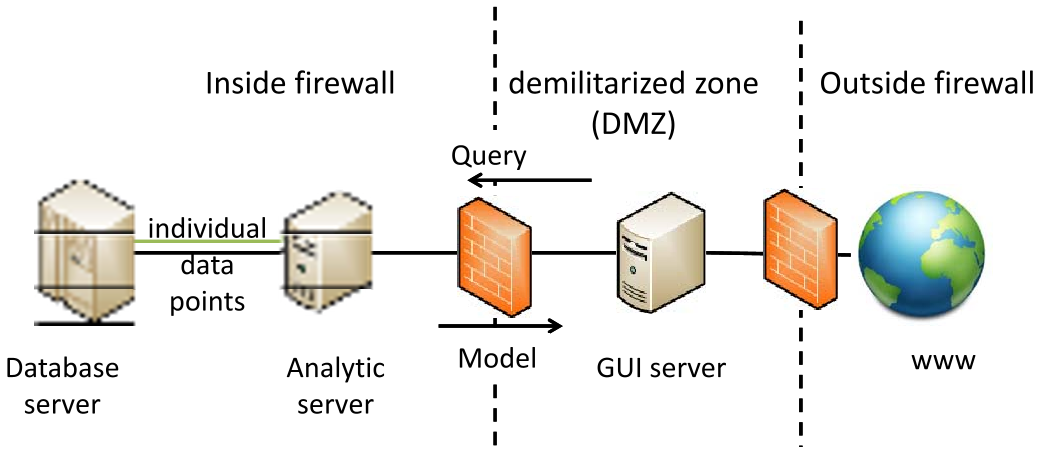
Security through Segregation
- Functional Segregation: The Graphical User Interface (GUI) server lives in a demilitarized zone (DMZ) and cannot directly talk to the Database Server.
- Data Salting & Synthesis: To ensure Revocability, data is subjected to one-way transformations (salting) or replaced with synthetic data that follows real distributions.
- Query Design: The analytic engine is designed to return model parameters (like weights of a neural net) rather than individual raw data points, preventing data leakage.
The Personalisation Toolkit
The heart of the paper lies in how it makes "Big Data" feel "Small and Personal":
- Model Adaptation: Training a "World Model" on everyone, then fine-tuning it to a specific patient’s history.
- Mixture of Experts: Dividing the population into homogeneous clusters and assigning a specialized model to each group.
- Patient Similarity: Finding a "digital twin" cohort—patients with similar histories—to predict the most likely outcome for a new patient.
Tackling the 3D Data Challenge
The authors map clinical data across three dimensions, suggesting specific technical solutions for each:
- Clinical Code Dimension: Using Latent Semantic Analysis (LSA) to find relationships between different diagnoses, effectively treating a patient's history like a "document" and clinical codes like "words."
- Temporal Dimension: Addressing the "missing at random" problem through imputation (Splines/ARIMA) and handling non-uniform intervals through spectral analysis (Lomb-Scargle Periodograms).
- Patient Dimension: Employing domain adaptation and multi-task learning to handle the diverse origins of data (primary vs. secondary care).
Experimental Performance & Insights
The paper highlights critical preprocessing steps. For instance, without Data Calibration, measurements like eGFR (Estimated Glomerular Filtration Rate) exhibit structural biases due to different reporting assay methods over time.
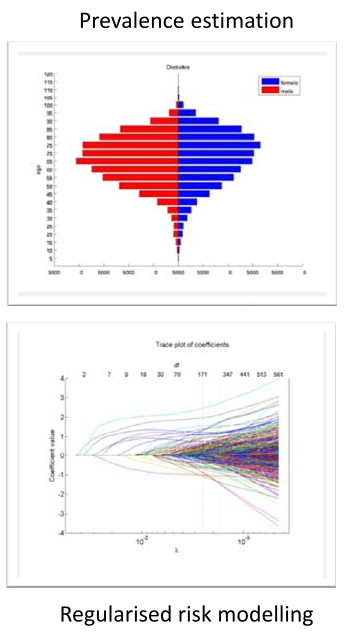 (Example of trend analysis to characterize inter- vs. intra-patient variability)
One of the key findings (Table I) compares Centralized vs. Distributed computing. While distributed systems offer better network security, they require significant modifications to ML algorithms. The authors lean toward a secured centralized repository with "Cancellable" databases to maximize utility for clinicians.
Critical Analysis & Conclusion
Takeaway
The shift from guidelines to evidence-based medicine requires more than just better algorithms; it requires a systemic rethink of how healthcare data is stored and retrieved. Personalisation is not just a feature—it is the solution to the "Big Data" noise problem in clinical settings.
Limitations & Future Work
While the paper provides a robust framework for structured CMR data, it touches only briefly on Unstructured Text (the <text> field in journals) and the emerging data from Smartphones/Wearables. The "holy grail" remains a unified model that can operate in all three dimensions (patient, time, concept) simultaneously without loss of information through discretization.
Predictive health is no longer a matter of "if," but "how safely." This paper provides the architectural roadmap to ensure the answer is "very safely."