
Scaling the Social Fabric: Navigating the Technical Debt of Massive Social Networks
Towards Identifying the Challenges Associated with Emerging Large Scale Social Networks
This paper identifies and categorizes the systemic challenges facing emerging large-scale Social Networks (SNs) like Facebook and Twitter. It highlights the gap between rapid user growth and the lagging capabilities of current Social Network Analysis (SNA) tools, specifically focusing on data volume, privacy, and trust modeling.
TL;DR
As social networking platforms evolve into global utilities, the sheer velocity and volume of data—reaching exabytes—have outpaced our analytical capabilities. This paper identifies the critical bottlenecks in Social Network Analysis (SNA), ranging from the "visual pollution" of massive graphs to the subjective difficulties of quantifying human trust in a digital environment.
The Scalability Crisis: Beyond the "Eye-Balling" Era
The fundamental problem identified by Malik and Malik is that while social networks have matured into vital daily infrastructure, the tools used to manage them remain in an "evolutionary" rather than "revolutionary" state. Most practitioners still rely on "eye-balling" plots—a method that is mathematically impossible when dealing with the dense, multi-terabyte logs generated by modern platforms.
The authors argue that we are trapped in a cycle where theoretical researchers use sophisticated mathematical models (like random graphs) that have never been validated against real-world, large-scale data because researchers lack access to proprietary systems and robust simulation frameworks.
Methodology: A Taxonomy of SN Challenges
The paper breaks down the challenges into several key pillars:
1. The Data Deluge (Volume & Structure)
Social networks are "living networks." With Facebook producing over a petabyte of data daily, traditional data mining is ineffective. The shift toward non-text content (video, sound) creates a semantic gap that current automated software cannot bridge, especially given the prevalence of slang and shorthand in social discourse.
 Typical growth trajectory and member distribution across niche social platforms.
2. The Validation and Simulation Void
A significant "speed bump" is the lack of open-source frameworks to test social theories at scale. Without repeatable simulation tools that can be "docked" against empirical results, practitioners are hesitant to apply new algorithms for fear of violating Service Level Agreements (SLAs) or causing performance degradation.
3. The Trust and Privacy Paradox
Privacy is described as a "double-edged sword." Information exposure is required for the platform to function (search, traversal), yet this exposure invites stalking and phishing. The authors highlight the Trust Construction Challenge, noting that digital trust must account for:
- Multidimensionality: Honesty, experience, and precision.
- Contextuality: Trust in a domain expert vs. a personal friend.
- Transitivity: How trust flows through mutual connections in a sparse graph.
Experimental Snapshot: The Weight of the Web
The authors present startling data on the membership levels of early-2010s networks, illustrating why manual analysis is a relic of the past.
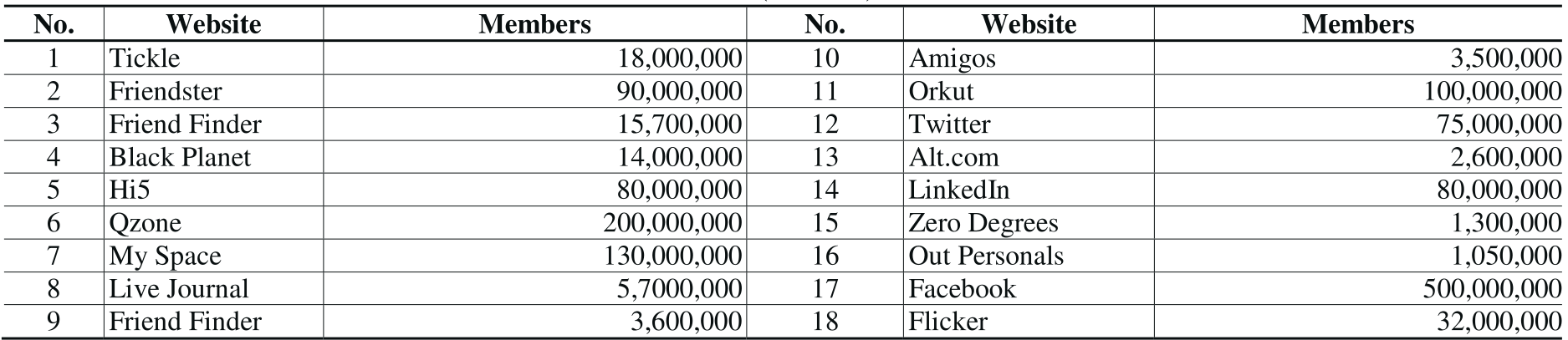 Table 1: The membership explosion across diverse social platforms.
Critical Analysis: A Call for Robust Social Tools
The paper serves as a vital snapshot of technical debt. Its core contribution is the realization that Trust Hubs—nodes that naturally accumulate influence—are both the strength of a network and its greatest vulnerability. If these authorities are compromised (via profile hijacking), the "Small World" effect ensures the damage spreads with high velocity.
Limitations
While the paper expertly identifies what is wrong, it offers few prescriptive how-to solutions for the trust problems mentioned. It relies on the de facto status of MapReduce, which, even at the time of writing, was beginning to struggle with graph-specific workloads.
Conclusion
The future of Social Network Analysis lies not in better visualization (which suffers from "space crunch"), but in intelligent, machine-augmented interpretation. We need systems that can quantify the "fuzziness" of human trust and simulate global-scale interactions before they are deployed into our fragile social ecosystems.
Final Takeaway: To move forward, the industry must transition from "social media management" to "social systems engineering," prioritizing robust simulation and multidimensional trust metrics.