
Beyond the Ledger: How 'Private Services' Drive Microfinance Innovation
The Challenges of Microfinance Innovation: Understanding ‘Private Services’
This paper explores the role of "private services"—unofficial advice and assistance provided by staff to clients—within a Microfinance Institution (MFI) in Azerbaijan. Based on an ethnographic study, it identifies how these informal interactions bridge the gap between rigid institutional processes and the actual socio-economic needs of the rural poor.
TL;DR
In the quest to digitize microfinance, we often optimize for the bank, not the borrower. This ethnographic study of a Microfinance Institution (MFI) in Azerbaijan reveals that the real value for the poor often lies in "private services"—informal help from loan officers that exists entirely outside official data systems. By understanding this "invisible work," we can design better HCI (Human-Computer Interaction) patterns that move from simple automation to genuine social empowerment.
The Disconnect: Automation vs. Empowerment
Microfinance was born from the vision of Nobel laureate Muhammad Yunus to empower the poor. However, the modern reality is often a struggle between two philosophies:
- Innovation in Microfinance: Reducing costs through automation, rigid credit management, and standardized "Poverty Scoring Cards."
- Microfinance for Innovation: Using financial services as a springboard for broader social change, education, and community building.
The authors argue that current MFIs are becoming "mini-banks" that focus on efficiency and high loan volumes, often ignoring the cultural and infrastructural constraints of the rural poor. This creates a gap where the technology (MIS) serves the institution, but the human actors (Loan Officers) have to improvise to make the system actually work.
Methodology: An Ethnographic Deep Dive
The researchers spent years engaging with MFI "ABC" in Azerbaijan, conducting semi-structured interviews and path-along observations in regions like Sabirabad and Imishli. They applied Grounded Theory to analyze over 40 interviews, focusing on the "articulation work" performed by loan officers—the extra labor required to coordinate tasks that the formal system doesn't account for.
The Loan Process in Context
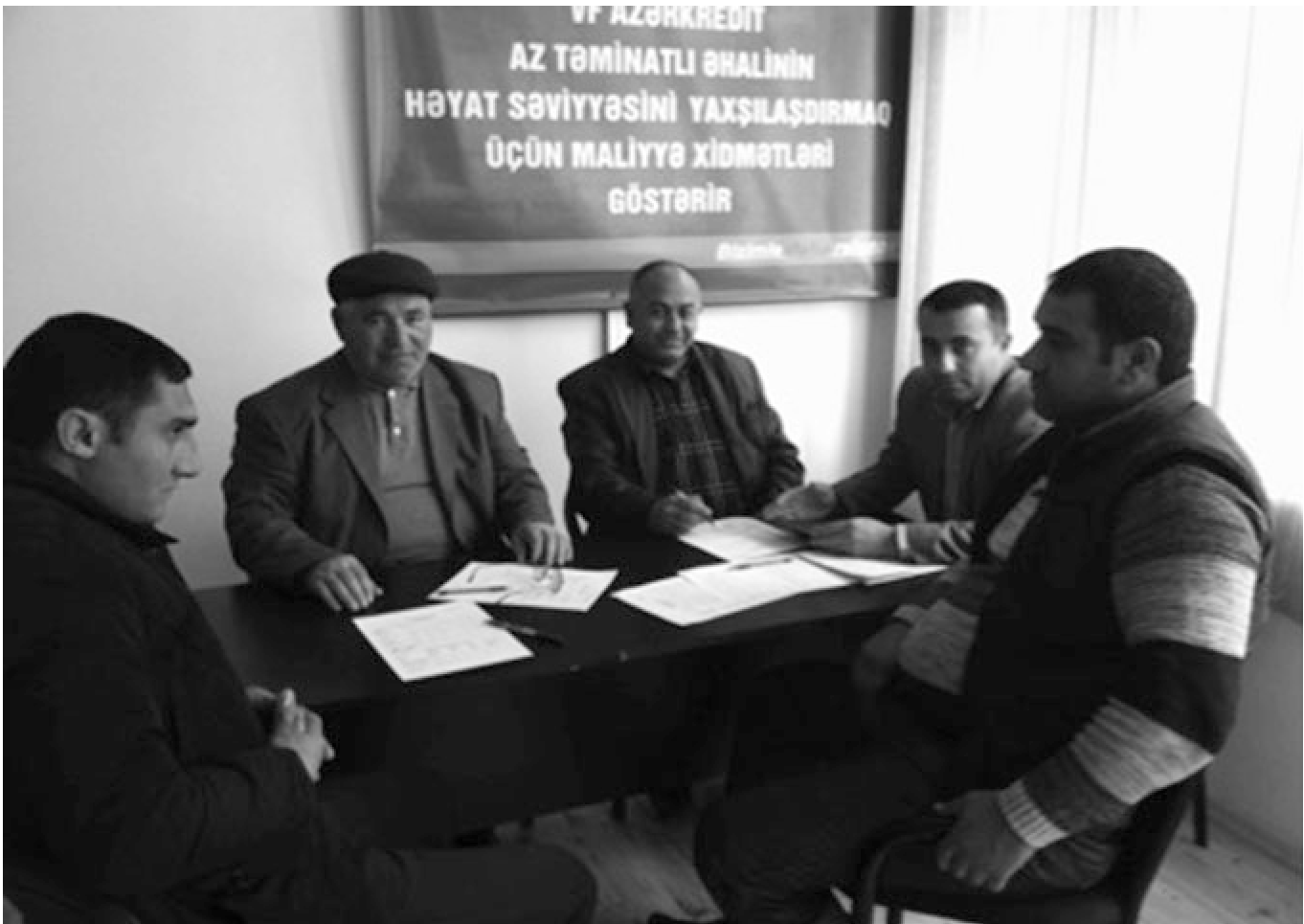 Figure 1: Face-to-face interaction between MFI staff and potential clients. This physical proximity is the site of both formal data collection and informal "private services."
Core Insight: The Power of 'Private Services'
The paper’s most provocative finding is the existence of Private Services. These are initiatives taken by loan officers (LOs) that the organization doesn't officially recognize or reward:
- The "Human Yellow Pages": An LO giving a client the phone number of another client who sells satellite receivers.
- Market Intelligence: Sharing vegetable market prices with farmers to help them decide when to sell.
- Logistics Brokering: Connecting dairy farmers to share the cost of a single truck for transportation.
- Informal Risk Management: Using local "well-informed individuals" to verify a borrower's true poverty level, bypassing the static and often inaccurate Poverty Scoring Cards.
These acts are a form of Social Capital. Because the formal MIS is often inaccessible or too rigid for field use, LOs maintain their own "bibles"—handwritten notebooks or private Excel files containing rich, diachronic histories of their clients.
Discussion: From Invisible Work to Design Requirements
The study highlights a classic CSCW (Computer-Supported Cooperative Work) problem: Articulation Work. When an IT department designs a system without talking to the field staff, the staff creates "workarounds."
Design Implications for HCI4D:
- Supporting Social Capital: Instead of just digitizing credit scores, technology should help LOs act as "community brokers."
- Data Sovereignty: There is a tension between "private" and "public" data. If these private services are formalized, they might lose their personal touch or expose clients to normative risks (e.g., calling a debtor's uncle to enforce payment).
- Seeding for Growth: Local records should be seen as "seeds" for future user-centered services. For example, a "transport-sharing" module could be built on top of existing informal networking practices.
Critical Analysis & Conclusion
Takeaway
The success of microfinance depends less on the algorithm of the poverty scorecard and more on the informal brokering that happens in the field. To truly innovate, technology must support the brokerage and closure of social networks, not just the automation of debt.
Limitations
The study acknowledges that "private services" operate in a legal grey zone. Formalizing them could introduce ethical risks regarding privacy and the "normative dimension" of loans—where social pressure is used as a tool for repayment.
Future Outlook
The next generation of MFI technology should focus on Meta-design, allowing local players to reshape the tools to fit their unique cultural and economic landscapes. The goal is to transform "private services" from accidental side-effects into organizationally supported products.