
Beyond Archetypes: Decoding Blended Emotions in Real-Life Call Centers
Challenges in real-life emotion annotation and machine learning based detection
This paper presents the Multi-level Emotion and Context Annotation Scheme (MECAS), a framework designed to handle non-basic, blended emotions in real-life call center interactions. Using SVM and Decision Tree classifiers, the authors demonstrate that integrating prosodic, lexical, and disfluency features significantly improves emotion detection in naturalistic French speech.
TL;DR
Researchers from LIMSI-CNRS challenge the status quo of "acted" emotion databases by analyzing real human-human interactions from stock exchange and medical emergency call centers. They propose MECAS, a multi-level annotation scheme capable of capturing "blended" emotions, and prove that combining what we say (lexical) with how we say it (prosody and disfluencies) is the key to cracking naturalistic emotion detection.
Context: The "Laboratory" Fallacy
In the early 2000s, most emotion recognition was trained on "acted" data—think of an actor shouting "I am angry!" into a studio microphone. While useful for baseline research, these archetypal emotions rarely appear in the wild. Real life is messy; we mask our fear with anger, or feel a mix of relief and stress when help finally arrives.
The authors argue that existing systems fail because they treat emotions as mutually exclusive discrete categories. To solve this, they look at two extreme real-world scenarios:
- Financial Call Centers: Low-intensity, shaded emotions (irritation vs. anxiety).
- Medical Emergency Centers: High-intensity, life-or-death scenarios where panic and relief collide.
Methodology: The MECAS Architecture
The core innovation is the Multi-level Emotion and Context Annotation Scheme (MECAS). Instead of assigning a single label to a segment, annotators assign:
- Major Label: The dominant emotional state.
- Minor Label: The background or "shaded" emotion.
This allows for the classification of Blended Emotions, divided into three categories:
- Ambiguous: Two labels from the same family (e.g., Annoyance/Anger).
- Unconflictual: Different families but same valence (e.g., Fear/Anger).
- Conflictual: Opposing valences (e.g., Relief/Anxiety).
The Feature Matrix
To detect these, the authors didn't just look at Pitch (F0). They utilized a holistic feature set:
- Prosodic: Pitch, Energy, and Duration.
- Spectral: Formants (F1, F2) to capture voice quality.
- Disfluency: The "euh" fillers and abnormal pauses that often signal high cognitive load or fear.
- Lexical: A unigram model to capture "keywords" associated with emotional states.
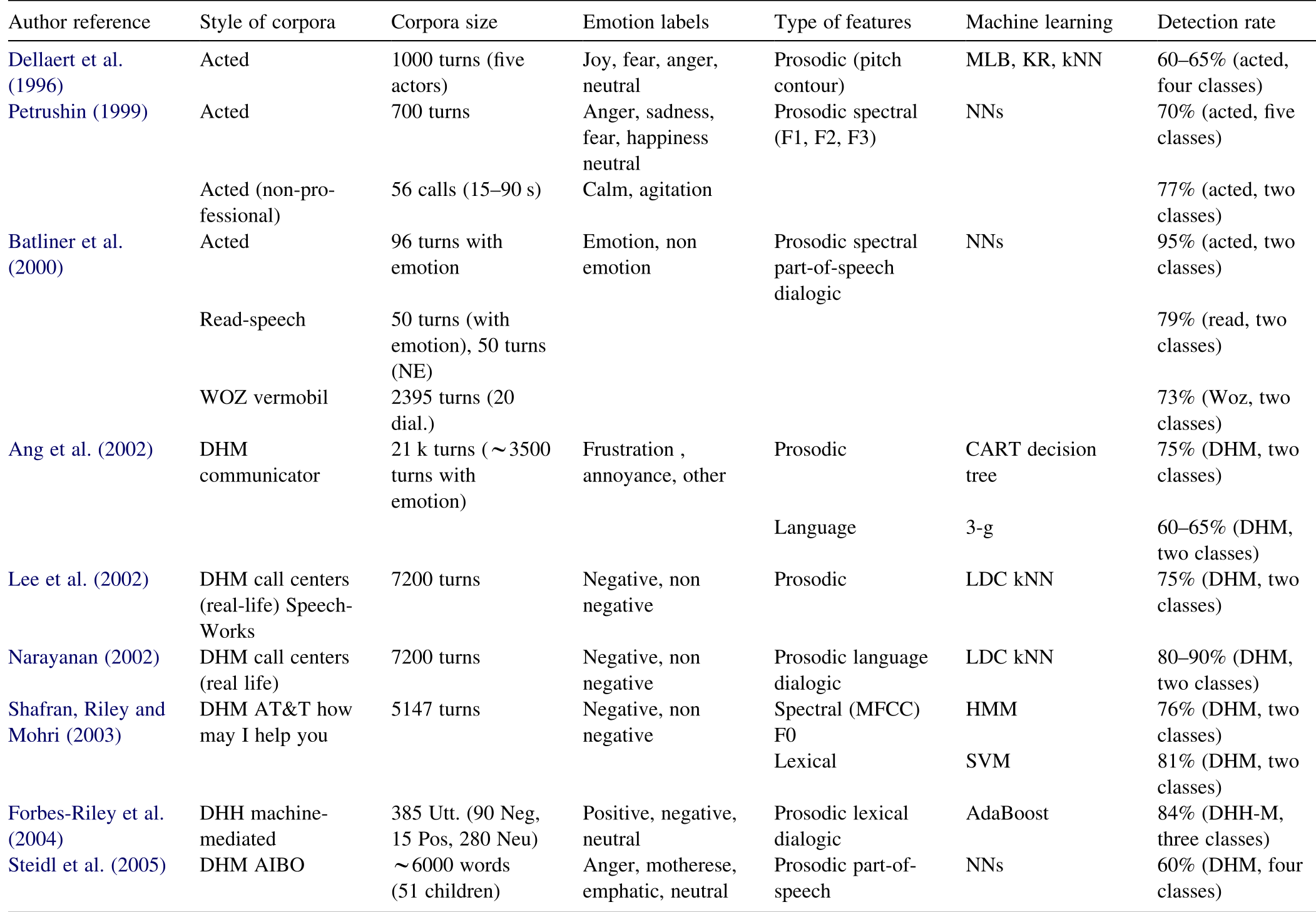 Figure 1: Comparison of various SOTA systems showing the shift from Acted to Real-Life data.
Experimental Insights: Why "How" Matters
The study highlights a fascinating takeaway regarding Fear vs. Anger. In the financial corpus, these two are often confused by prosodic-only models because both involve high arousal. However, the authors found that Fear induces significantly more disfluencies (stuttering, fillers) than Anger. By adding disfluency markers, the distinction between these two becomes much clearer.
Performance Highlights
- Lexical + Prosodic Fusion: In Corpus 1, combining the two data streams led to a performance jump of 5%, outperforming either modality used in isolation.
- SVM Dominance: For the high-stress Medical corpus, Support Vector Machines (SVM) reached an 83.2% accuracy for detecting negative states in clients.
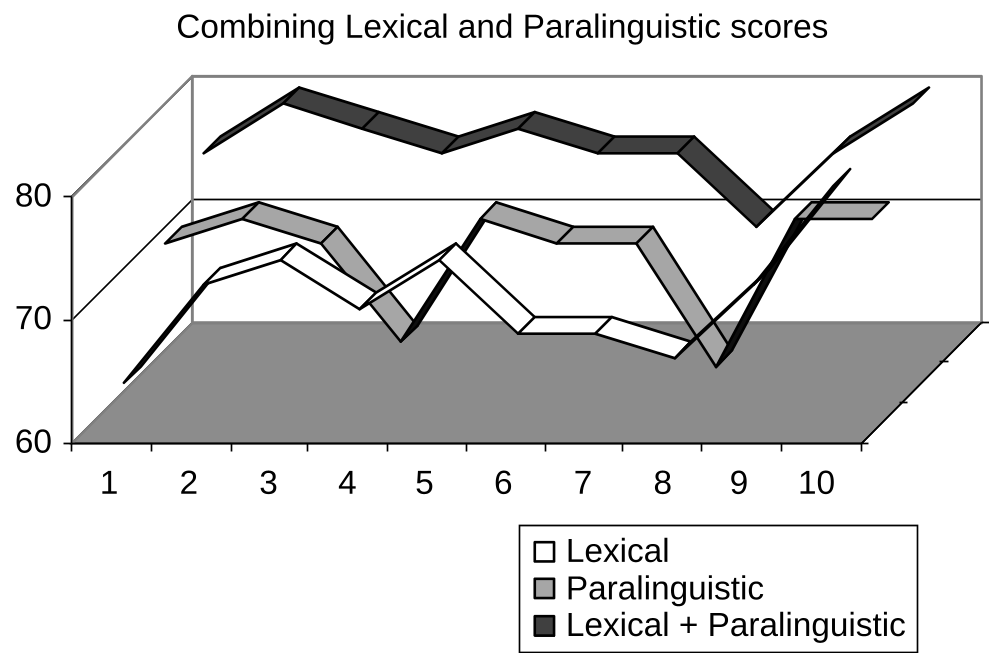 Figure 2: Performance gains from combining lexical and paralinguistic scores.
Critical Analysis & Takeaways
The paper’s greatest contribution is the empirical proof that blended emotions are the norm, not the exception, in natural speech. In the medical corpus, nearly 40% of non-neutral segments were identified as blended.
Limitations:
- The inter-annotator agreement (Kappa) for agents was remarkably low (0.35/0.37). This suggests that "controlled" professional speech is much harder to label than the "raw" emotion of the client.
- The study is French-specific; emotional markers like fillers ("euh") and prosodic contours may vary significantly across cultures.
Future Outlook: This work paved the way for modern "Soft Label" classification. Instead of forcing a model to choose 100% Anger, we should train models to output a distribution (e.g., 70% Anger, 30% Fear), mirroring the "Major/Minor" human perception established here.