
Beyond the Crawl: Why Skipping Nodes is the Key to Efficient Social Network Sampling
Challenging the limits: Sampling online social networks with cost constraints
This paper introduces a mathematical framework for graph sampling under explicit cost constraints, proposing "random skipping" as a mechanism to balance sample quality and quantity. By integrating skipping into standard random walk crawls (like MHRW and SRW), the authors achieve significant reductions in estimation error (e.g., MSE reduced by up to 98% in some scenarios) compared to traditional skip-free samplers.
TL;DR
In the world of Online Social Networks (OSNs), data isn't free—it costs API calls, time, and bandwidth. This paper challenges the "sample everything" status quo by proving that intentionally skipping nodes during a random walk can drastically improve the accuracy of network statistics. By deriving a new cost-based asymptotic variance, the authors find an optimal "skipping rate" that balances the quality of independent samples against the quantity of a large budget.
The Hidden Cost of "Unbiased" Sampling
Researchers typically use Random Walks (SRW) or Metropolis-Hastings (MHRW) to estimate properties like average user age or degree distribution. However, these methods have two major flaws in production environments:
- High Correlation: Social graphs are "slow-mixing," meaning neighbor nodes are very similar. Sampling every node in a path gives you a lot of redundant, highly correlated data.
- Resource Ignorance: In reality, downloading a user's full profile ("Sampling") is much more expensive than just looking at their friend list to move to the next person ("Transition").
Most existing literature ignores this cost, assuming every sample costs "1 unit." This paper argues that if you have a fixed budget of 1,000 seconds, you might be better off taking 100 high-quality, spread-out samples than 500 low-quality, clustered samples.
Methodology: The Logic of Random Skipping
The authors propose a "Random Skipping" policy. Instead of sampling every visited node , the crawler samples node with probability . If it skips, it still moves to a neighbor, incurring a small "transition cost" () but avoiding the high "sampling cost" ().
The Cost-Based Asymptotic Variance
The core innovation is the new metric :
- : The average cost to obtain one sample (higher when you skip more).
- : The standard asymptotic variance (lower when you skip more because samples become less correlated).
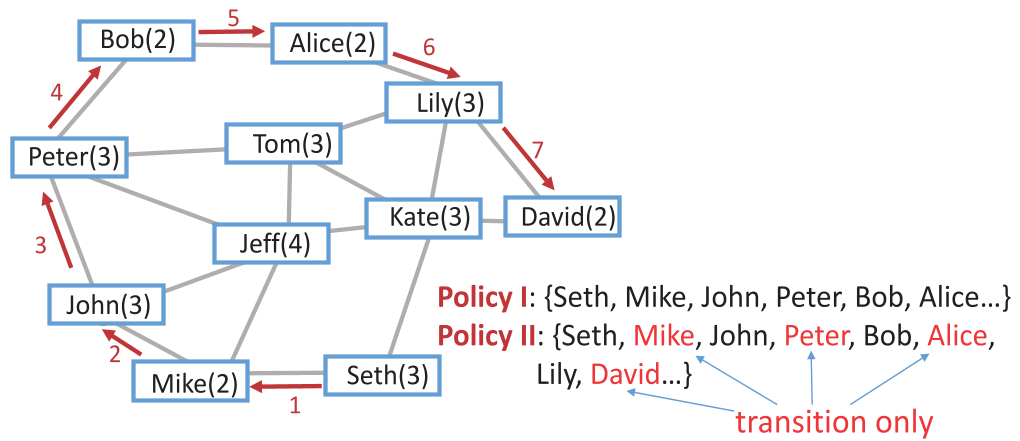 In the illustration above, Policy II collects fewer samples but covers a more diverse "neighborhood" of the graph within the same time budget.
The authors mathematically prove that is convex, meaning there is a single "sweet spot" for that minimizes error.
Experimental Proof: Youtube and Beyond
The team tested their framework on datasets like Youtube and Slashdot. The results were striking:
- Constant Cost: When the cost of sampling a user profile was 100x the cost of a simple transition, the optimal policy was to sample only 0.35% of the nodes visited. This reduced the estimation error by over 98%.
- Degree-Dependent Cost: When estimating the Clustering Coefficient (where cost is proportional to node degree), they used State-Dependent Sampling. By skipping high-degree (expensive) nodes more often and using a reweighting trick to keep it unbiased, they reduced MSE by over 99%.
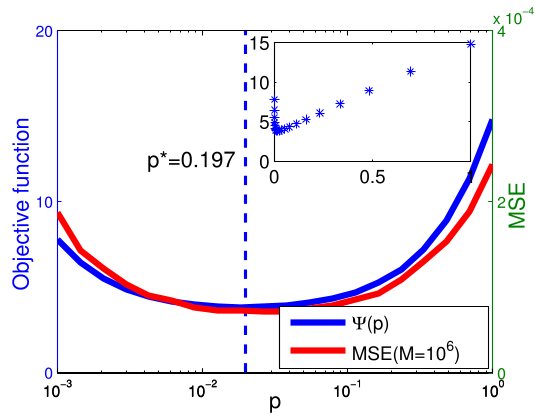 As shown here, the theoretical cost-based variance (Psi) perfectly tracks the actual Mean Squared Error (MSE), validating the framework.
Critical Analysis: Why This Matters
The genius of this work lies in its Inductive Bias. It acknowledges that while random walks are theoretically unbiased in the limit, we never operate in the limit—we operate under bank balances and server timeouts.
Limitations
- Prior Knowledge: To find the perfect , you need to know some graph properties (like the second eigenvalue ), which usually requires a "pilot" crawl.
- Dynamic Graphs: The math assumes a static graph, whereas social networks change by the second.
Conclusion
This paper provides a rigorous foundation for what many practitioners suspected: more data is not always better data. By treating "skipping" as a strategic tool rather than a waste of time, researchers can now navigate the intricate trade-off between sample quality and quantity, squeezing maximum insight out of every API request.