
Chameleon: Taming the Trace Explosion with Online Clustering
Chameleon: Online Clustering of MPI Program Traces
This paper introduces Chameleon, an online, signature-based clustering framework for MPI program traces. By integrating with ScalaTrace V2, it enables on-the-fly inter-node compression with a logarithmic time complexity of O(log P), achieving high-fidelity trace generation at extreme scales.
TL;DR
Chameleon is a scalable tracing framework that solves the "data explosion" problem in MPI applications. By using online signature-based clustering, it identifies redundant process behaviors and only records traces for a few representative "lead" processes. This results in a 1,000x reduction in overhead and significant space savings without sacrificing the structural accuracy of communication traces.
Background: The Scalability Wall
In the world of High-Performance Computing (HPC), understanding communication patterns is vital for performance tuning. However, tracing tools like Tau or Scalasca often generate enormous log files—sometimes exceeding 5TB for a single run. While tools like ScalaTrace use structural compression (RSDs/PRSDs) to handle loop-level redundancy, they still struggle with the inter-node compression step, which typically involves all processes at the end of execution, leading to massive bottlenecks as process counts () grow.
The Insight: "Follow the Leader"
The authors of Chameleon observed that most scientific codes follow the SPMD (Single Program Multiple Data) paradigm. Even at extreme scales, large groups of processes perform nearly identical tasks.
Chameleon capitalizes on this by:
- Phase Recognition: Building a transition graph to track program states.
- Online Clustering: Grouping processes based on their Call-Path signatures at interim execution points (Markers).
- Lead-Only Tracing: Once a repetitive pattern is identified, only "lead" processes keep their recorders on. Everyone else stops tracing, relying on the leader's data.
Methodology: The Transition Graph
The heart of Chameleon is its state machine, which governs how and when clustering occurs.
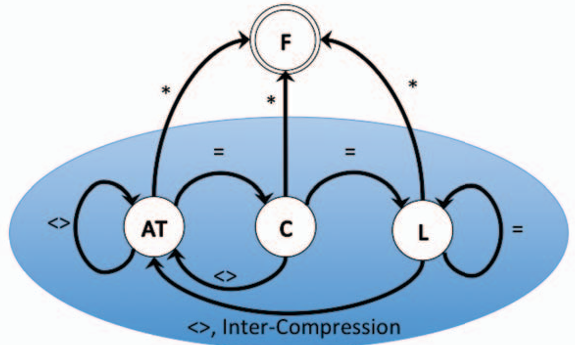
- All Tracing (AT): The initial state where every node is being monitored.
- Clustering (C): Triggered when nodes observe repetitive Call-Path signatures. Nodes are grouped, and leaders are elected.
- Lead (L): The "steady state." Non-lead processes turn off their tracing engines to save memory and I/O.
- Final (F): The wrap-up phase during
MPI_Finalize.
By using 64-bit stack signatures, Chameleon can uniquely identify MPI calls without the heavy overhead of comparing full trace strings. This signature-based approach allows the clustering logic to run in time.
Experimental Performance
The system was evaluated using the NAS Parallel Benchmarks (NPB), Sweep3D, and the Parallel Ocean Program (POP).
1. Overhead Reduction
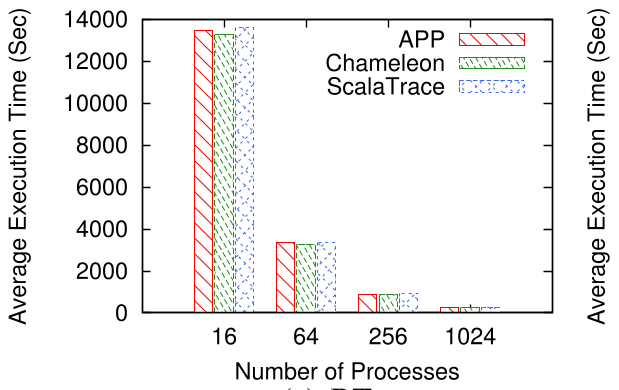
Compared to the baseline ScalaTrace, Chameleon demonstrates a dramatic reduction in execution overhead. In strong scaling scenarios, the cost of tracing with Chameleon remains nearly constant or grows logarithmically, while traditional methods often see overheads exceeding the actual application runtime.
2. Replay Accuracy
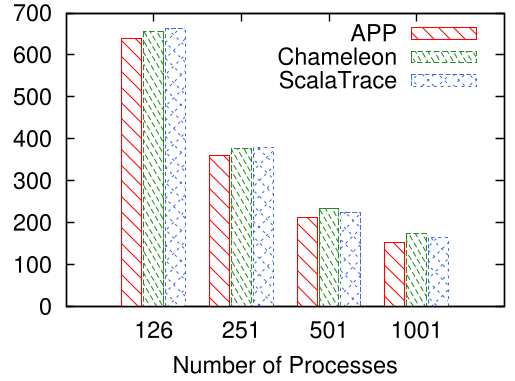
A critical question for any lossy compression or clustering technique is: Is the resulting trace still useful? By replaying the traces through the ScalaReplay engine, the authors proved that Chameleon’s lead-process traces represent the original application's execution time with 87.5% to 98% accuracy.
Space and Energy Efficiency
One of the most impressive results is the reduction in memory footprint. In a test with BT Class D on 1,024 processes, non-lead processes required 0 bytes of trace space during the "Lead" phase, compared to nearly 100KB per node in traditional tracing. This "tracing silence" effectively prepares the way for future optimizations like Dynamic Voltage and Frequency Scaling (DVFS), where idle tracing logic could translate directly into energy savings.
Critical Analysis & Conclusion
Chameleon represents a significant leap forward for HPC performance tools. By moving clustering from a post-mortem or finalize-only task to an online, incremental process, it enables tracing at scales where traditional tools would simply crash or stall the system.
Limitations
- Manual Instrumentation: Currently, developers must manually insert "Markers" (e.g., at the end of a timestep loop).
- Irregular Codes: While it handles some imbalance, highly non-deterministic or task-parallel workloads with massive divergence might still force the system back into the "All Tracing" state frequently.
Final Takeaway
Chameleon proves that in the era of exascale computing, we don't need more data; we need better data. By intelligently selecting leaders and recognizing phases, we can maintain high-visibility into application behavior with a fraction of the traditional cost.