
Champion-Level Vision: How Reinforcement Learning Conquered Gran Turismo 7 Using Pixels Only
A Champion-Level Vision-Based Reinforcement Learning Agent for Competitive Racing in Gran Turismo 7
The paper introduces a champion-level vision-based Reinforcement Learning (RL) agent for Gran Turismo 7 that achieves superhuman performance in competitive multi-opponent racing. Utilizing an asymmetric actor-critic framework and a recurrent neural network, the agent relies solely on ego-centric camera views and onboard sensors during inference, consistently outperforming built-in AI and human champions.
TL;DR
Researchers have developed a vision-based autonomous racing agent for Gran Turismo 7 (GT7) that outperforms world-class human champions and built-in AI. Unlike previous "superhuman" agents that required perfect knowledge of the track and opponent locations (global features), this agent operates like a human: it looks at the screen (ego-centric view) and feels the car (IMU data). By using an Asymmetric Actor-Critic architecture and a Recurrent Neural Network, it masters the art of overtaking and slipstreaming at 340 km/h.
The Problem: The "Oracle" Crutch
In the world of autonomous racing, Reinforcement Learning (RL) has already reached superhuman status. However, there has always been a catch. Famous agents like GT Sophy relied on "Global Features"—an "Oracle" view that provided exact coordinates of every opponent and every inch of the track boundary.
In the real world, you don't have an Oracle. You have cameras and sensors. Existing vision-based agents often failed because:
- Partial Observability: If an opponent is in your blind spot or behind a curve, they "disappear" from your current frame.
- Dimensionality: Processing 60fps video in real-time while making split-second steering decisions is computationally intensive.
- Overfitting: Agents often memorize the color of a specific wall rather than learning the physics of the racing line.
Methodology: The Asymmetric Advantage
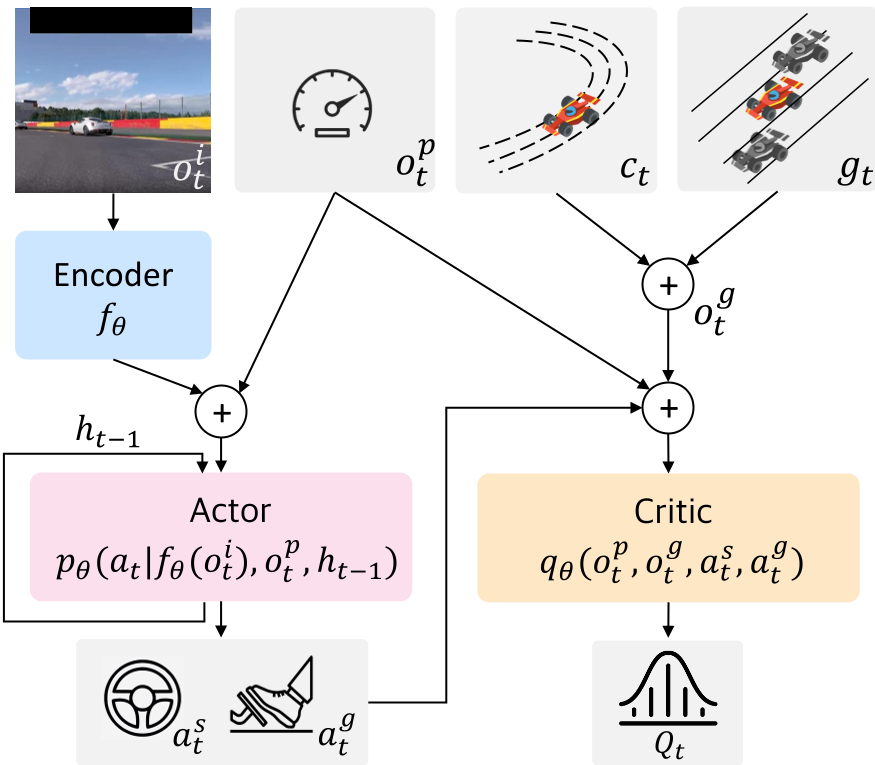
To bridge the gap between "seeing" and "knowing," the authors implemented an Asymmetric Actor-Critic framework.
1. Training with Privileged Information
The Critic (the "teacher" during training) is allowed to see everything—global track data, opponent velocities, and physics. This allows it to accurately judge whether an action was good. The Actor (the "driver"), however, is "blindfolded" to this global data. It only sees a downsampled 64x64 RGB image and basic proprioceptive data (speed, acceleration).
2. Giving the Agent a Memory
Since a single image cannot tell you if a car is accelerating or braking, the Actor uses a Gated Recurrent Unit (GRU). This recurrent module maintains a hidden state that carries information from previous frames, allowing the agent to "remember" where an opponent was even if they are momentarily occluded or off-screen.
3. Combatting Overfitting
To ensure the agent generalizes, the team used:
- Network Reinitialization: They "reset" the network during training once the memory buffer was full, forcing the model to relearn basic skills with a more diverse dataset.
- Random Shift Augmentation: Slightly shifting the camera view to prevent the agent from becoming over-reliant on specific pixel-perfect visual cues.
Experimental Battleground: Outracing Champions
The agent was tested on three diverse tracks—Tokyo (tight walls), Spa (technical turns), and Sarthe (high-speed straights).
Key Results:
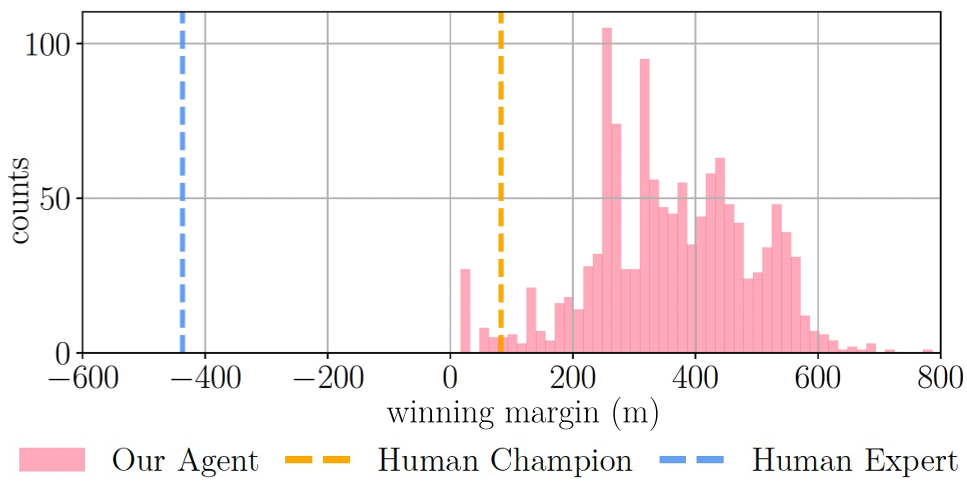
- Winning Margin: In almost every scenario, the vision-based agent secured a larger winning margin than 25-year veterans and even world-title champions.
- Gap Perception: Interestingly, the vision agent outperformed the state-based GT Sophy on the Tokyo track. Why? Because seeing the orientation of an opponent's car in a video feed is more intuitive than treating them as a mathematical point-mass.
| Scenario | Track Type | Performance vs. Human Champion |
|---|---|---|
| Tokyo | Urban, Tight | Superior (Better gap perception) |
| Spa | Technical | Matched (Perfect racing lines) |
| Sarthe | High Speed | Superior (Effective slipstreaming) |
Deep Insight: What is the Agent "Looking" At?
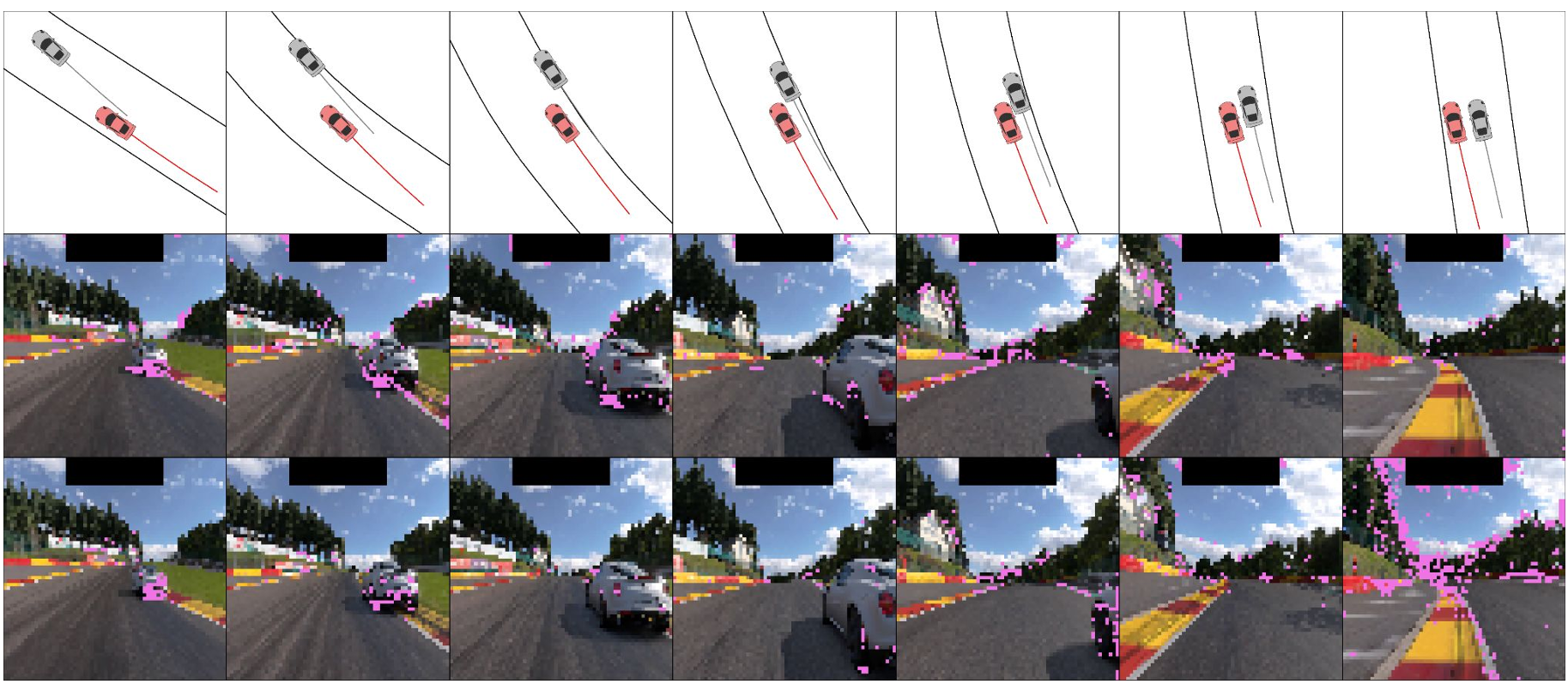
Using Integrated Gradients (IG), the researchers visualized the agent's attention. The results are strikingly human-like:
- In Traffic: It focuses on the tail-lights and shadows of opponents to judge distance.
- On Straights: It looks at the "vanishing point" and the skyline to orient itself for the next corner.
- In Curves: It tracks the curbs and track edges to optimize the apex.
Conclusion & Future Look
The significance of this work goes beyond gaming. It demonstrates that vision-based RL is now mature enough to handle high-speed, adversarial environments without needing expensive external tracking (like GPS or LIDAR maps).
Limitations: Currently, the agent is trained on specific car-track pairs with fixed weather. The next frontier is Generalization—an agent that can jump into any car, on any track, in the rain, and still take the checkered flag.
Takeaway for AI Researchers
The success of the asymmetric architecture confirms a vital RL intuition: Train with your eyes open (Global Features), but learn to act with only what you see (Local Sensors).