
Champion-Level Racing from Pixels: Breaking the Localization Barrier in GT7
A Champion-Level Vision-Based Reinforcement Learning Agent for Competitive Racing in Gran Turismo 7
The paper introduces a champion-level vision-based Reinforcement Learning (RL) agent for Gran Turismo 7 that achieves superhuman performance using only ego-centric camera views and onboard sensor data. By utilizing an asymmetric actor-critic framework and a recurrent neural network, the agent consistently outperforms built-in AI and matches or exceeds human world champions in competitive multi-opponent racing.
TL;DR
Researchers have developed a vision-based autonomous racing agent that can beat human world champions in Gran Turismo 7. Unlike previous SOTA agents that "cheat" by accessing perfect map data and opponent coordinates, this agent sees only what a human sees: the dashboard and the track through the windshield. Using an asymmetric actor-critic architecture and recurrent memory, it bridges the gap between simulated "perfect knowledge" and real-world "onboard perception."
Positioning
While the original GT Sophy (2022) was a milestone for RL, it relied on global telemetry (precise GPS-like data) that isn't available in real-world racing without massive infrastructure. This paper is a critical evolution, shifting the paradigm from "global-state racing" to "perception-based racing," proving that images alone are sufficient for champion-level competitive maneuvers.
Problem & Motivation: The "Global Feature" Crutch
In high-fidelity simulators, it is easy to give an RL agent the exact coordinate of every opponent and the precise distance to the next corner. However, in the real world:
- Sensors have latency: Processing LiDAR or external positioning takes time.
- Partial Observability: Opponents hide in blind spots or behind other cars.
- Infrastructure dependence: Real tracks don't have "global sensors" feeding data to your car's brain.
The authors' insight was to create an agent that learns with global knowledge but drives with local sight.
Methodology: The Asymmetric Power
The core of this breakthrough is the Asymmetric Recurrent Actor-Critic architecture.
1. Actor vs. Critic
- The Actor (The Driver): Input is limited to a 64x64 RGB image and basic IMU data (velocity, acceleration). It uses a Gated Recurrent Unit (GRU) to "remember" where opponents were a second ago, even if they are currently off-screen.
- The Critic (The Coach): During training, the Critic is "privileged." It sees everything—the entire track map and the exact position of all 19 opponents. This allows the Critic to provide highly accurate feedback to the Actor, steering its learning process toward optimal racing lines and overtaking strategies.
2. Architecture Diagram
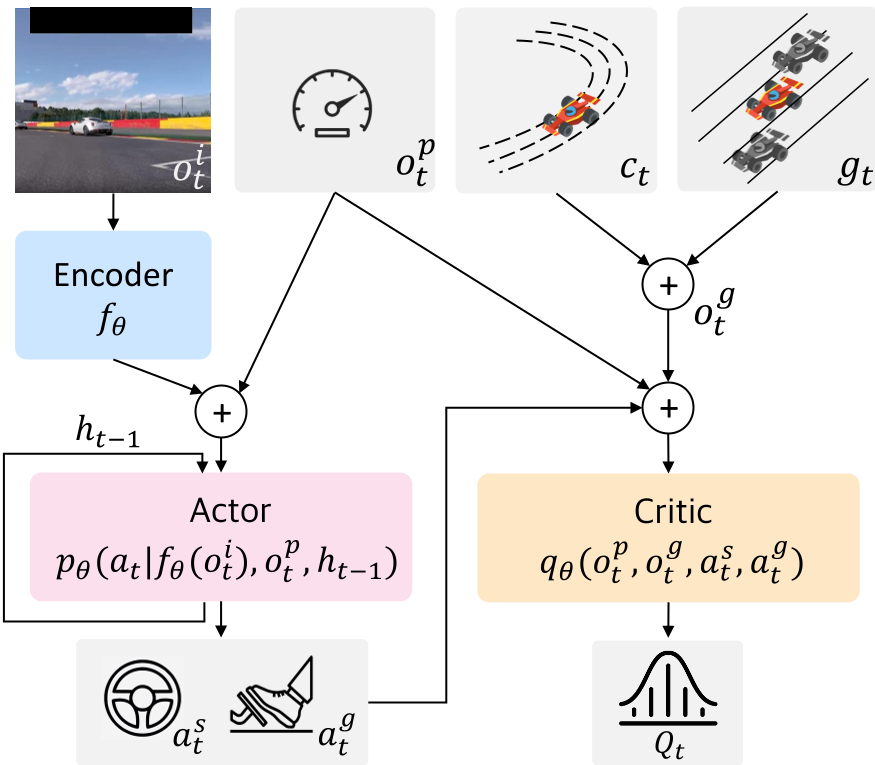 The Actor-Critic split: The Actor (left) focuses on pixels, while the Critic (right) leverages global state to stabilize training.
Experiments: Outracing the Champions
The agent was tested against 19 Built-in AI (BIAI) opponents on three iconic tracks: Tokyo Expressway, Spa, and Sarthe.
Key Breakthroughs:
- Tokyo Track: This track is notorious for tight walls and no run-off areas. The vision-based agent actually outperformed GT Sophy. Why? Because pixels provide "orientation" data (seeing a car's angle) which helps in tight-gap perception better than the point-mass coordinates used by Sophy.
- Human Comparison: The agent's winning margin was consistently higher than that of Human Experts and matched Human Champions.
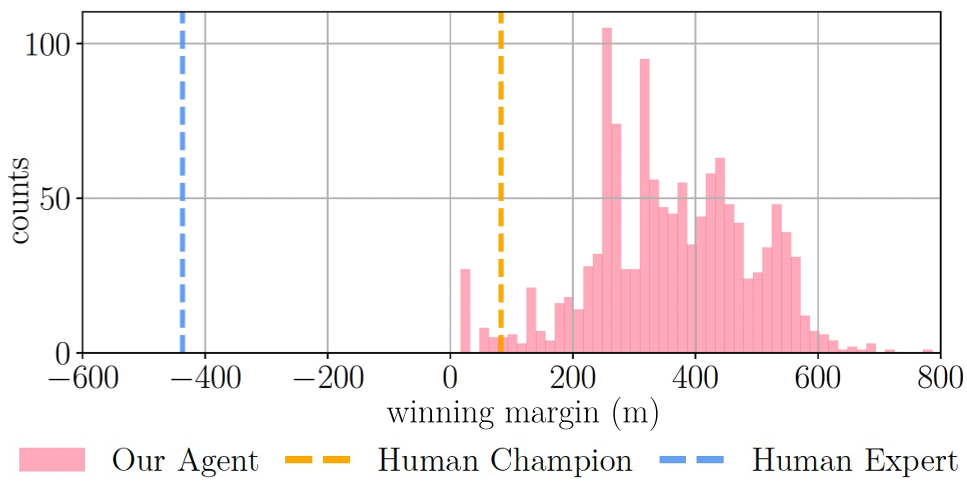 Top: The agent racing in a pack. Bottom: Winning margin histograms showing the agent (blue) far ahead of human experts (green).
What is the Agent Looking At?
Using Integrated Gradients, the authors visualized the agent's "attention."
- On Straights: It looks at the horizon, treelines, and skylines (just like pro drivers) to anticipate the track layout.
- In Traffic: It focuses on the shadows and lower rear sections of opponent cars to judge distance for overtakes.
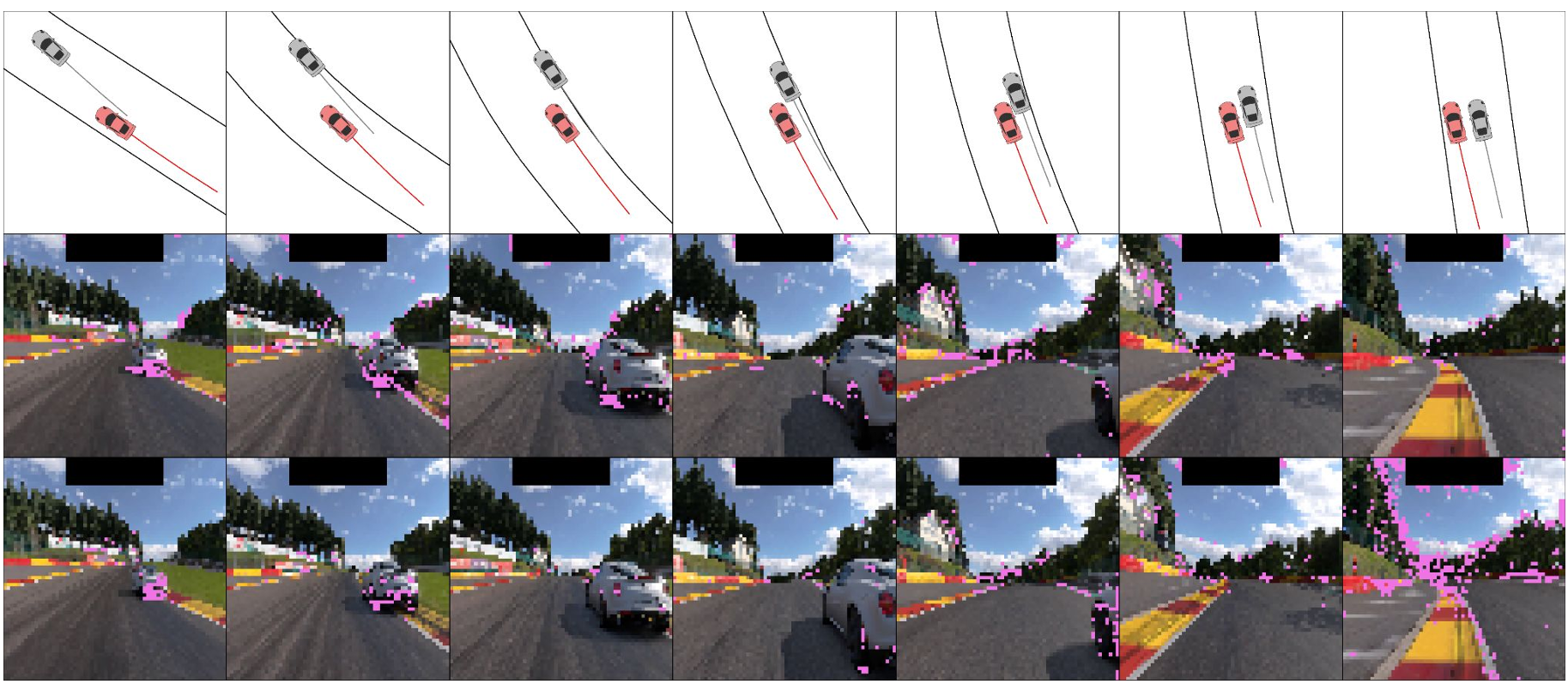 Visualizing attention: The agent ignores the dashboard and focuses on the vanishing point and opponent car edges.
Critical Analysis & Conclusion
Takeaway
This work demonstrates that vision-based RL is now competitive at the highest levels. By combining asymmetric training with recurrent memory, we can create agents that handle occlusion and high-speed decision-making without needing expensive external sensors.
Limitations
- Simplified Conditions: The agent was tested with fixed weather and specific car-track pairings. Real-world racing involves rain, changing light, and different vehicle dynamics.
- Collision Aggression: In some scenarios (like Sarthe), the agent had a slightly higher collision time than human champions, suggesting that while it is fast, its "sportsmanship" or fine-grained spatial awareness in dense packs still has room for improvement.
Future Work
The next frontier is Generalization. Can one single brain drive any car on any track under any weather? This paper provides the perceptual foundation to start answering that question.