
Champion-Level Vision-Based RL: Mastering Gran Turismo 7 Without Global GPS
A Champion-Level Vision-Based Reinforcement Learning Agent for Competitive Racing in Gran Turismo 7
This paper presents a vision-based Reinforcement Learning (RL) agent capable of champion-level competitive racing in Gran Turismo 7 (GT7). By leveraging an asymmetric actor-critic framework and Recurrent Neural Networks (RNN), the agent operates purely on ego-centric visual and onboard sensor data during inference, surpassing built-in AI and matching world-class human champions.
TL;DR
Researchers have developed a vision-based autonomous racing agent for Gran Turismo 7 (GT7) that rivals world-class human champions. Unlike previous iterations that required "God-perspective" global data, this agent relies solely on what a human driver sees—a camera feed and dashboard sensors—achieving 1st place in 20-car competitive grids.
Contextual Positioning: Beyond "God Mode"
In the world of autonomous racing, there has always been a trade-off between perception and performance. GT Sophy, the landmark agent from Sony AI, achieved superhuman status but relied on global features: the exact (x, y, z) coordinates of every car on the track. While effective in a simulator, this is the equivalent of "cheating" in the real world where GPS is noisy and opponent telemetry is unavailable.
This paper represents a pivotal shift: Vision-based navigation. The agent must now "understand" the track geometry and opponent intent through a downscaled 64x64 pixel image.
The Core Problem: The Shadow of Occlusion
The jump from time-trials (racing alone) to competitive racing (racing against others) introduces partial observability. When an opponent car blocks your view of a turn, or when you are slipstreaming at 340 km/h, the immediate visual input is insufficient. You need memory.
Methodology: The Asymmetric Breakthrough
The researchers solved this using two critical design choices:
1. Asymmetric Actor-Critic (AAC)
The architecture uses an "unfair" training phase to create a "fair" agent.
- The Critic (The Teacher): During training, the Critic has access to all global data (track coordinates, opponent velocities). It learns the true value of every action.
- The Actor (The Student): The Actor only sees the 64x64 image and IMU data (acceleration, velocity). By learning from the "all-knowing" Critic, the Actor learns to extract critical features from pixels that correlate with global success.
2. Recurrent Memory (GRU)
To solve occlusions, the Actor isn't just a CNN; it includes a Gated Recurrent Unit (GRU). This allows the agent to "remember" where an opponent was even if they are currently in a blind spot, or to internalize the track layout as it drives.
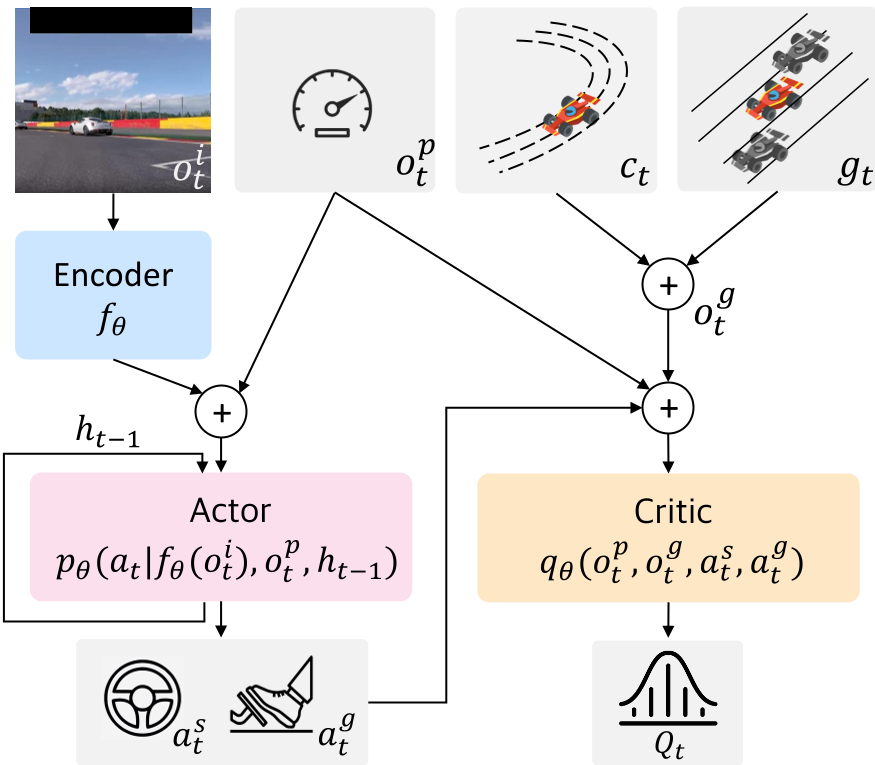 Figure: The Asymmetric Actor-Critic architecture, highlighting the integration of visual input and recurrent memory.
Experiments: Dominating the Grid
The agent was tested on three legendary tracks: Tokyo Expressway, Spa-Francorchamps, and Circuit de la Sarthe.
Key Findings:
- Superior Gap Perception: On the tight Tokyo track, the vision-based agent actually outperformed the global-feature-based GT Sophy. Why? Because pixels provide "orientation" data. While Sophy sees opponents as point masses, the vision agent sees the angle of the car, allowing for more aggressive and precise overtakes.
- Generalization: Through network reinitialization (preventing the agent from getting stuck in early-training bad habits) and data augmentation, the agent proved robust across different car types (Front-Wheel Drive, Rear-Wheel Drive, and 4WD).
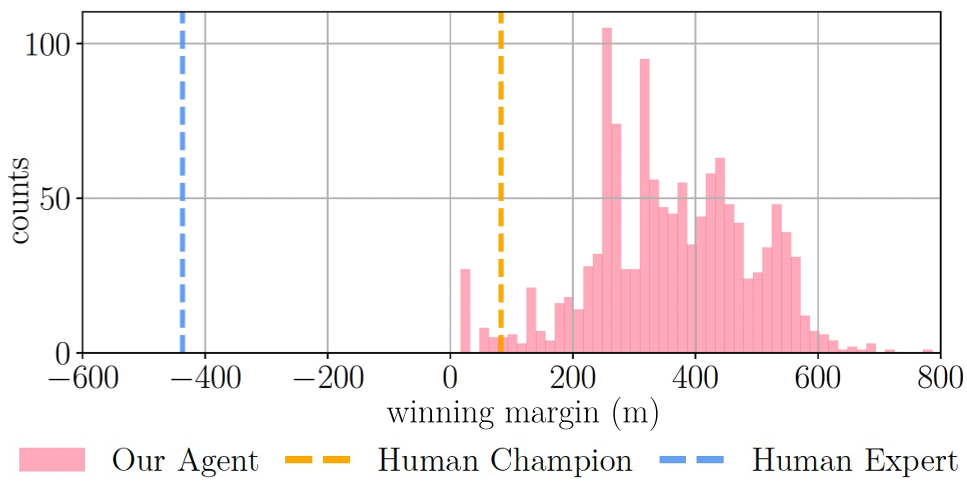 Figure: Performance comparison. The agent (blue) consistently finishes with a higher winning margin than Human Champions (green) across 500 episodes.
Visual Intelligence: What Does the Agent See?
Using Integrated Gradients, the authors visualized the agent's focus. The findings mirror professional human drivers:
- On Straights: The agent focuses on the vanishing point and the skyline (track localization).
- In Traffic: The focus shifts to the shadows and rear bumpers of opponents (proximity and speed differential).
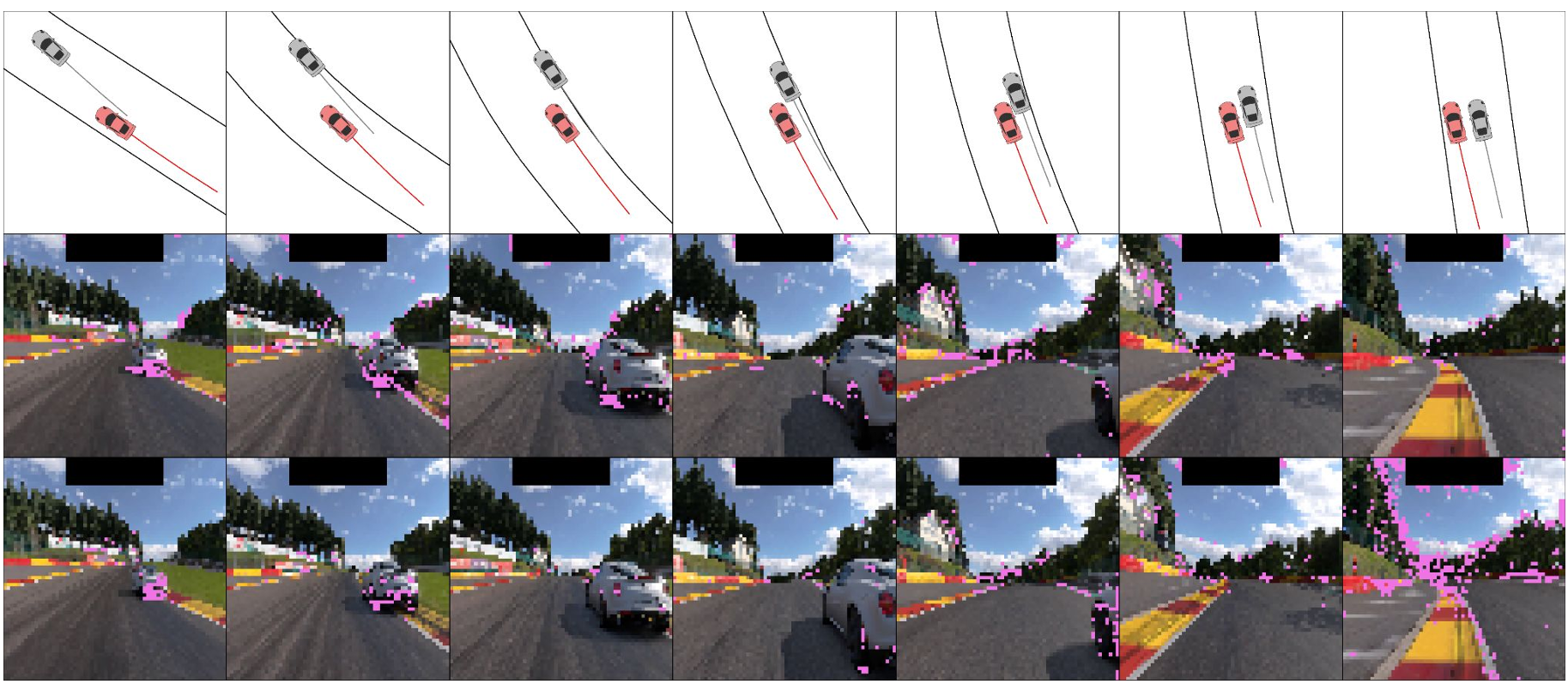 Figure: Saliency maps showing the agent's attention on opponents' lower regions to gauge distance.
Conclusion & Future Look
The significance of this work lies in its real-world potential. By stripping away the need for global instrumentation and proving that 10Hz control loops and low-res vision can beat human champions, the path to real-world autonomous racing—and perhaps safer consumer ADAS—becomes much clearer.
Limitations: The agent currently trains for specific car-track combos. The next frontier? A single vision-based weight set that can handle any car on any track in any weather—the "Foundation Model" for racing.