
Champion-level Vision: How RL Conquered Gran Turismo 7 with Pixels Alone
A Champion-Level Vision-Based Reinforcement Learning Agent for Competitive Racing in Gran Turismo 7
This paper introduces a champion-level vision-based reinforcement learning agent for competitive racing in Gran Turismo 7. By utilizing an asymmetric actor-critic framework and a recurrent neural network, the agent achieves superhuman performance using only ego-centric camera views and onboard sensor data.
TL;DR
Researchers have developed a vision-based Reinforcement Learning (RL) agent that achieves champion-level performance in Gran Turismo 7. Unlike its predecessors that relied on "cheating" with global telemetry, this agent wins races using only an ego-centric camera and basic onboard sensors. By employing an Asymmetric Actor-Critic architecture and a Recurrent Neural Network (RNN), it doesn't just drive fast—it maneuvers through a 20-car pack with the precision of a world-ranked human driver.
Problem & Motivation: The "Global Feature" Crutch
Recent breakthroughs in autonomous racing, like Sony’s GT Sophy, achieved superhuman speed by consuming global data: the exact XYZ coordinates of every opponent and every inch of the track geometry.
In the real world, this is a luxury. Cars don't have access to "God-view" telemetry. To make autonomous racing practical, agents must rely on local sensors—cameras and IMUs. However, vision-based RL is notoriously difficult because:
- Partial Observability: Opponents in blind spots or behind bends are "invisible" to a static frame.
- High Dimensionality: Processing raw pixels at high speeds adds latency and complexity.
- Adversarial Dynamics: Overtaking requires understanding not just where an opponent is, but their orientation and intent.
Methodology: The Asymmetric Advantage
The core of this breakthrough is the Asymmetric Actor-Critic framework based on Quantile Regression Soft Actor-Critic (QR-SAC).
1. Asymmetric Information Flow
The intelligence is split during training:
- The Critic (The Teacher): During training, the Critic sees everything—track limits, opponent grids, and global coordinates. This allows it to accurately evaluate the "value" of an action.
- The Actor (The Driver): The Actor is restricted. It only sees a downscaled 64x64 RGB image and IMU data (velocity, acceleration). This ensures that during inference (actual racing), the agent is self-reliant.
2. Temporal Memory via RNN
To solve the "blind spot" problem, the Actor uses a Gated Recurrent Unit (GRU). This allows the agent to maintain a "mental map" of where opponents were in previous frames, effectively estimating their velocity and direction even when they disappear from the camera view.
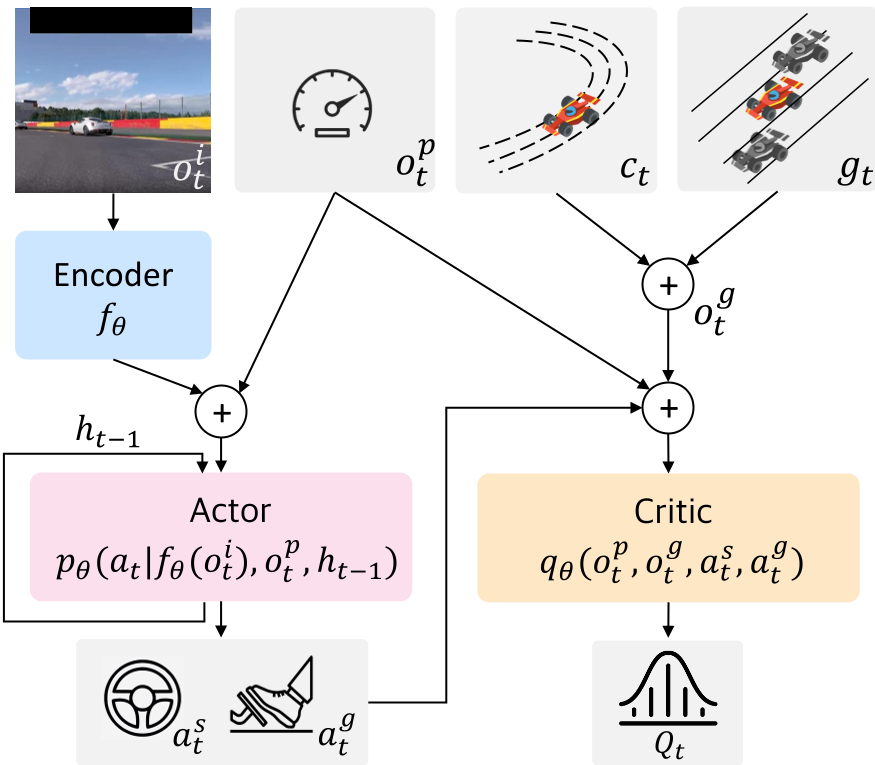 Figure 1: The Asymmetric Architecture. Note how Global Features are funneled only into the Critic.
3. Fighting the Primacy Bias
Deep RL agents often overfit to early, simple experiences. To combat this, the authors used Network Reinitialization. Once the replay buffer was full of diverse racing data (overtakes, crashes, drafting), they reset the network weights, forcing the agent to relearn with a more "mature" dataset.
Experiments: Outperforming the Best
The agent was tested on three diverse tracks: Tokyo Expressway, Spa-Francorchamps, and Circuit de la Sarthe.
The Challenge: Start in 20th place (last) and finish 1st against GT7's Built-in AI (BIAI).
Key Results:
- Tokyo: The agent significantly outperformed all baselines. Interestingly, it beat its telemetry-based predecessor (GT Sophy) because pixels allowed it to "see" the orientation of opponent cars more naturally than point-mass coordinates, enabling more daring overtakes in tight corridors.
- Spa & Sarthe: The agent matched or exceeded Human Champion performance, maintaining near-perfect racing lines even at speeds exceeding 340 km/h.
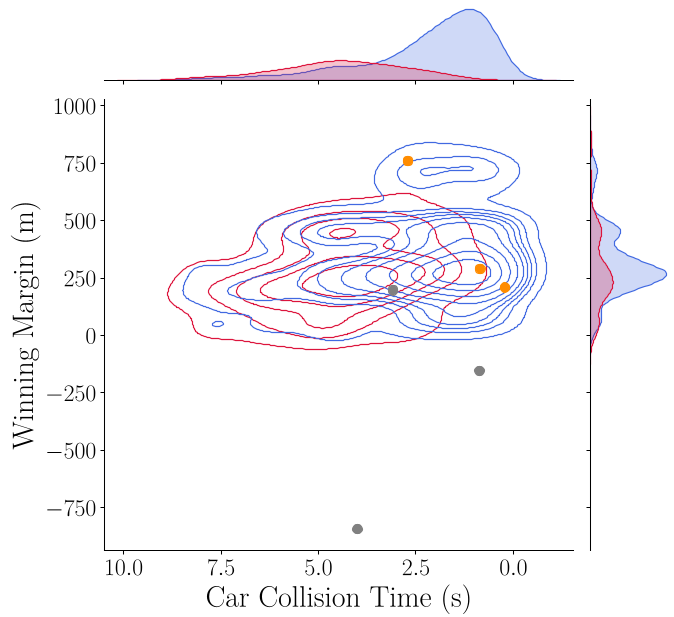 Figure 2: Performance comparison showing our agent (V-RL) consistently in the top-right corner (high winning margin, low collision time).
Deep Insight: What is the Agent "Seeing"?
Using Integrated Gradients (IG), the researchers visualized the agent's attention patterns.
- In Traffic: The agent focuses on the shadows and lower bumpers of cars ahead to judge distance—exactly like professional human drivers.
- On Straights: It looks at the treeline and vanishing points to anticipate upcoming turns.
- Memory Integration: Backpropagation-through-time reveals that the agent uses data from seconds ago to predict the future trajectory of nearby opponents.
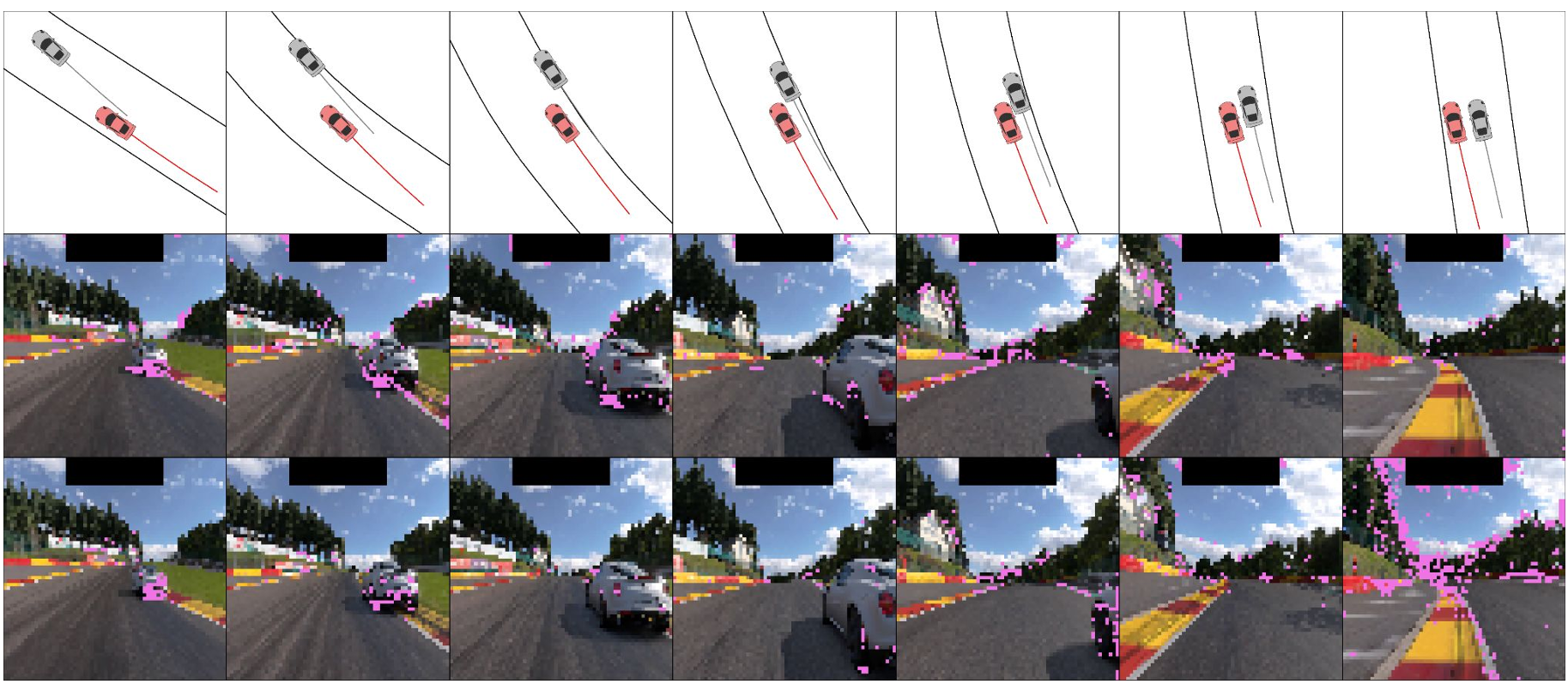 Figure 3: Saliency maps showing the agent's focus on car shadows (for depth) and distant horizons (for navigation).
Critical Analysis & Conclusion
While this is a milestone for vision-based RL, the study recognizes limitations:
- Controlled Conditions: Fixed weather and time-of-day were used. Real-world racing involves changing grip and visibility.
- Hardware Sync: The training required 20 PlayStations running in parallel, highlighting the massive computational cost of high-fidelity RL.
The Takeaway: This research effectively kills the argument that vision-based agents are inherently inferior to those using direct simulator telemetry. By combining asymmetric training with temporal memory, we now have a blueprint for autonomous systems that can "see" and "think" like champions.