
From Freelancers to Factories: The Rise of "Crowdfarms" in China's Gig Economy
The changing landscape of crowdsourcing in China:from individual crowdworkers to crowdfarms
The paper investigates a paradigm shift in the Chinese crowdsourcing ecosystem, moving from individual freelancers to "Crowdfarms"—specialized companies that execute crowdsourcing tasks en masse. The study identifies this trend through interviews with 48 experienced workers and 5 experts on major platforms like ZBJ.com.
TL;DR
The landscape of crowdsourcing in China has undergone a fundamental transformation. What used to be a domain for individual freelancers earning extra income has evolved into a "factory-based" model. This research identifies Crowdfarms—companies that exist solely to harvest and execute crowdsourced tasks en masse—as the new dominant force in the world's largest digital economy.
Problem: The Death of the Individual Crowdworker?
Early crowdsourcing research focused on the "open-call" to individuals (the Amazon Mechanical Turk model). However, in China, this model is breaking down. Individual workers are finding it nearly impossible to secure tasks because:
- Task Complexity: Tasks have shifted from simple clicks to complex "Macrotasks" (product design, coding) that require team collaboration.
- Algorithmic Disadvantage: Crowdfarms use organized labor to snatch up tasks as soon as they are posted.
- Economic Pressure: Crowdfarms are undercutting bids, creating a downward pressure on remuneration that makes it financially unviable for individuals to stay independent.
Methodology: Insights from the Ground
The authors utilized a qualitative approach, interviewing 48 experienced crowdworkers and 5 policy experts in mid-2019. By analyzing the operations of platforms like ZBJ (Zhubajie) and Epwk, they uncovered a symbiotic relationship between platforms, the government, and these new "Crowdfarms."
The "Crowdfarm" Architecture
The emergence of these entities isn't accidental; it is driven by a unique triple-threat of factors:
- Government Policy: The "Mass Entrepreneurship and Mass Innovation" initiative provides low taxation and subsidies for "Internet companies."
- Platform Incubation: Platforms like ZBJ act as landlords, renting "crowdsourcing factories" (office spaces) to these companies for as little as $130 USD per month.
- Workforce Professionalization: A well-educated workforce prefers the stability of a registered company (which offers pensions and health insurance) over the uncertainty of solo freelancing.
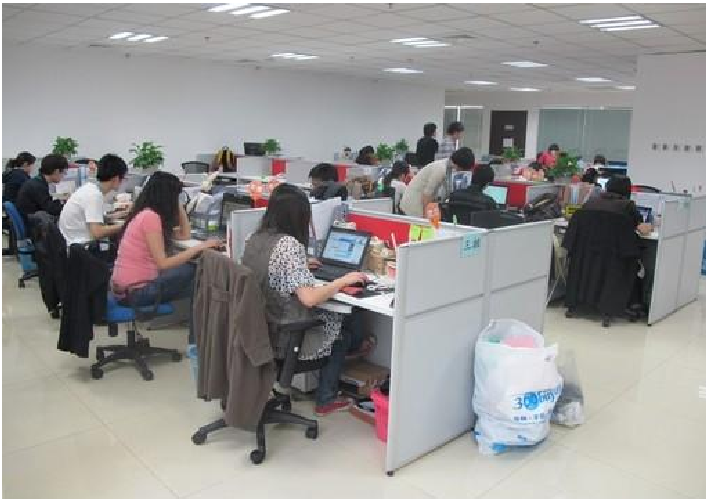 Figure 1: A large-scale Crowdfarm environment where crowdwork is industrialized.
The "Race to the Bottom": Experimental & Field Findings
The study highlights a paradoxical result: while the "industry" is growing (serving 190,000 enterprises), the actual workers feel the squeeze.
- Price Erosion: Crowdfarms often "re-post" tasks. They take a project from a requester and then outsource the difficult sub-modules to individuals at a fraction of the cost, acting as a "middleman" that captures the lion's share of the value.
- Social Safety Net vs. Autonomy: On the positive side, these "farms" employ people who might otherwise be jobless, providing a minimum wage and social benefits. However, workers are generally negative about this trend, viewing it as the loss of the original "freedom" promised by the gig economy.
 Figure 2: Even small-scale operations mimic traditional office structures rather than home-based gig work.
Critical Analysis & Conclusion
This paper identifies a critical "re-intermediation" of the labor market. While the internet was supposed to connect workers directly to tasks, the complexity of modern work has forced the "crowd" back into "factories."
Key Takeaways:
- For Researchers: We must stop looking at crowdsourcing as a bipartite relationship (Platform-Worker) and start looking at the Tripartite model (Platform-Company-Worker).
- For Policy Makers: While "Crowdfarms" help hit employment targets and provide social security, they may stifle the original innovation potential of a "distributed crowd" by centralizing control and suppressing wages.
The "Crowdfarm" model is a glimpse into the future of global gig work—where the individual is replaced by the institution, and the "crowd" is managed by a new class of digital foremen.