
Decoding MOOCs: How "Specificity" and Teaching Context Transform Resource Discovery
Towards a Characterization of Educational Material: An Analysis of Coursera Resources
This paper introduces a data-driven framework to characterize Massive Open Online Course (MOOC) resources by analyzing the DAJEE dataset from Coursera. It proposes "Specificity" as a novel metric alongside teaching context features to improve the classification and recommendation of educational materials for instructors.
TL;DR
Searching for the perfect educational video is a needle-in-a-haystack problem for teachers. This paper introduces Specificity—a novel metric that measures how "straight-to-the-point" a resource is—and identifies 7 distinct instructional profiles on Coursera. By combining internal content features with external teaching contexts, the authors provide a roadmap for the next generation of academic recommendation systems.
Background & Motivation: Beyond Titles and Timestamps
When a teacher searches for a video on a MOOC platform like Coursera, they are usually met with sparse data: just a title and a duration. Does the video provide a high-level overview or a deep dive? Is the instructor's style conversational or academic?
Current platforms treat educational resources as "black boxes." The authors argue that to make these resources truly reusable, we must decode their internal structure (what’s inside) and their pedagogical application (how they are used).
Methodology: The Math of "Specificity"
The core contribution of the study is the concept of Specificity.
1. Structural Characterization
The authors define Specificity as the ratio of keyword frequency to the total word count in a transcript.

- High Specificity (Close to 1): The resource is dense with core concepts and "straight-to-the-point."
- Low Specificity (Close to 0): The resource is conversational, likely containing anecdotes or general introductions.
2. Contextual Characterization
The research doesn't stop at the content. It looks at the "Teaching Context"—the environment in which the resource exists. They analyzed 484 instructors using features like:
- Semantic Density: The ratio of concepts to lesson duration.
- Instructional Style: How many resources an instructor typically uses to explain a single concept.
Experimental Results: Better Clustering, Better Insights
The authors validated their approach using the DAJEE dataset, a structured snapshot of Coursera resources.
Finding the Natural Groups
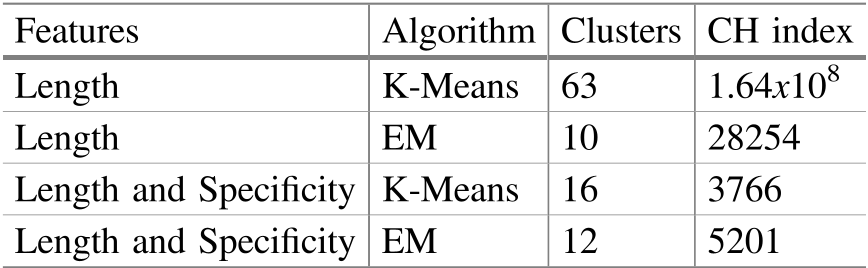
When clustering resources using only "Length," the algorithm struggled to find a tight fit (suggesting 63 clusters). However, when adding Specificity, the model settled on 16 highly distinct clusters, proving that specificity captures a fundamental educational trait that duration alone misses.
Profiling the Teachers
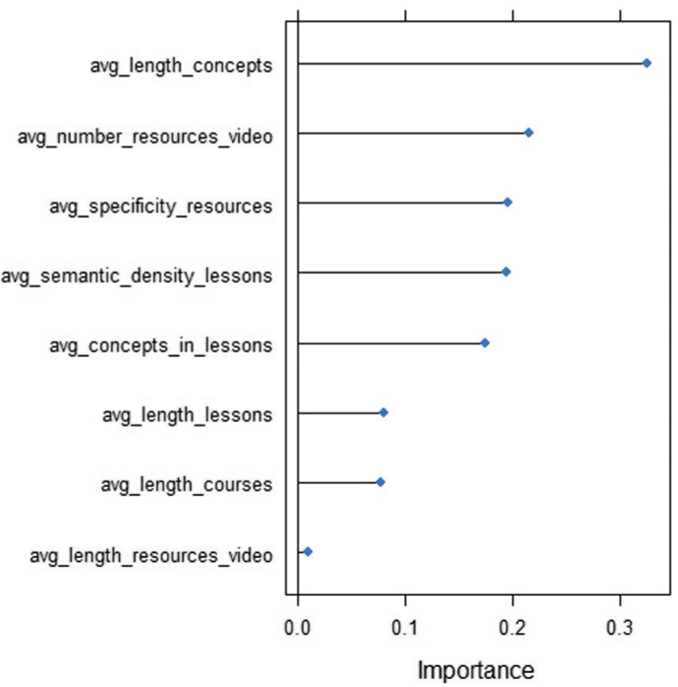
By applying Feature Selection (Recursive Feature Elimination), the authors narrowed down 8 instructional variables to the 5 most important predictors. This allowed them to identify 7 unique "Teaching Contexts."
Critical Insight: The Two-Layer Model
The most valuable takeaway from this work is the Dual-Layer Characterization model.
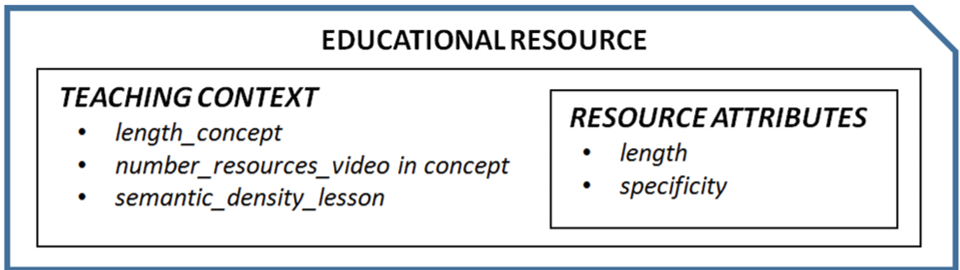
A resource is no longer just a file; it is defined by:
- Internal Layer (Attributes): Length and Specificity (the "What").
- External Layer (Context): Semantic density and instructor profile (the "How").
Conclusion and Future Outlook
This research moves us closer to "Context-Aware" Education. By automatically extracting these features using text mining, MOOC platforms can finally offer recommendations that match a teacher's specific instructional style.
Limitations: The study relies on transcripts, which may not capture visual aids or non-verbal teaching methods. Future work should look at multi-modal features (e.g., visual density in video frames) to further refine the characterization of MOOC resources.