
Beyond Topology: Unveiling Social Network Hidden Structures via Weighted Diffusion Wavelets
Characterization and graph embedding of weighted social networks through Diffusion Wavelets
This paper introduces an enhanced graph embedding framework based on Graphwave, integrating edge weights into diffusion wavelets to characterize complex social networks. By leveraging spectral graph theory and Principal Component Analysis (PCA), the authors achieve more accurate structural similarity mapping in weighted topological spaces.
TL;DR
This research advances the Graphwave embedding framework by incorporating edge weights into the diffusion wavelet process. By treating weights as a core component of energy propagation across a network, the authors successfully map complex relationships—such as airline hubs and key corporate influencers—with much higher precision than purely topological methods.
Context: Why Topology Isn't Enough
In the realm of graph embedding, most algorithms (like Node2Vec or DeepWalk) are obsessed with where a node is located. However, in real-world social networks, how much interaction occurs is often more important than the simple existence of a link. A person who sends 1,000 emails to a colleague has a different structural role than someone who sends one.
Existing structural identity methods often suffer from priori misjudgment: they treat all connections as equal. This paper argues that to truly understand a "hub" or a "key person," we must view the network through the lens of Weighted Diffusion.
Methodology: The Physics of Information Spread
The authors utilize the Graphwave algorithm as their foundation. The intuition is beautiful: imagine placing a "heat source" (unit energy) on a node and watching how that heat diffuses through the network over time using the Heat Kernel ().
1. Weighted Laplacian Transformation
The core innovation starts with the weighted adjacency matrix , where . This is transformed into a Laplacian Matrix , which essentially describes the "slope" or "gradient" of the network.
2. Spectral Wavelet Coefficients
By applying a Dirac Delta Signal to a node, the algorithm calculates a wavelet coefficient : In this paper, the authors ensure the weights influence this "signal" propagation, making the structural signature sensitive to the intensity of connections.
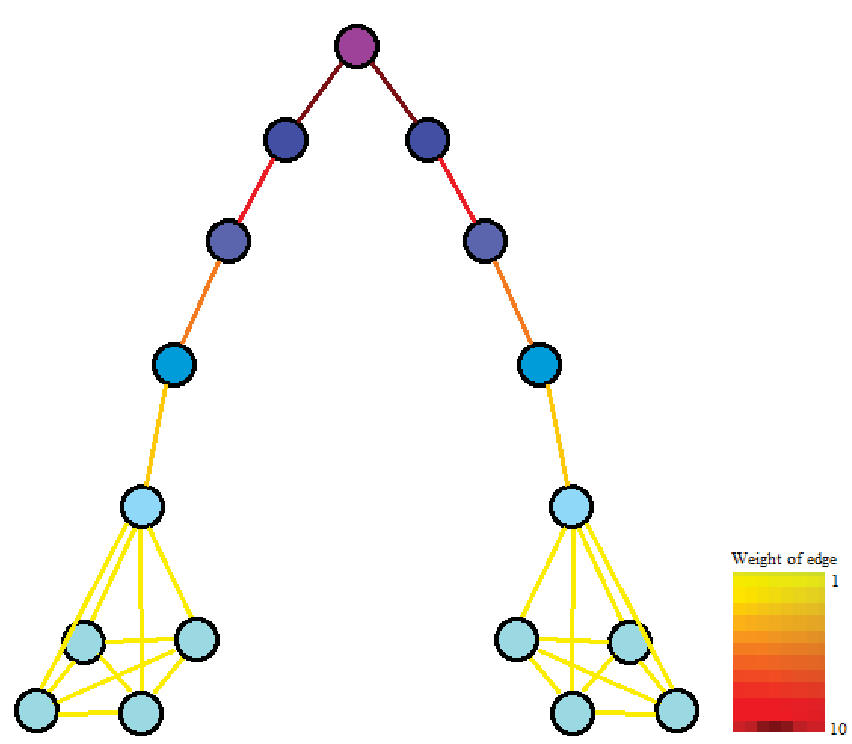 In a Barbell graph, weighted symmetry is maintained, proving that the embedding captures both the structural "role" and the weight intensity.
3. PCA via SVD
To make these complex wavelet coefficients interpretable, the authors apply Principal Component Analysis (PCA) using Singular Value Decomposition (SVD). This reduces the multi-dimensional probability distributions into a 2D or 3D space where nodes with similar roles (e.g., "influencers" or "isolated nodes") cluster together naturally.
Experimental Results: Hubs and Suspects
The method was tested across diverse datasets, from synthetic Barbell graphs to the infamous Enron email network.
- Aviation Networks: Specifically analyzing China's domestic flight data, the weighted algorithm correctly identified top hub airports with 90% accuracy. The weighted version clearly separated hub cities from local airports, whereas the unweighted version struggled with overlap.
- The Enron Case: By embedding 148 staffers involved in the Enron investigation, the algorithm isolated "high-weighted" nodes (Phillip Allen, John Lavorato) who acted as critical liaisons in the communication network.
 Table: Comparison of Weighted vs. Unweighted performance on the Flight Network. Note the massive leap in the Silhouette Score (0.24 to 0.52), indicating far more distinct and meaningful clusters.
Critical Insight & Future Outlook
The most striking takeaway is the Clustering Clarity. By adding weights, the Silhouette Score—a measure of how similar an object is to its own cluster compared to other clusters—doubled. This proves that weight isn't just "extra data"; it is the defining feature of structural identity in social systems.
Limitations & Next Steps
- Temporal Layering: The authors noted that in the "International Football Network," data spanning 100 years becomes "muddied." A star country in 1920 might not be a star in 2018.
- Future Work: The team aims to investigate temporal embeddings, where the network is sliced into time layers to see how structural roles evolve over decades.
Conclusion
This work provides a rigorous mathematical bridge between "role-based" graph embedding and "weight-based" data analysis. For practitioners in social media analysis, fraud detection, or logistics, this weighted Graphwave approach offers a sophisticated tool to find the "structural prominence" that simple connectivity charts miss.