
Deciphering the Migrant Journey: How Cell Phone Traces Reveal the Reality of Internal Migration
Characterization of internal migrant behavior in the immediate post-migration period using cell phone traces
This paper introduces a quantitative framework to characterize internal migrant behavior in the immediate post-migration period using Call Detail Records (CDRs) from 48 million Mexican cell phone subscribers. By analyzing spatial dynamics and social ties, it identifies significant behavioral shifts and achieves high correlation with census-based migration flows.
TL;DR
Researchers leverage big data from 48 million cell phone users in Mexico to map the "unseen" phase of migration—the immediate period after moving. The study reveals that migrants remain "tethered" to their origins, traveling further for work and struggling to build new local social circles compared to long-term residents.
Problem & Motivation: The Data Gap in Migration
Human migration is a defining challenge of the 21st century, yet our understanding often stops at the moment someone crosses a border or moves between cities. Macro-level studies (census) tell us "who" and "where," but lose the individual. Micro-level studies (interviews) capture the "why" but are too small to represent a nation.
The authors recognize that Internal Migration—moving within the same country—is a complex psychological and social process. They use Call Detail Records (CDRs) as a "passive sensor" to observe how migrants explore their new physical environments and rebuild their social fabric in real-time.
Methodology: From Pings to People
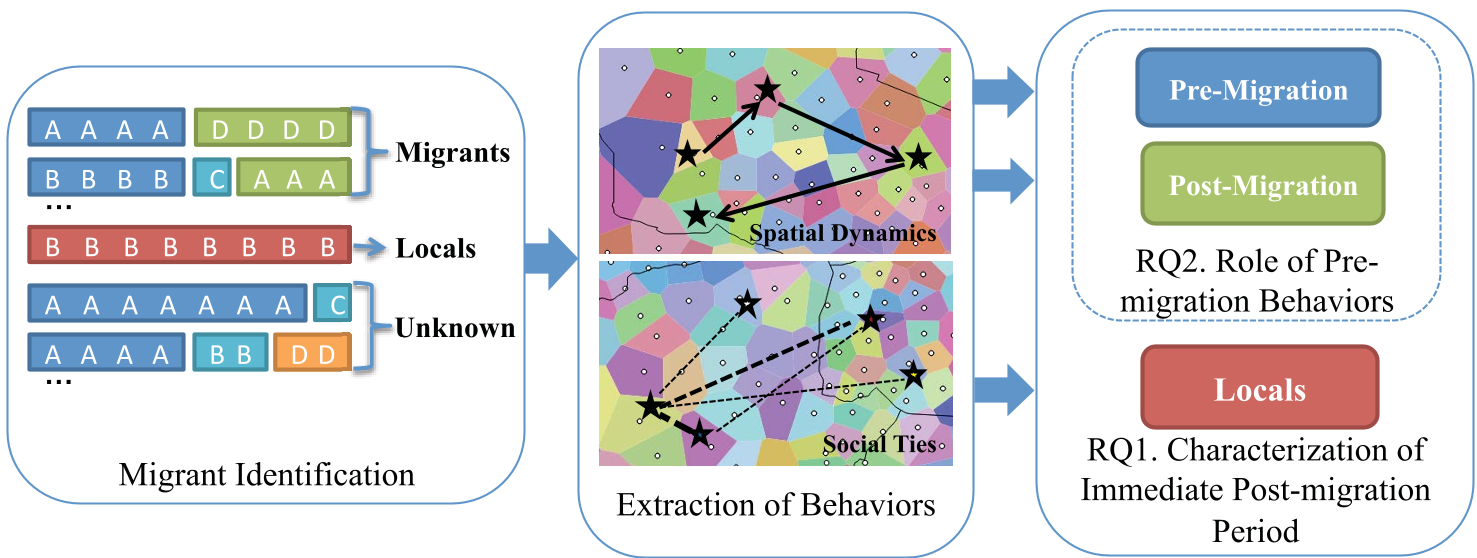
The framework consists of a robust pipeline to turn raw pings into sociological insights:
- Migrant Identification: By tracking the most used cellular tower between 6 PM and 6 AM, the authors identified "home locations." A migrant is defined as someone whose home remains stable for 3 months, shifts to a new municipality, and stays there for at least another 3 months.
- Behavioral Features:
- Spatial Dynamics: Radius of Gyration (ROG), daily mobility, and entropy of visits.
- Social Ties: Network size, call frequency, and the ratio of "local" (new city) vs. "remote" (old home) contacts.
- Validation: They compared their findings against Mexico's ENADID 2010 survey and gravity/radiation models to ensure the data accurately reflected national trends.
Core Insights: The "Tethering" Effect
The results from the comparison between migrants and "locals" (long-term residents) reveal a distinct behavioral signature for the newly arrived:
1. The Burden of Distance
Migrants travel significantly longer distances daily than locals (average of 3.78km vs 3.12km). This suggests a higher spatial dispersion of jobs available to migrants, who may have to commute further or take multiple informal jobs to survive. Their movement is also more "entropic" or irregular, reflecting the search for new routines.
2. Social Isolation and "Old Ties"
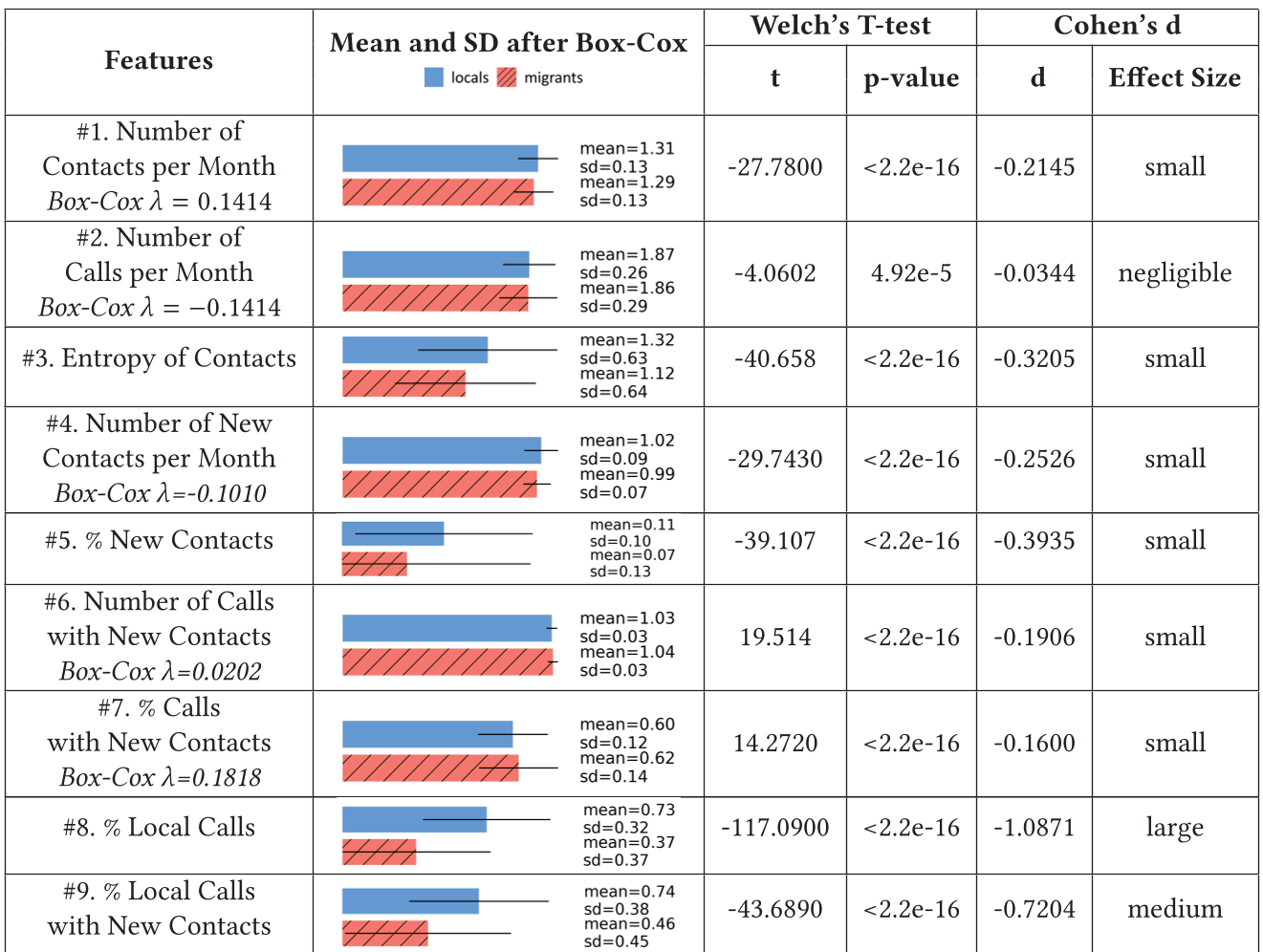
Perhaps the most striking finding is in the social sphere. Locals make 73% of their calls to other people within the same municipality. For migrants, that number drops to 37%.
- Migrants communicate with fewer people but call them more frequently.
- They struggle to expand their network; the ratio of new contacts is significantly lower for migrants than for locals.
The Power of Pre-Migration Preparation
The study used multivariate regression to see if pre-migration behavior could predict post-migration success. They found that:
- Pre-existing connections are key: Migrants who had even a single social contact in their destination before moving had shorter commutes and better social integration post-arrival.
- The "Social Anchor": Having information about the new environment through social ties bridges the "challenges of adaptation," effectively making the migrant's mobility patterns look more like a local's.
Critical Analysis & Conclusion
Takeaway
This research provides a quantifiable "adaptation curve" for migrants. It underscores a vital policy implication: Social support matters as much as economic opportunity. If a migrant arrives "cold" without a social anchor, they are likely to remain spatially and socially marginalized for months.
Limitations
The study is constrained by its 8-month window, making it difficult to distinguish between permanent and circular (seasonal) migrants. Furthermore, the dataset (from 2009-2010) predates the ubiquitous era of smartphones and internet-based messaging (WhatsApp/Signal), which might change how social ties are maintained today.
Future Outlook
By integrating this quantitative CDR framework with qualitative interviews, governments could identify "high-risk" migrant groups—those with zero local ties—and provide targeted settlement assistance to ease their integration into the urban fabric.