
Decoding Anxiety: How Our Digital Social DNA Reveals Mental Health Struggles
Characterizing Anxiety Disorders with Online Social and Interactional Networks
This study presents a computational framework to characterize Anxiety Disorders using Twitter's social and interactional networks. By analyzing 200 expert-validated users and 200,000+ posts, the authors build a supervised SVM classifier that achieves 79% accuracy and 0.84 ROC-AUC in identifying anxiety status compared to a matched control group.
TL;DR
Researchers from the Georgia Institute of Technology have pioneered a method to identify anxiety disorders by looking beyond what we say to how we are connected. By analyzing Twitter network structures and interaction patterns, they developed an AI model capable of detecting anxiety with nearly 80% accuracy, uncovering that those with anxiety often inhabit fragmented social "islands" and prefer the anonymity of weak ties.
Background Positioning: This work moves the field from simple linguistic analysis (text mining) to Structural Mental Health Analytics, situating itself as a foundational study in using network science to map the digital manifestations of psychological distress.
Problem & Motivation: The "Recall Bias" in Mental Health
Traditionally, psychologists understood that anxiety is linked to social isolation. However, mapping this was difficult because patients often struggle to accurately remember their social interactions during clinical interviews (Retrospective Recall Bias).
The authors' insight was simple yet profound: Twitter is a living lab. Every "follow," "reply," and "retweet" is a permanent, objective record of a social tie. By studying these digital footprints, we can see the "skeletal structure" of an individual's social world without relying on their memory.
Methodology: The Anatomy of a Digital Ego
The study analyzed four distinct categories of features to build a comprehensive "digital phenotype" of anxiety:
- Social Engagement: Volume of tweets, retweets, and distribution of replies.
- Egocentric Social Graph: The structural properties of a user's direct network (e.g., How many mutual friends do they have? How central are they?).
- Interaction Graph (Signed): Analyzing the sentiment of interactions to designate ties as "positive" or "negative."
- Social Behaviors: Linguistic styles using LIWC (e.g., use of pronouns, health-related words).
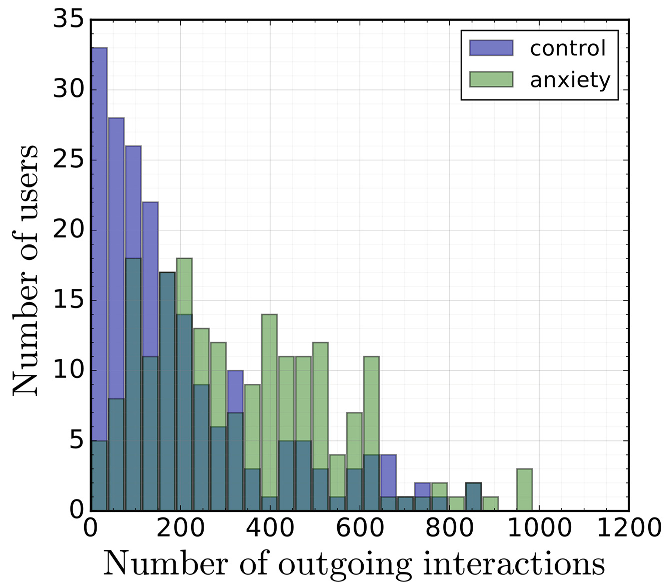 Fig 1: Comparative distributions of social interactions between anxiety and control groups.
The "Signed Network" Concept
A key innovation was moving beyond "A follows B." The authors used sentiment analysis to determine if an interaction was supportive or antagonistic. They found that a "balanced triad" (a stable social group) could still be toxic if the ties were consistently negative—a crucial nuance for mental health modeling.
Experiments & Results: The "Weak Tie" Paradox
The SVM classifier achieved its highest performance (79% accuracy) when combining all features, outperforming models that only looked at language or only looked at network structure.
Key Findings:
- The Island Effect: Anxiety users have a higher number of "ego components"—meaning their friends don't know each other. They interact with diverse but disconnected sub-networks.
- Low Embeddedness: They have significantly fewer mutual friends with their neighbors, indicating a lack of a cohesive "inner circle."
- Preference for Weak Ties: Anxiety users showed a 19% higher rate of replying to "non-friends" (celebrities or strangers). The authors hypothesize that interacting with people who don't know you reduces the pressure of "impression management."
- Linguistic Signaling: A massive 95% increase in the use of "I" and "me" (first-person singular pronouns), validating the psychological theory of "self-attentional focus" in distress.
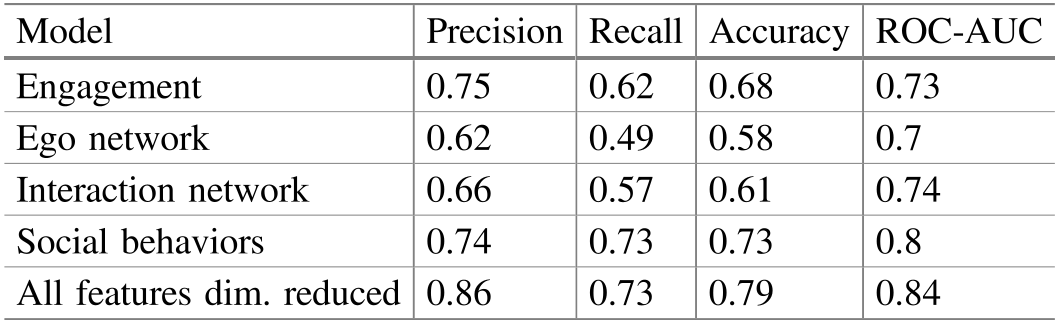 Table 1: SVM outperforms other classifiers, with Social Behaviors and Interaction Networks being the strongest predictors.
Critical Analysis & Conclusion
Takeaway
This research proves that our Social Architecture is a mirror of our mental state. For product designers, this suggests that platforms could improve mental health by recommending "positive" bridges between disconnected sub-communities or facilitating low-stakes "weak tie" interactions during high-stress periods.
Limitations
- Selection Bias: The study relies on users who self-disclose their diagnosis, which may not represent the "silent majority" of anxiety sufferers.
- Validation: There is no direct clinical validation (e.g., a doctor's note) beyond the experts verifying the self-disclosure tweets.
Future Outlook
This work lays the groundwork for Proactive Digital Intervention. Imagine a Twitter that doesn't just show you "Who to Follow" based on interests, but suggests "Supportive Connections" based on your current network fragmentation and emotional tone. We are moving toward a future where social media acts as a passive diagnostic tool for public health.