
Debunking the 90-9-1 Rule: A New Hierarchy of Twitter Engagement
Characterizing the Behavioral Evolution of Twitter Users and The Truth Behind the 90-9-1 Rule
This paper presents a data-driven characterization of Twitter user behavior by analyzing 36 million actions from 122,894 users. It classifies users into four activity levels—High, Medium, Low, and No-Activity—and identifies five distinct functional roles: Tweeters, Quoters, Retweeters, Replyers, and Likers.
TL;DR
For over a decade, the "90-9-1 rule" has been the golden ratio for understanding social media participation: 90% lurk, 9% contribute occasionally, and 1% create everything. This research by Antelmi et al. uses a massive dataset of 36 million Twitter actions to prove this rule is outdated. By redefining "activity" to include hidden actions like profile changes and "likes," the study reveals a more engaged user base, proposing a new 5-20-75 (AMS) distribution.
Background: The Ghost in the Machine
In 2006, Jakob Nielsen proposed a hierarchy of participation inequality. In this pyramid, the vast majority were "lurkers"—silent observers who consumed but never produced. In the context of modern platforms like Twitter, identifying these ghosts is technically challenging. If a user never tweets, are they a "lurker" or have they simply abandoned the account (a "churner")? This paper bridges the gap by tracking "hidden" activities that signal a user is still present even if they are not talking.
Methodology: Beyond the Surface
The authors moved beyond simple tweet counts. They used a sophisticated multi-stage sampling method to avoid the "active user bias" (where datasets only include people who post).
The Two Pillars of Analysis
- Quantity-Based Features: Total activities, weekly frequency, and the average time between actions.
- Typology-Based Features: Breaking down actions into Specific Roles: Tweets, Quotes, Retweets, Replies, and Favorites.
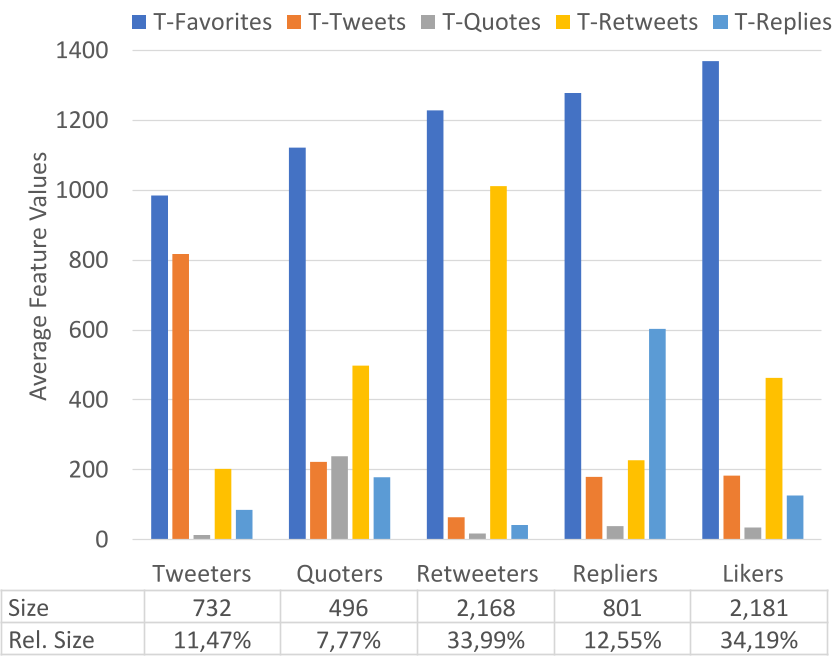 Table 1: The four identified clusters based on activity levels (H-A, M-A, L-A, and No-A).
Identifying Social Roles
One of the most insightful parts of the study is the discovery that users, regardless of how often they post, fall into five "Archetypes":
- Likers: The silent majority who interact primarily through the "heart" button.
- Retweeters: Content amplifiers who share rather than create.
- Repliers: The conversationalists who focus on mentioning others.
- Tweeters: The original content creators.
- Quoters: The most sophisticated users who add commentary to shared content.
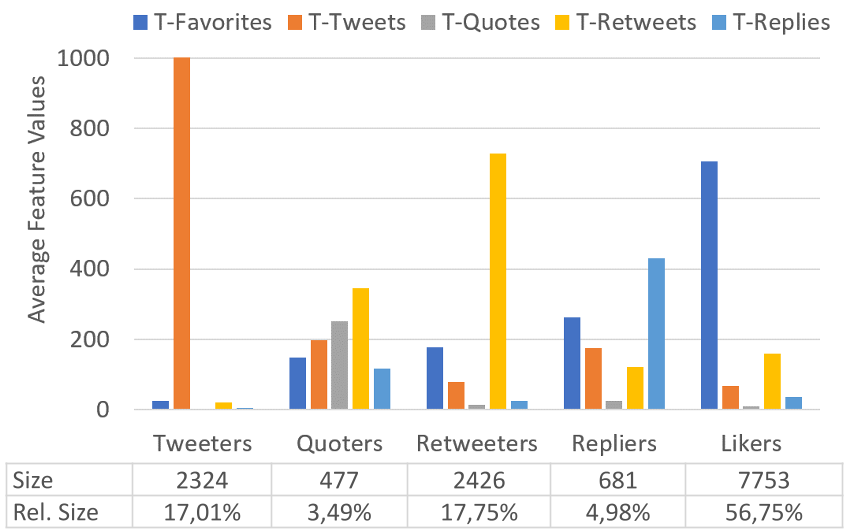 Figure 2: Distribution of roles within the Medium-Activity group, showing the dominance of "Likers".
The "AMS Rule": A New Reality
The core contribution of this work is the "AMS Rule" (Active, Moderately-Active, Silent Lurkers).
The data shows that:
- Lurkers are fewer than expected: Instead of 90%, they represent about 74.36% of users.
- The "Middle Class" is growing: Moderately-active users (those performing about 6-9 actions per day) make up 20.42% of the platform.
- Active Users are more prevalent: The "1%" has grown into a 5% vanguard that generates 40% of the total activity.
 The 5-20-75 split represents the modern reality of Twitter engagement better than the 1-9-90 rule.
Critical Insight: Why Does This Matter?
If 25% of your users are somewhat active instead of just 10%, the implications for Algorithmic Curation and Digital Marketing are profound. Users are shifting from "Broadcasting" (Tweeting) to "Active Consumption" (Liking and Retweeting).
Limitations
- Platform Specificity: Twitter's culture of "low-effort" interactions (likes/retweets) might not translate to more intensive platforms like YouTube or Wikipedia.
- Static Window: The 4-month observation period might miss seasonal behavioral shifts (e.g., during major political events).
Conclusion
The 90-9-1 rule was a useful heuristic for the early web of forums and wikis. However, in the age of mobile-first social media, the "Silent Lurker" is becoming an endangered species. As users become more "Moderately Active," platforms must evolve their analytics to account for these subtle but vital signals of engagement.