
Designing Trust: A Socio-Economic Framework for P2P Reputation Systems
Characterizing Economic and Social Properties of Trust and Reputation Systems in P2P Environment
This paper proposes a multi-disciplinary framework to secure P2P systems by modeling trust as a social network with economic incentives. It introduces a VCG-like (Vickrey-Clarke-Groves) remuneration mechanism to ensure truthful reputation feedback and utilizes weighted small-world metrics (efficiency and cost) to characterize the network's structural properties.
TL;DR
P2P systems are often plagued by "free-riding" and dishonest feedback. This paper moves beyond simple reputation scoring by treating trust as a weighted social network. By introducing a VCG-like incentive mechanism that pays peers for truthful feedback and measuring network Global/Local Efficiency, the authors provide a blueprint for a self-sustaining, honest, and efficient trust ecosystem.
Background: Why Trust Isn't Free
In decentralized Peer-to-Peer (P2P) environments, nodes are autonomous and often selfish. Providing feedback on a transaction requires effort and carries risks (like retaliation), yet most systems assume this data is provided for free. Research indicates that up to 70% of users are free-riders. Without a formal mechanism to reward honesty and penalize silence, reputation systems quickly collapse into noise.
Methodology: The Core Innovations
1. Decoupling the Dimensions of Trust
The authors argue that trust is not a single scalar. They propose a hierarchical structure:
- Functional Trust (): Your trust in a peer's ability to provide the actual service (e.g., file sharing).
- Referral Trust (): Your trust in a peer's ability to recommend others.
Crucially, Referral Trust is subdivided into Similarity (do we have the same standards?) and Truthfulness (is the peer lying?). This prevents "picky" honest peers from being misidentified as malicious simply because their ratings are lower than the average.
2. The VCG-like Incentive Engine
To make truth-telling the "dominant strategy," the paper adapts the Vickrey-Clarke-Groves (VCG) mechanism.
- The Logic: Trust values () are converted into costs using the formula .
- The Payment: When a requester seeks a trust path to a target, intermediate "referral" nodes are paid a "reputation remuneration." This payment is based on the marginal utility they add to the network's social welfare.
- The Result: Because a peer's payment is independent of their own reported cost, they have no reason to lie.
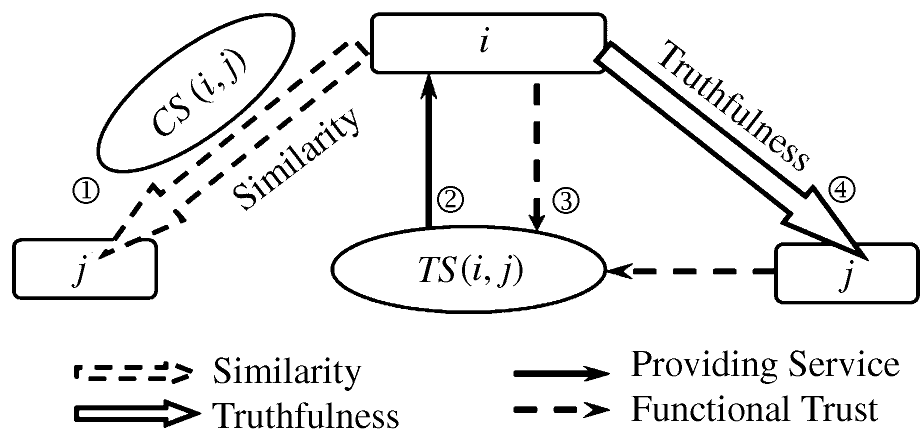 Figure 1: The sequence of similarity evaluation, service transaction, and dual-trust update.
Experiments and Social Insights
The researchers used Matlab simulations to compare their "Referral Trust" setting against "Random" settings.
- Success Rate: As the percentage of strategic (selfish) peers increases, systems without incentives see a sharp drop in successful transactions. The VCG-mechanism maintains high performance by forcing these peers to participate.
- Inference Accuracy: By filtering for "Truthfulness" rather than just looking at the raw referral score, the system correctly identifies honest peers even when their subjective rating criteria differ significantly from the requester's.
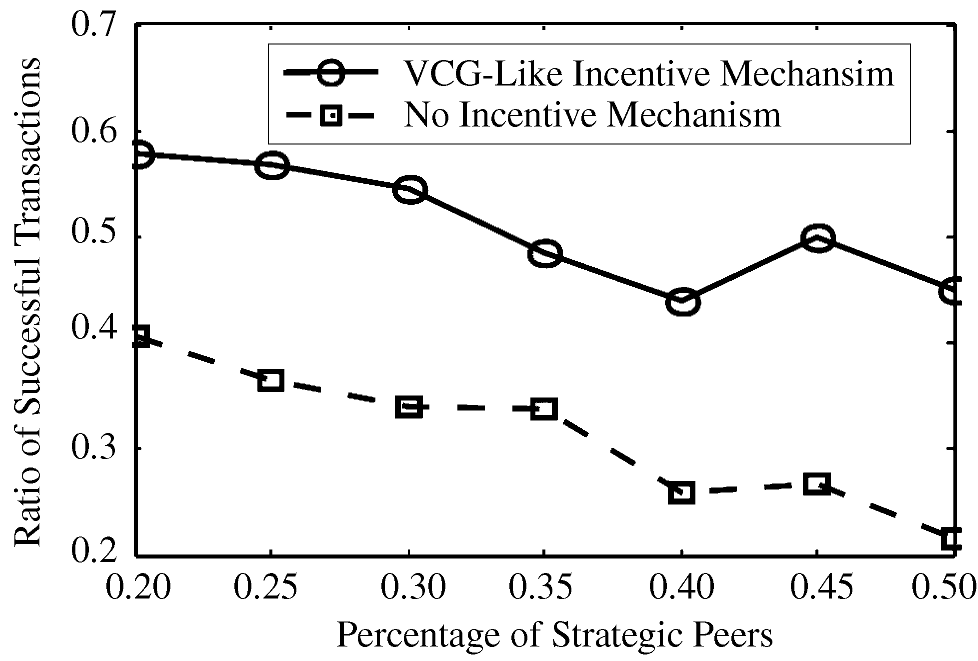 Figure 2: Separating similarity and truthfulness drastically reduces the error of misidentifying honest peers as malicious.
The "Small-World" Characteristic
From a macro perspective, the authors found that trust networks mirror human social structures. They are highly clustered (high local efficiency among friends) but maintain small path lengths (global efficiency) via a few high-cost "long-range" trust links.
Critical Analysis & Conclusion
This work's brilliance lies in its multidisciplinary approach, bridging the gap between graph theory, microeconomics, and network security.
Takeaways for the Industry:
- Reputation as Currency: In any decentralized system (Web3, P2P, Federated Learning), feedback must be treated as a valuable asset that requires compensation.
- Structural Health matters: Monitoring the "Global Efficiency" of a trust network can predict how quickly a system can isolate new malicious actors.
Limitations: The VCG mechanism can be computationally expensive in massive networks, and the paper's assumption of a decentralized PKI for identity is a significant prerequisite. Future research should investigate how "Sybil attacks" (one person creating many identities) might try to gaming the VCG payments.