
Decoding the Rhythm of Feelings: Large-Scale Emotion Entrainment in Social Media
Characterizing emotion entrainment in social media
This paper introduces a model-free framework to quantify <b>Emotion Entrainment</b> on a large-scale social media dataset (Livejournal). Using Transfer Entropy to distinguish directional influence, the study reveals that emotion synchronization follows a power law and that positive emotions act as a primary catalyst for social entrainment.
TL;DR
Why do we "catch" the moods of people we interact with online? This paper provides the first large-scale empirical evidence of Emotion Entrainment—the unconscious synchronization of emotional states—using data from 1.6 million bloggers. By applying Information Theory, the researchers found that positive vibes are the strongest drivers of social connection and that our collective online interactions naturally push us toward an even distribution of moods.
Background: The Social "Sync"
Entrainment is a well-known phenomenon in sociology: people naturally align their speech rates, facial expressions, and even heart rates during interaction. However, studying this at the emotion level in the "wild" (real-world digital environments) has been historically difficult. Most previous work relied on controlled labs or focused on word choices rather than the underlying emotional pulse.
The "Why": Why Modern Metrics Fall Short
The authors identify a critical gap in prior research:
- Symmetry: Traditional tools like correlation can tell you two people are "in sync," but they can't tell you who is leading the dance.
- Linearity: Human emotion is messy and non-linear; simple models often miss the complex "pulses" of social media interaction.
- Scale: Most studies haven't looked at how millions of people influence each other over years.
Methodology: Entropy as a Ruler for Emotion
To solve these problems, the authors turned to Transfer Entropy (TE). Think of TE as a way to measure how much the "history" of User A helps predict the "future" of User B.
The Framework
The researchers categorized 1,449 mood tags from Livejournal into Positive, Neutral, and Negative. They then modeled these as Markov processes and used Simpson's Rule to approximate the information flow.
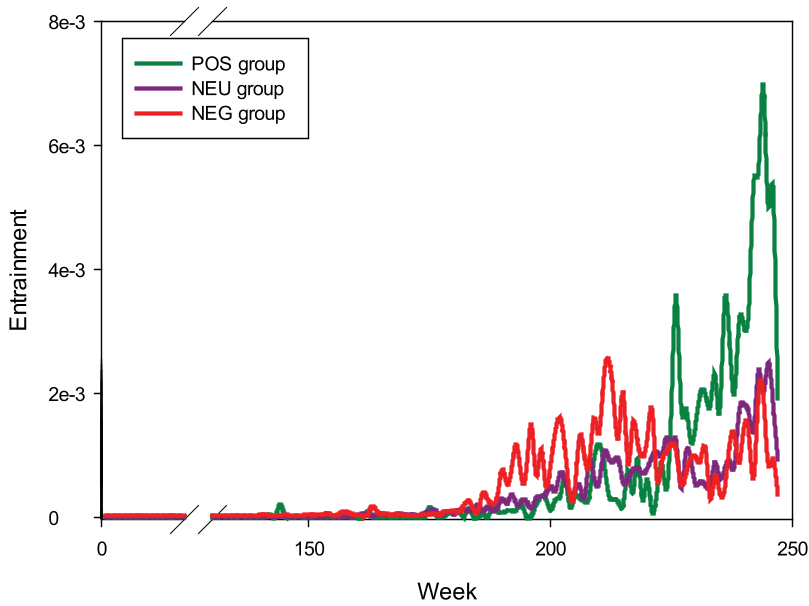 Figure 1: The Markov chain representing how users transition between emotional states through entrainment.
Key Insights from the Data
1. The Power Law of Connection
Just like the number of followers or post frequencies, emotion entrainment follows a Power Law. This means while most people have a modest influence on others' moods, a small "elite" group of users has a massive emotional pull.
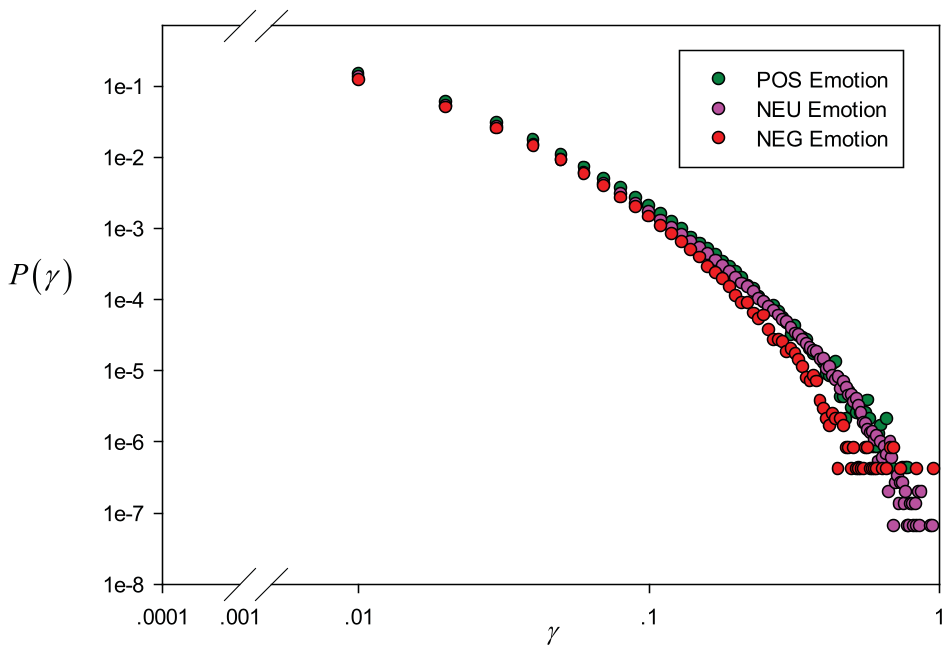 Figure 2: Distribution of entrainment strength across Positive (POS), Neutral (NEU), and Negative (NEG) groups.
2. Positivity is Magnetic
The data suggests a clear "bias" towards happiness.
- Positive users are more influential: People are more willing to "sync" with those in a good mood.
- Positive states are more "entrainable": Users are more likely to be influenced when they are already feeling positive.
- The "Slow Escape": Users in a negative mood have the weakest entrainment toward positive users, explaining why it's so hard to "cheer up" simply by looking at happy content.
3. Toward Social Balance
One of the most profound findings is that entrainment acts as a negotiator. Over time, the entrainment process drives the system toward a state of higher "Emotion Entropy"—meaning the community moves toward a balanced, even distribution of emotions rather than everyone becoming polarized.
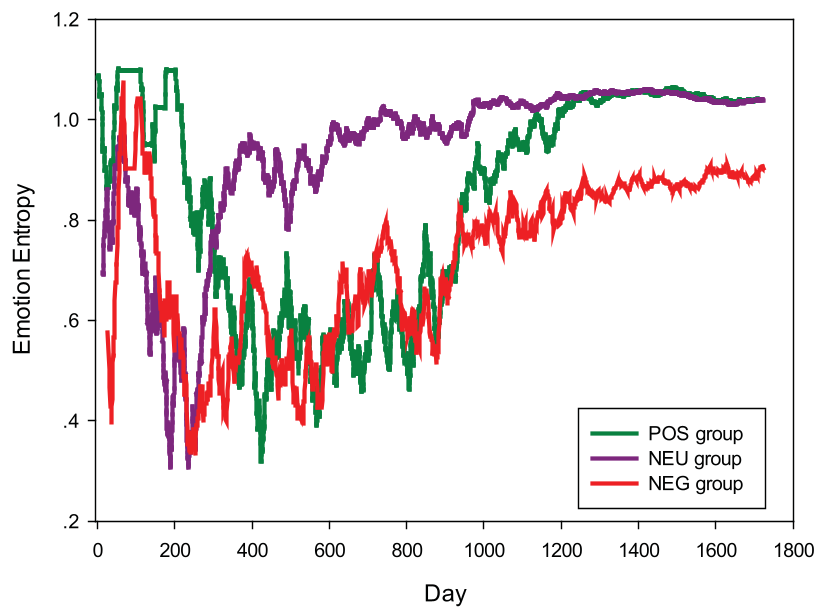 Figure 3: Evolution of emotion entropy, showing the stabilization of the social system.
Detailed Performance: Quantitative Evidence
The researchers validated their Markovian assumption by comparing the calculated stationary distribution against real-world data.
- Calculated Entropy: 1.097
- Real Entropy: 1.043
- Accuracy: The 5.17% relative error confirms that emotional evolution in social networks can be modeled as a predictable Markov process driven by entrainment.
Critical Analysis & Future Outlook
This work provides a robust mathematical foundation for what we intuitively feel: our digital environment shapes our inner state.
Takeaway: If you want to influence a network, positivity isn't just a "vibe"—it's a high-bandwidth information signal.
Limitations: The study relies on self-labeled mood tags, which might be subject to social desirability bias. Future research could integrate AI-based sentiment analysis to capture "hidden" emotions in text.
Future Work: The authors suggest looking at "time-spent" as a variable. Does the "digital native" who spends 10 hours a day online entrain differently than a casual user? This could have massive implications for digital mental health and algorithmic design.