
Designing for Diversity: Leveraging Semiotic Engineering for Intercultural HCI
Characterizing Intercultural Encounters in Human-Computer Interaction
The paper introduces a theoretical framework merging Cultural Viewpoint Metaphors (CVM) with Peirce’s Typology of Signs (icons, indices, symbols) to characterize indirect intercultural encounters in HCI. It validates this synergy through a two-step empirical study on cross-cultural platforms like Wikipedia and Englishtown, aiming to guide designers in selecting interface elements that promote cultural diversity perception.
TL;DR
In an increasingly globalized digital landscape, how do we design interfaces that don't just "translate" text, but facilitate meaningful encounters with foreign cultures? This paper proposes a robust framework combining Semiotic Engineering and Peircean Semiotics (Icons, Indices, and Symbols) to help designers consciously manage the "cultural distance" within user interfaces.
Background: Beyond Simple Localization
Traditional HCI often treats culture as a set of variables to be localized (e.g., date formats, currency). However, this paper argues for a deeper perspective: Indirect Intercultural Encounters. These occur when a user interacts with "traces" of foreign beliefs, laws, and practices embedded in a system. The authors seek to move beyond simple usability to "Culturability," positioning the designer as a "deputy" who mediates a journey between the user’s native culture and a foreign one.
The Core Blueprint: Cultural Viewpoint Metaphors (CVM)
The authors categorize the intensity of these encounters using five distinct metaphors, mapped along a continuum of cultural approximation.
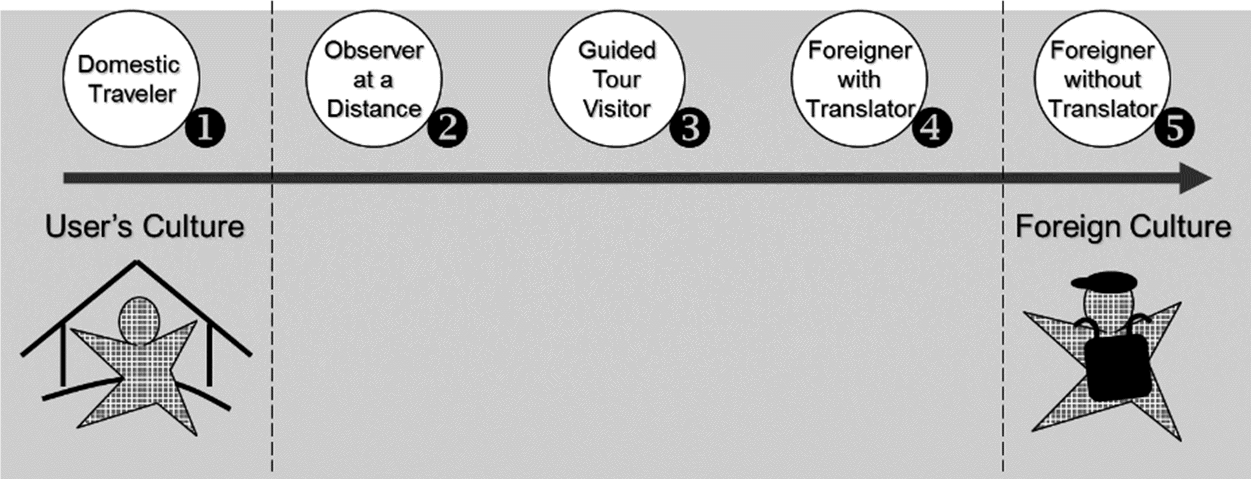
- Domestic Traveler: The user stays "at home"; foreign elements are invisible.
- Observer at a Distance: Cultural markers are provided as "bits of information" (facts) without an immersive experience.
- Guided Tour Visitor: Strong mediation; the foreign culture is explained and illustrated in the user's native tongue.
- Foreigner with Translator: Direct experience of cultural markers, but verbal content is translated.
- Foreigner without Translator: Total immersion with zero mediation (the most intense encounter).
Methodology: The Peircean Connection
The brilliance of this work lies in how it links these metaphors to Peirce’s Typology of Signs. The authors argue that his categories of Firstness, Secondness, and Thirdness provide the "how-to" for implementing these metaphors:
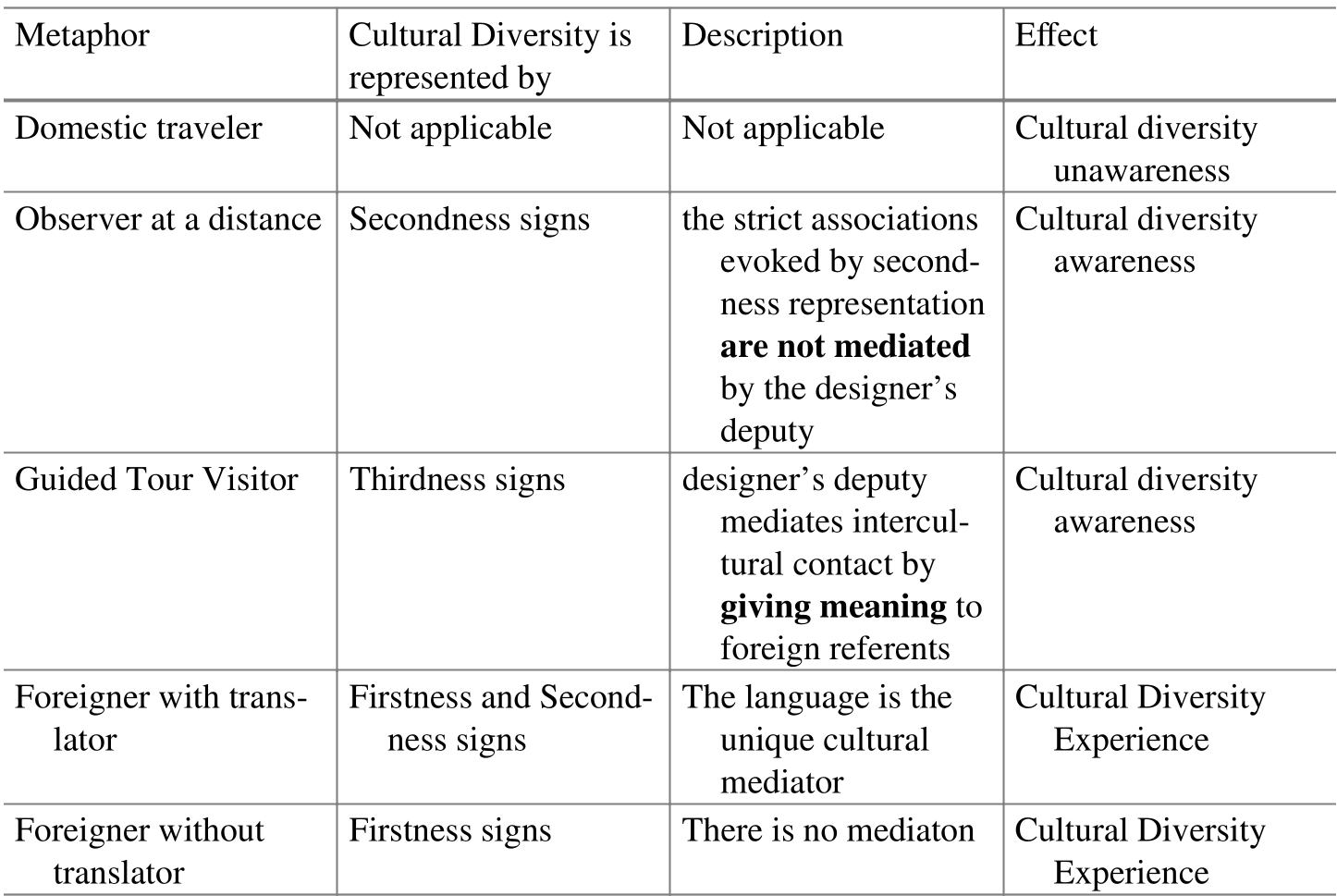
- Firstness (Icons): Evokes the "feeling" or "quality" of a culture (e.g., the sound of a traditional instrument). This correlates with a direct Cultural Experience.
- Secondness (Indices): Acts as a pointer or a "brute fact" (e.g., a link to geographical data). This fosters Cultural Awareness.
- Thirdness (Symbols): Involves rules, conventions, and mediation (e.g., an explanatory text). This provides structured Cultural Awareness via specific meanings.
Theoretical Alignment Table
The researchers synthesized their theory into a clear guideline for designers:
Empirical Validation: Wikipedia and Englishtown
To test this, the authors observed users interacting with sites that naturally host intercultural content:
- Englishtown (Learning Context): Users noted that videos of native speakers (Firstness/Icons) provided a visceral sense of "accent" and "behavior" that text could not.
- Wikipedia (Informational Context): Users experienced Secondness (Indices) through links to diverse regional cuisines and Thirdness (Symbols) through comparative tables of countries.
One powerful finding was that when users faced a page in Polish (with no translator), they reported feeling "illiterate"—a classic "Firstness" reaction where the representamen (the foreign text) hit them as a brute quality before any meaning could be extracted.
Critical Insight: The Designer as a Cultural Guide
The paper successfully demonstrates that Intercultural HCI is not a binary state (localized vs. not) but a spectrum. By choosing between Icons (experiential), Indices (informational), and Symbols (interpretive), designers can dial the "cultural presence" up or down.
Limitations and Future Work
While the theoretical alignment is elegant, the authors acknowledge that user semiosis is an "unlimited" process. A sign intended as a simple "index" might become a complex "symbol" for a more experienced user. Future research aims to turn these insights into more accessible design "scaffolds" for practitioners.
Conclusion (Takeaway)
This work provides a sophisticated vocabulary for designers of global systems. It teaches us that if your goal is empathy and experience, lean into Icons (Firstness). If your goal is instruction and understanding, lean into Symbols and Guided Tours (Thirdness). Ultimately, the interface is the bridge where cultures meet—and as designers, we are the architects of that encounter.