
Deciphering the Digital Divide: Sociolinguistic Markers in the Vaccination Debate
Characterizing Sociolinguistic Variation in the Competing Vaccination Communities
This study presents a comprehensive sociolinguistic and network-level characterization of pro-vaccination and anti-vaccination communities on Twitter. Utilizing label propagation for stance detection and analyzing over 580,000 tweets, the authors identify distinct linguistic markers and structural behaviors that define these competing archetypes.
TL;DR
Researchers from Carnegie Mellon University have mapped the linguistic and structural DNA of pro- and anti-vaccination communities on Twitter. Their findings reveal that anti-vaxxers don't just hold different opinions; they belong to a more insular, "echo-chambered" network and use language characterized by high emotional intensification and anecdotal pronoun usage—traits often associated with perceived social powerlessness.
Perspective: Beyond "Right vs. Wrong"
In the effort to debunk health misinformation, the scientific community often defaults to a "deficit model"—the idea that people simply lack the right facts. This paper shifts the coordinate system from information accuracy to social identity. By understanding vaccination stance as a "non-negotiable social identity," the authors explain why traditional debunking often falls on deaf ears.
Problem & Motivation: The Identity Trap
Existing health communication often fails because it ignores preference-based framing. The authors argue that a message's effectiveness depends on three pillars: the messenger, the medium, and the content. Prior work had not sufficiently explored how the specific linguistic choices (like the choice of pronouns) relate to the underlying network structure of these polarized groups.
Methodology: Mapping the Conversation
The researchers utilized a sophisticated pipeline to categorize 6,262 users and 588,110 tweets:
- Stance Detection: Using seed hashtags like
#VaccinesSaveLivesvs.#VaccineInjury, they applied a Label Propagation Algorithm to calculate the "valence" of users. - Linguistic Variables: They tracked the frequency of intensifiers (e.g., "really," "total"), pronouns (tracking narrative structure), and uncertainty words.
- Cross-Network Metrics: They compared "Mention," "Reply," and "Retweet" networks using the EI (External-Internal) Index to measure insularity.
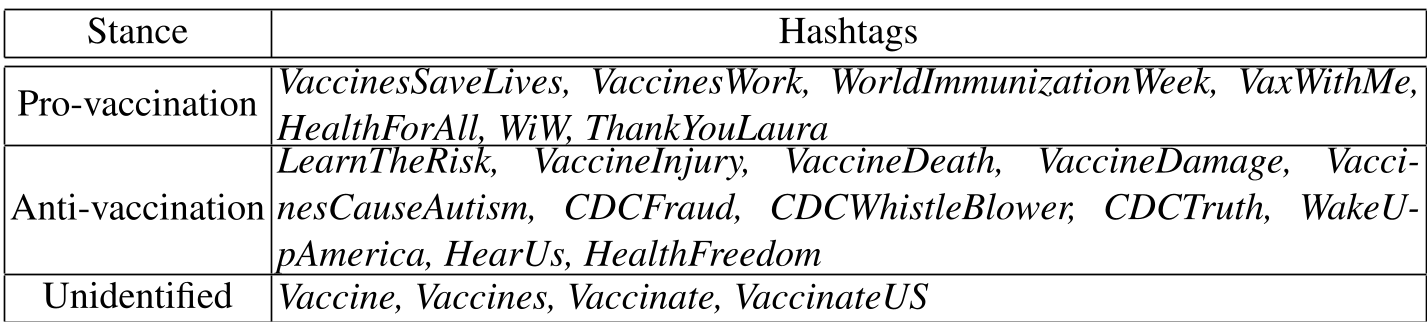 Table 1: The hashtags used as proxies for community stance identification.
Key Insights: Language as a Proxy for Power
The most striking findings come from the linguistic analysis:
- The Powerless Speech Paradox: Contrary to the initial hypothesis, anti-vaxxers use more intensifiers and hedges. In sociolinguistics, this "intensified" style is often a marker of low social power. Since anti-vaxxers perceive themselves as a marginalized minority fighting "the establishment," their language shifts toward emotional emphasis to bolster their arguments.
- Narrative through Pronouns: Anti-vaxxers showed a significantly higher usage of third-person and gendered pronouns. This aligns with their reliance on personal anecdotes and anaphoric references—telling stories about individuals rather than citing abstract population data.
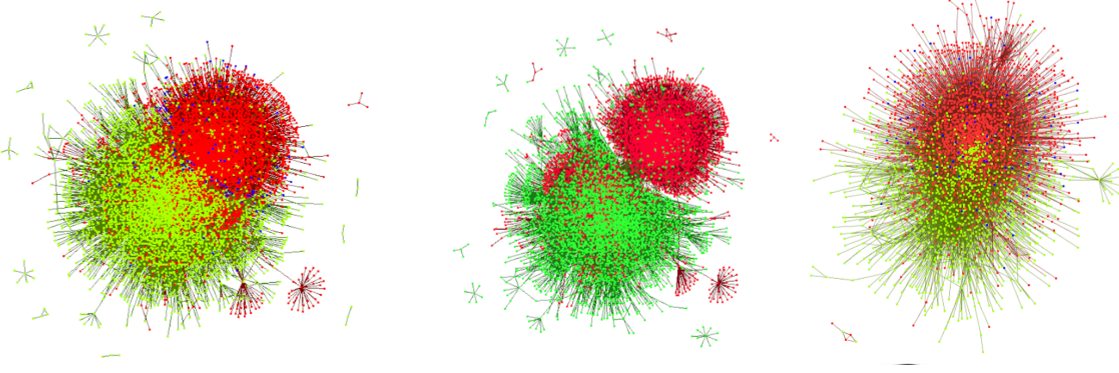 Figure 1: Visualization of communication networks. Notice the stark separation in the Retweet network, where communities rarely interact across the divide.
Network Results: The Anatomy of an Echo Chamber
The structural data confirms the linguistic intuition:
- Density & Groupthink: Anti-vax networks are significantly denser. This structural tightness often leads to "groupthink," where conformity is prioritized and outside scientific evidence is easily collective rejected.
- The EI Index: While pro-vaxxers had a positive EI Index in mention/retweet networks (indicating they engage with external sources/users), anti-vaxxers showed a strong negative index, signaling a heavy preference for internal "echo-chamber" interactions.
| Metric | Mention (Pro) | Mention (Anti) | Retweet (Pro) | Retweet (Anti) |
|---|---|---|---|---|
| EI Index | +0.025 | -0.276 | +0.023 | -0.432 |
| EC (Echo-chamberness) | 0.0064 | 0.0093 | 0.0054 | 0.0079 |
Critical Analysis & Conclusion
This work provides a vital takeaway: If you want to reach a community, you must speak their dialect.
Takeaway: Anti-vaxxers are not just "uninformed"; they are a structurally tight-knit group that values narrative and emotional intensity. Limitation: The authors acknowledge that this is a correlational study. We don't yet know if the network structure causes the linguistic style or if people with specific linguistic styles are drawn to these networks. Future Outlook: The next generation of AI-driven public health bots must move beyond simple fact-checking and begin to adopt "identity-safe" framing that mimics the narrative and intensification patterns of the target community to build trust.