
Characterizing User Behavior in Weibo: The Pulse of China's Digital Information Hub
Characterizing User Behavior in Weibo
This paper presents a large-scale measurement study of Sina Weibo, the dominant microblogging platform in China, using a dataset of over 20 million user profiles and 100 billion tweets collected over one year. The study characterizes user demographics, temporal activity patterns, and structural behaviors, establishing Weibo as a primarily information-driven Online Social Network (OSN) rather than a purely social one.
Executive Summary
TL;DR: This research provides a deep-dive measurement of Sina Weibo, revealing that it is far more than a "Chinese Twitter clone." By analyzing 20 million users, the authors uncover a landscape dominated by information seeking, concentrated influence in developed urban centers, and a surprisingly low rate of reciprocal social following.
Background: Positioned as a landmark measurement study, this paper moves beyond simple topological analysis to explain the social-physical connection—how the real-life habits of Chinese citizens dictate the digital rhythms of one of the world's largest microblogging platforms.
The "Why": Beyond the Mirror of Twitter
While Facebook and Twitter dominate Western discourse, Weibo evolved under a unique cultural and technical umbrella. The authors felt that existing OSN models (focused on "friendship" or "social ties") failed to explain why Weibo grew faster than Twitter despite launching three years later. Their intuition: Weibo isn't a social network; it's a decentralized newsroom.
Methodology: Mapping 200 Million Nodes
The researchers built Weicraw, a distributed crawling system that utilized 21 machines and 100 accounts to navigate aggressive API rate limits (1,000 requests/hour).
User Categorization
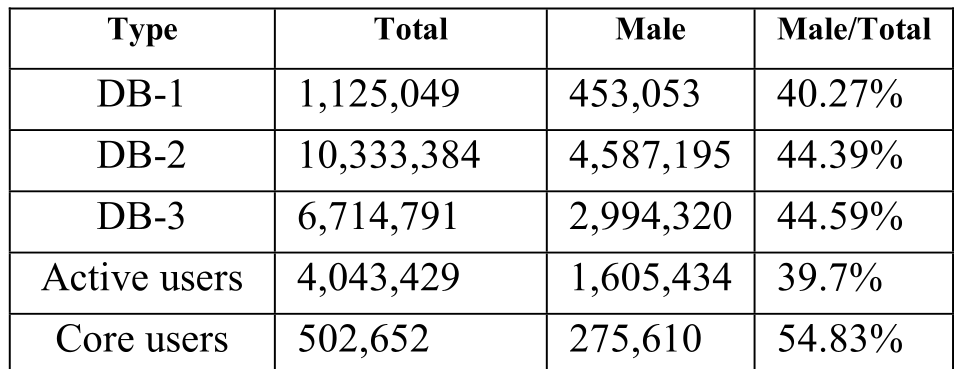
The study cleverly segments users based on influence thresholds rather than just raw numbers:
- Edge Users: < 100 followers (The "Silent Majority").
- Active Users: 100 - 1,000 followers.
- Core Users: 1k - 10k followers.
- Super-Core Users: > 10k followers (The "Opinion Leaders").
Core Insights: Who is Weibo?
1. The Geographic Concentration
Data reveals a massive "Information Gap." The top 5 provinces (Beijing, Guangdong, Shanghai, Zhejiang, and Jiangsu) account for over 52% of all users. This suggests that Weibo is a tool of the urban elite, with activity concentrated in highly developed metropolitan areas.
2. The Diurnal Rhythm of China
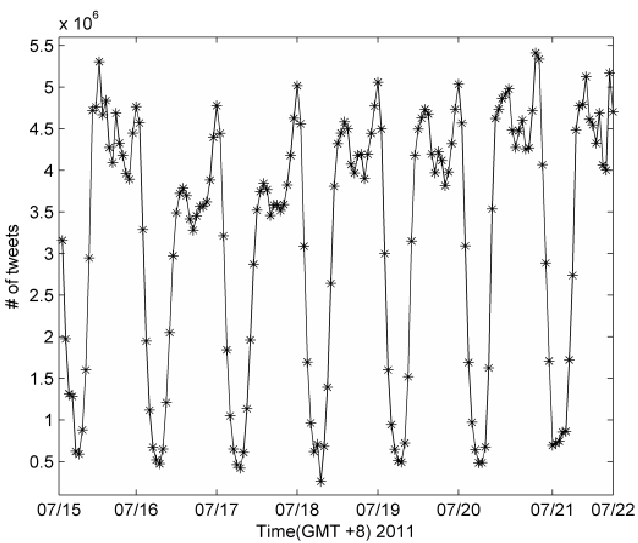
Unlike global platforms with constant 24/7 noise, Weibo follows a strict "Life Cycle." Activity surges at 06:00 (waking up), peaks throughout the day until 24:00 (bedtime), and drops to near zero in the early predawn hours.
Analysis of Interaction: Low Reciprocity
One of the paper's most critical findings is the Reciprocal Rate. In traditional social networks like Facebook, reciprocity is near 100% (friends follow each other). On Weibo, it is significantly lower than Twitter's 22.1%.
For Super-core users, while they may follow back a subset of people, the massive influx of followers makes true symmetry impossible. This confirms the Assymmetric Information Flow: a few speak, and the millions listen.
The Following Power Law
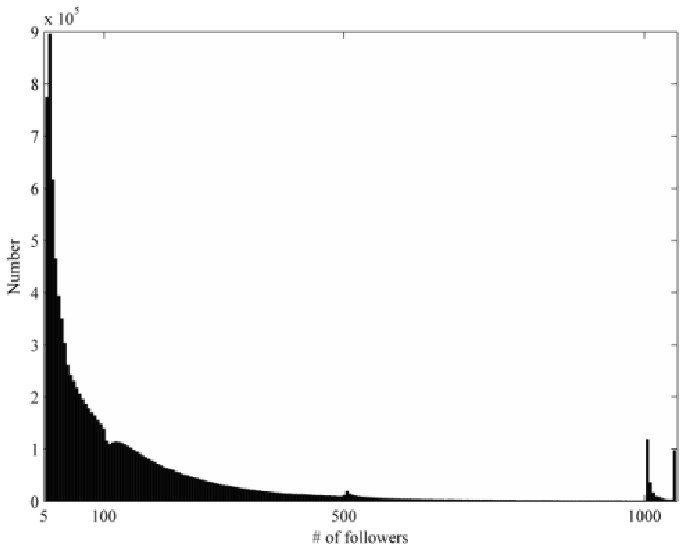
The distribution of "Following" links follows a power law with an exponent of 2.3 for . Interestingly, almost no one follows more than 2,000 people—a hard cap dictated by both platform rules and the human cognitive limit to process information.
Critical Analysis & Future Outlook
Takeaway: Weibo is an Information-Driven OSN. Its value lies in content discovery (news, videos, celebrity updates) rather than maintaining personal relationships.
Limitations: The study relies on 2011-2012 data. Since then, the rise of WeChat (private social) and Douyin (short video) has likely migrated some of these behaviors. The "gender faking" analysis, while interesting, relies on heuristics that may be difficult to verify without ground-truth identity data.
Future Work: The authors point toward Topic Detection and Diffusion Analysis—measuring how a single tweet from a "Super-core" user ripples through the 200-million-user fabric.