
Beyond the Wall: Decoding the Silent 92% of Social Network Behavior
Characterizing user behavior in online social networks
This seminal paper presents a "first-of-a-kind" analysis of User Workloads in Online Social Networks (OSNs) using granular clickstream data. By analyzing 4.6 million HTTP requests from 37,024 users across Orkut, MySpace, Hi5, and LinkedIn, the authors uncover that "silent" browsing (non-visible interactions) accounts for 92% of all user activity, a finding that fundamentally challenges the accuracy of prior studies based solely on public data crawling.
TL;DR
If you think a social network's health is measured by comments and likes, you are missing 92% of the story. This benchmark paper by Benevenuto et al. utilizes rare clickstream data to prove that browsing—the "silent" act of peering into profiles and photos—is the engine of OSNs. By looking at what users do rather than just what they post, the researchers found that social interaction is actually 16 times more intense than previously thought.
Background: The Visible Data Trap
Before this study, academic understanding of social networks was built on "archaeological" evidence: public comments, wall posts, and friendship links. While easy to crawl, these "visible artifacts" are only the tip of the iceberg. The authors argue that relying on this data is like trying to understand a city's social life by only looking at public billboards while ignoring everyone talking in private cafes or walking through the streets.
Methodology: The Clickstream Model
The authors leveraged a unique vantage point: a Social Network Aggregator. By capturing the full HTTP clickstream of 37,000 users, they could see every "silent" click.
They categorized behavior into 41 distinct activities and mapped them using a first-order Markov Chain. This allowed them to visualize not just what users did, but the logical "flow" of a session (e.g., a user browses their homepage, then jumps to a friend's scrapbook, then spends 10 minutes viewing photos).
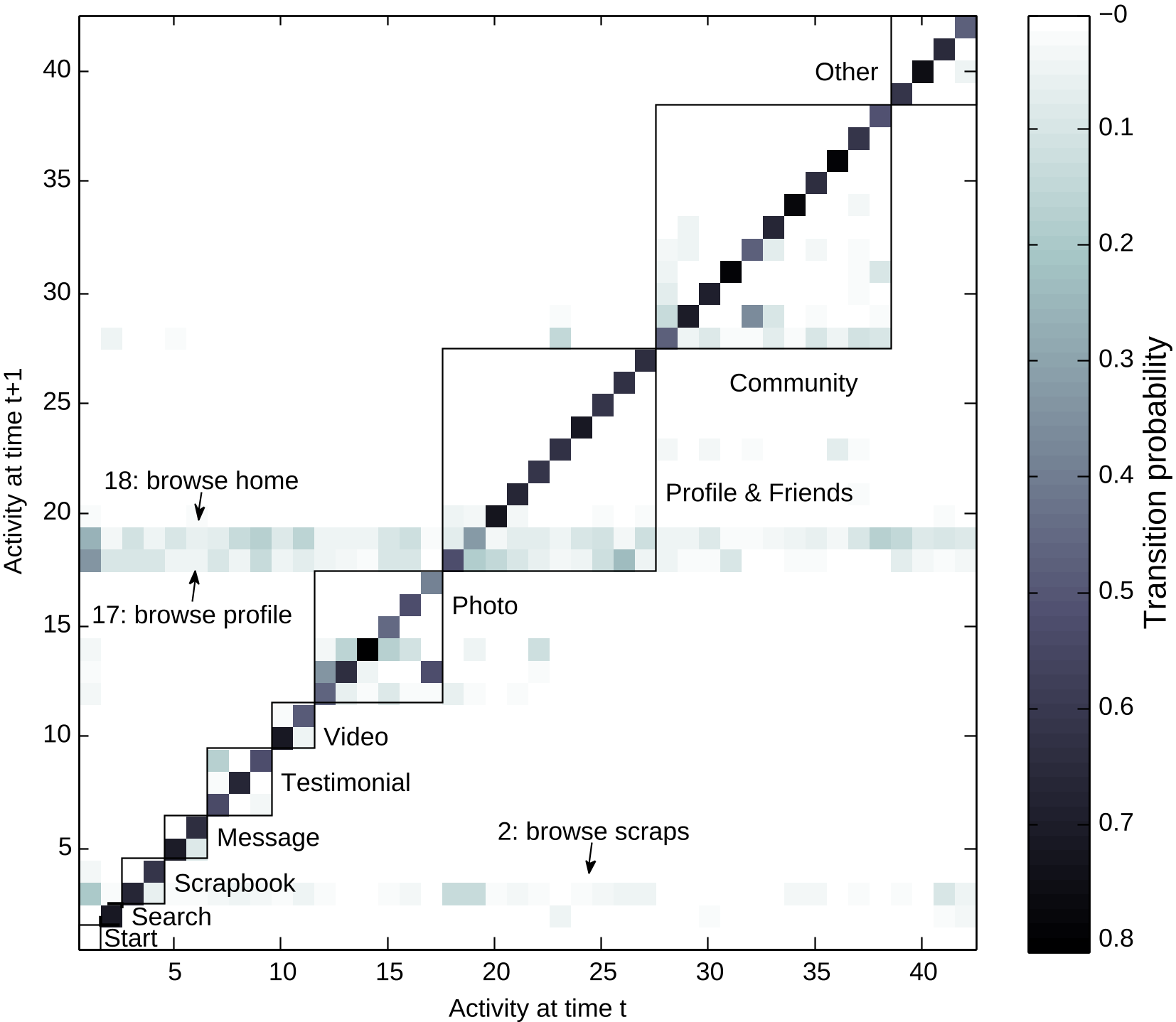 Figure 1: The Transition Probability Matrix of User Activities. The dark diagonal line confirms that users tend to repeat activities (like browsing multiple photos in a row).
Key Insights: The Power of Silence
1. The 92% Rule
The most staggering discovery: 92% of all HTTP requests are browsing-related. In Orkut, "browsing profiles" and "browsing scrapbooks" were the most frequent activities. This proves that OSNs are primarily consumption platforms, not just communication platforms.
2. We Interact More Than We Post
By correlating clickstreams with friendship graphs, the authors found that the "Interaction Degree" (who we actually look at) is an order of magnitude higher than the "Visible Interaction Degree" (who we post to).
- Visible Interaction: 0.2 friends per 12 days.
- Total Interaction (including silent): 3.2 friends per 12 days.
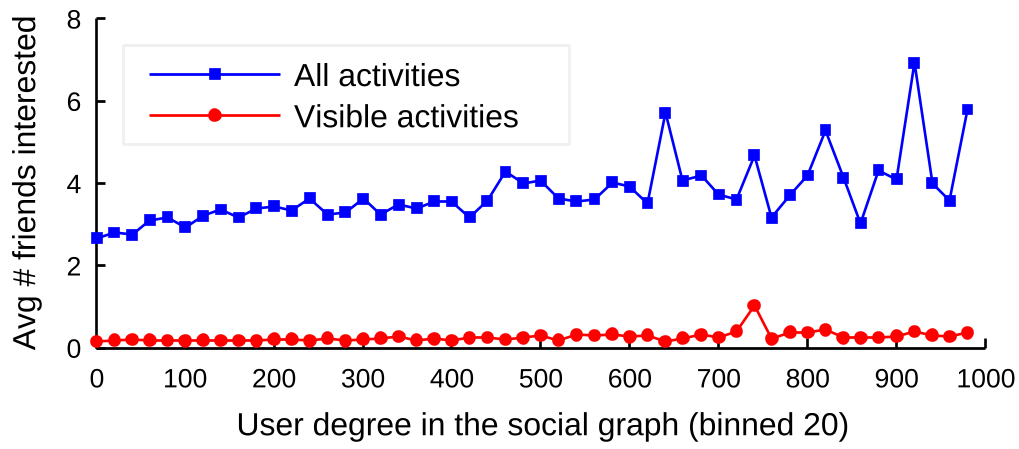 Figure 2: The gap between visible interaction (dots at the bottom) and total interaction (top line) shows how much behavior was previously invisible to researchers.
3. The "Friend-of-a-Friend" Exposure
The study found that 22% of browsing activity is directed at people two or more hops away in the social graph. Users aren't just staying in their immediate circle; they are constantly "browsing the neighborhood," which provides the structural basis for viral content and social cascades.
Methodology Breakdown: Transitions
The authors found that users rarely jump randomly. 77% of transitions happen within the same category. For example, once someone enters the "Photos" state, there is an 86% probability the next click will also be a photo. This "sticky" behavior is a key metric for UX designers and ad-tech engineers.
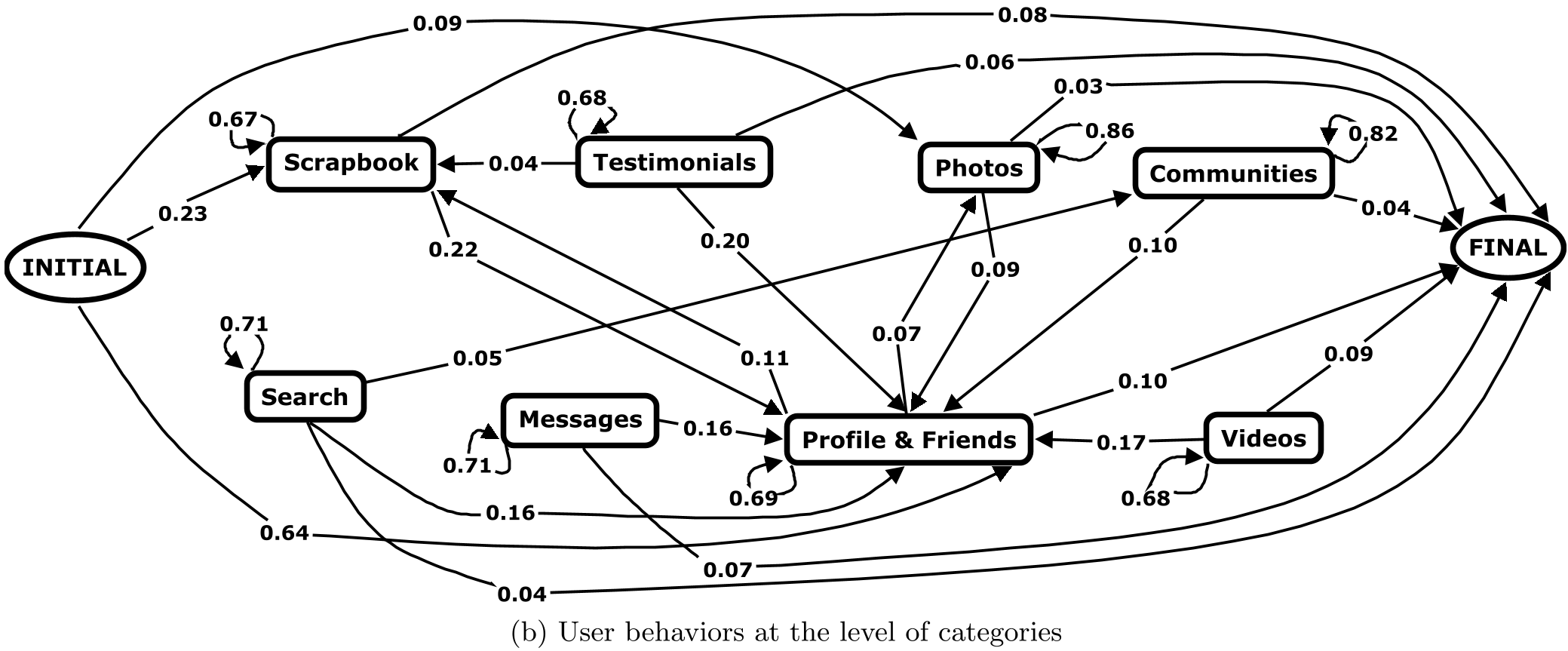 Figure 3: Holistic view of transitions between activity categories. Note how 'Profile & Friends' acts as the central hub for most sessions.
Critical Analysis & Conclusion
This paper fundamentally shifted the "Social Network" research paradigm from structural analysis (who is connected to whom) to behavioral analysis (how do they move through the network).
Takeaways for the Industry:
- Caching/CDN: Since 80% of content discovery happens via 1-hop friends, content should be pre-cached at edge nodes relative to a user's social circle, not just geographic location.
- Monetization: Browsing homepages and scrapbooks are the prime targets for "passive" advertising, as they represent the most repeated "gateway" behaviors.
- Limitations: While the clickstream data is gold, the study was limited to a 12-day window in 2009. Today's "infinite scroll" and "algorithmic discovery" models likely exacerbate the "silent interaction" effect even further.
In conclusion, Benevenuto et al. taught us that the "social" in social networks isn't just in the talking—it's in the watching.