
Decoding Inke: Why Social Links and Edge Computing are the Future of Mobile Livecasting
Characterizing User Behaviors in Mobile Personal Livecast
This paper presents a comprehensive measurement study of Mobile Personal Livecast (MPL) using a massive dataset from "Inke" comprising 11M users and 502M sessions. It characterizes unique user behaviors in crowdsourced, real-time mobile environments and proposes a collaborative Cloud-Edge computing framework (CoMPL) to optimize delivery.
TL;DR
Analyzing 502 million sessions from the Inke platform, researchers have uncovered the "secret sauce" of Mobile Personal Livecast (MPL): social relationships aren't just for notifications—they are the primary driver of session duration and patience. By proving that most livecasts are "locally popular," the paper advocates for a shift from centralized Cloud architectures to a collaborative Cloud-Edge (CoMPL) framework.
Background: The Shift from TV to Individual Broadcasters
Unlike traditional Live TV where content flows from a central provider to many, MPL is crowdsourced. Anyone with a smartphone is a potential broadcaster. This creates a dual-role environment where 17.7% of users both create and consume content. However, this spontaneity leads to highly fragmented attention: the average user visit lasts only 13 minutes but involves switching between nearly 8 different broadcasts.
Problem: The Fragility of Mobile Engagement
Existing streaming systems struggle with two main issues:
- High Churn: Viewers switch channels every ~1.7 minutes.
- Network Sensitivity: In a mobile environment, a 30-second stall often leads to immediate abandonment.
The authors sought to find the "anchor" that keeps users engaged despite these obstacles.
Methodology: Social and Geographic Determinants
The researchers used a two-pronged data collection approach: session logs for traffic analysis and a distributed crawler to map the social graph of 11M users.
1. The Power of the Social Graph
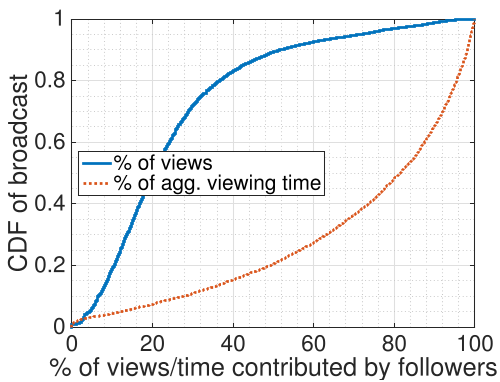
The study found a massive disparity between "roamers" (non-followers) and "loyalists" (followers).
- The 80/20 Rule of Time: Followers represent a minority of views but contribute 81-82% of the total viewing time.
- The Patience Factor: When the network fails, followers are 2x more patient. They will stay through multiple "problematic sessions" (buffering/reconnects) while non-followers leave almost immediately.
2. Geographic Locality
By calculating Broadcast Entropy, the authors found that most content is not "global."
- 85% of broadcasts get more than 60% of their views from a single top region.
- 89% of the time, that region is exactly where the broadcaster is located.
Methodology Core: The CoMPL Framework
Based on the finding that most broadcasts are regional, the authors propose CoMPL (Collaborative Mobile Personal Livecast).
- Edge Layer: Uses localized cloudlets to handle transcoding and delivery for "chatting" or "locally popular" broadcasters. This slashes latency and saves expensive core network bandwidth.
- Cloud Layer: Reserved for "Premium" or "Globally Popular" broadcasters (e.g., celebrities/talents), handling massive concurrent loads that exceed edge capacity.

Experimental Insights
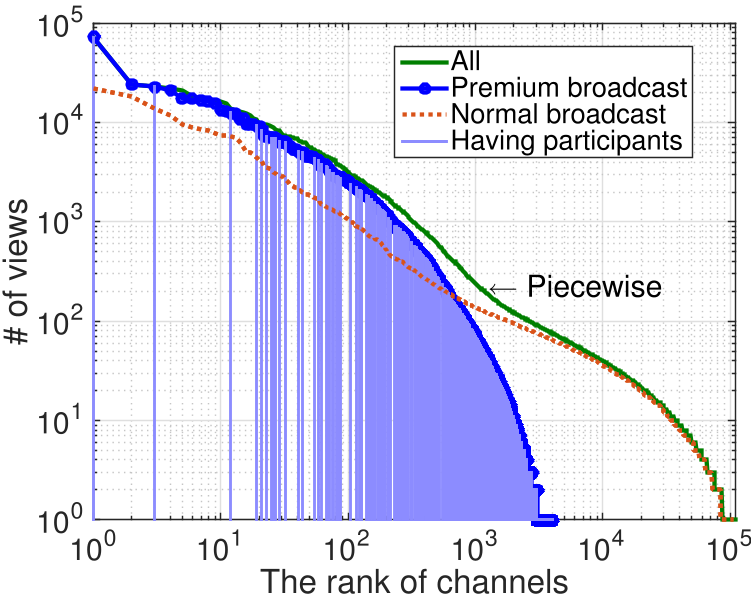
The data revealed a piecewise popularity distribution. While top broadcasts follow a typical power law, there is a sharp break at the top 1,000 rank. This is attributed to Inke's Quality of Service (QoS) tiering: Premium broadcasters get adaptive bitrate transcoding, making their streams smoother and, consequently, far more popular than "normal" broadcasters.
Critical Analysis & Conclusion
Takeaway
The success of an MPL platform depends on Social Stickiness. System designers should not treat every viewer the same—resource allocation (bandwidth, server priority) should be prioritized for "Follower-Followee" sessions, as these users are the backbone of the platform's viewing hours.
Limitations & Future Work
The study relies on provincial-level geolocation; finer-grained GPS data could further optimize "Nearby" edge caching. Future work should explore Predictive Prefetching: since 80% of switches occur among the top 16% of broadcasts, the system can "pre-warm" these streams on the user's device to eliminate start-up delay during the frequent switching observed.
Final Thought
This paper effectively bridges the gap between social science and systems engineering, proving that who you follow is just as important as where you are when it comes to the architecture of the modern internet.