
Temporal Block-Link LDA: Unveiling Hidden Echo Chambers in Online Communities
Characterizing user-subgroups in Flickr Group : A Block LDA based approach
The paper introduces Temporal Block-Link LDA, a generative probabilistic model designed to identify user-subgroups within Flickr Groups. By jointly modeling image metadata (tags), user-to-user interactions (comments/likes), and temporal timestamps, the method uncovers latent "subgroup-themes" that are localized in both social structure and time.
TL;DR
Online social groups are rarely monolithic; they are composed of fleeting "sub-communities" that emerge around specific events. This paper presents Temporal Block-Link LDA, an unsupervised generative model that mines user-subgroups by connecting what they say (tags), who they talk to (interactions), and when they are active (time). By treating time as a Gaussian distribution tied to latent topics, the model effectively maps the pulse of interest groups in Flickr.
The Hidden Heterogeneity of Social Groups
In a "Festivals" group on Flickr, not everyone cares about every festival. A user interested in the Notting Hill Carnival in London might never interact with someone posting about the Songkran festival in Thailand.
The authors argue that previous SOTA methods often treat social links or content in isolation. The core Insight here is threefold:
- Homophily: Users with similar interests interact more frequently.
- Contextual Metadata: Image tags provide the semantic "glue" for these interactions.
- Temporal Localization: Many subgroups are transient—their activity spikes during specific windows of time.
Methodology: The Anatomy of Temporal Block-Link LDA
The model is a sophisticated extension of Latent Dirichlet Allocation (LDA). Unlike standard LDA which only models document-word distributions, this approach models a link matrix of user interactions and a continuous temporal attribute for each document.
The Generative Logic
For every document (image) and interaction (link):
- It samples a topic distribution.
- It samples entities (tags and users) based on those topics.
- Crucially, it samples a timestamp from a Gaussian distribution specific to the topic.
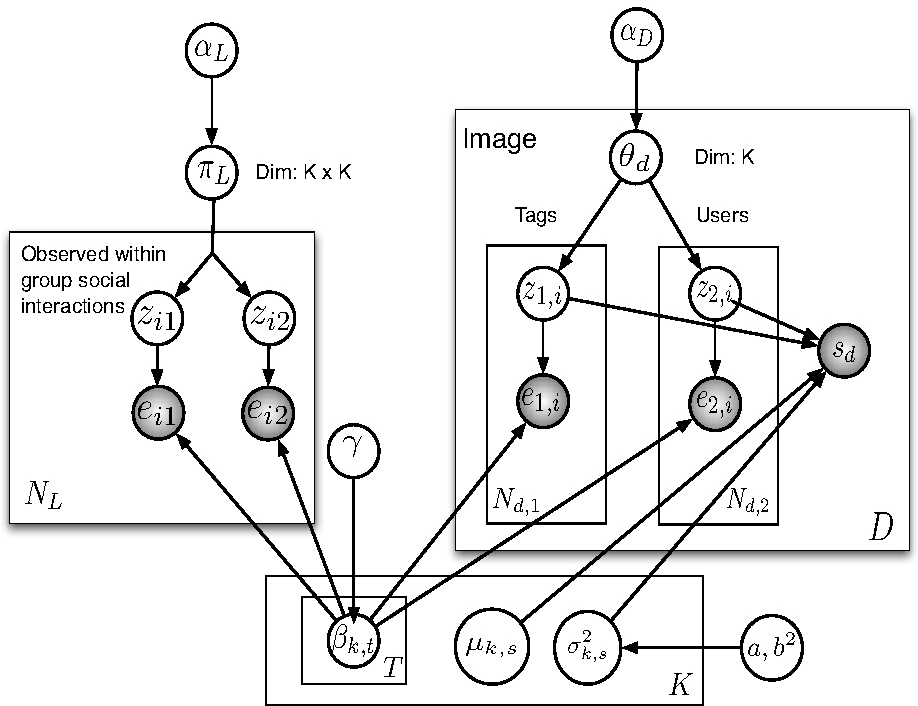
The usage of a Gaussian for time allows the model to identify the "mean time" () of an event and its "duration" or "spread" (). This is a significant improvement over discrete time-bins, as it allows for a continuous mathematical representation of event lifecycles.
Experiments & SOTA Comparison
The researchers tested their model on four diverse Flickr datasets. To evaluate the model's predictive power, they used Link Perplexity—a metric indicating how well the model predicts "who will interact with whom" based on learned latent topics.
Quantitative Superiority
The results showed that across all datasets (Festivals, Tennis, World Events, Photojournalism), the Temporal Block-Link LDA achieved lower perplexity than the standard Block-LDA. This proves that adding temporal data doesn't just provide "extra info"—it actually helps the model regularize and better understand the social structure itself.
Qualitative Insights: The Tennis Example
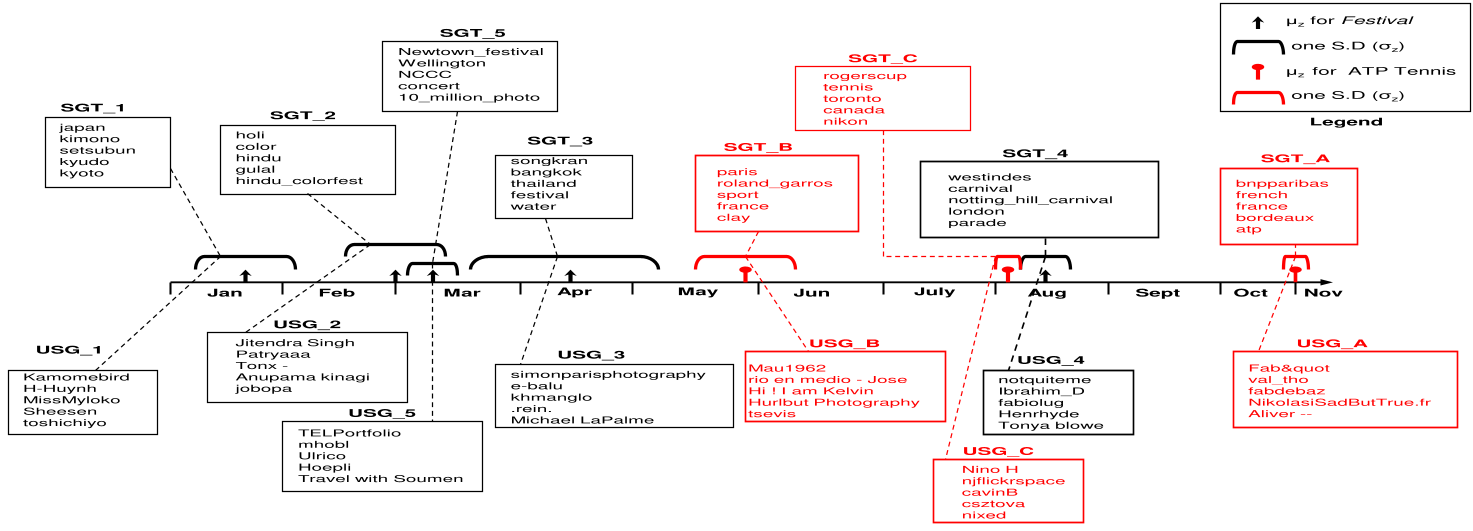
In Dataset B (ATP Tennis), the model didn't just find "tennis fans." It successfully separated fans of Roland Garros from fans of the Rogers Cup. The model correctly identified the periods of the year (April/July) when these subgroups became active, showcasing its ability to perform unsupervised event discovery.
Deep Insight & Conclusion
The real value of this work lies in its unsupervised nature. Without any manual labeling, the model successfully disentangles the "who, what, and when."
Limitations: Using a single Gaussian for temporal distribution assumes each topic has only one peak of activity. In reality, some festivals (like Christmas) are recurring/periodic. A Von Mises distribution (circular) or a Gaussian Mixture Model (GMM) might be a more robust future replacement for the temporal component to handle multi-modal or periodic events.
Final Takeaway: For platforms looking to improve recommendation systems or "trending topic" algorithms, this research provides a blueprint for how to use temporal "spikes" as a high-signal feature for identifying high-quality user clusters.