
Chasing Luck: Why Rural Betting Challenges the Hegemony of "AI Rationality"
Chasing Luck: Data-driven Prediction, Faith, Hunch, and Cultural Norms in Rural Being Practices
This ethnographic study investigates online and offline sports betting in rural Bangladesh, introducing the concept of "other rationalities" where decisions are driven by faith, hunches, and cultural norms alongside statistical data. The authors propose integrating these diverse human values into Human-AI Interaction and HCI design for the Global South.
TL;DR
In the villages of Jessore, Bangladesh, a digital betting revolution is happening—but it doesn’t look like the one in Silicon Valley. This paper reveals that rural bettors treat AI-driven odds and statistical probabilities not as objective truths, but as mere ingredients in a complex cocktail of faith, hunches, and communal morality. The authors argue that for AI to be truly global, it must learn to speak the language of "other" rationalities.
The "Objective" Mismatch
Modern AI and data-driven systems are built on a foundation of Economic Rationality: the belief that a user’s goal is always to maximize personal profit through objective reasoning.
However, the authors point out a glaring blind spot: In the Global South, decisions are rarely individualistic or purely secular. Existing models ignore the "non-intellectual" values (social, emotional, and religious) that guide real-world behavior. This creates a friction where AI becomes unpredictable and inaccessible to those who don't share its Western philosophical roots.
Methodology: A Ten-Month Deep Dive
The research team embedded themselves in seven Bangladeshi villages, observing everything from tea-stall "Khojeting" (offline Seeking) to "Nete" (online betting via mobile apps).
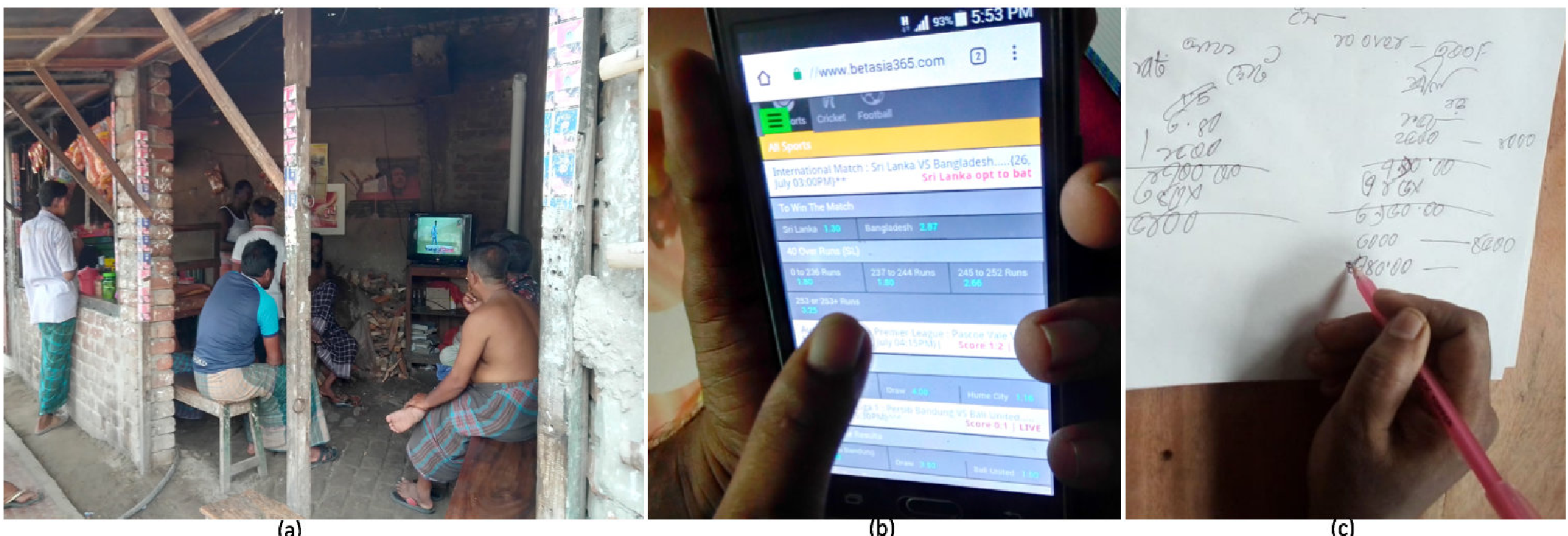 Figure 1: (a) A rural tea-stall hub, (b) A bettor navigating online rates, (c) An expert calculating strategic wagers for the community.
Key Insights: The Anatomy of "Other" Rationality
The study identifies four pillars that compete with "Scientific Rationality" in the betting arena:
- Collective Welfare: Unlike the solitary gambler in Las Vegas, rural bettors act as a unit. Experts (those with better numeracy/literacy) often calculate "guaranteed" bets where the whole group can profit, even if the individual gain is small.
- Sacred Numbers and Tabiz: Bettors look for Islamic significance in statistical data (e.g., the number 66 for God). If a digital account loses too often, they don't blame the algorithm; they assume the SIM card is "cursed" and take it to a holy shrine (Mazar) to be "halal-ed" (cleansed).
- Nationalism as a Constraint: Bettors often refuse to bet against the Bangladesh national team, even when statistics favor the opponent, viewing it as a sacrifice rather than a loss.
- The "Kufa" Factor: Certain individuals are labeled as "Opoya" (bringers of bad luck). No matter what the data says, if a "Kufa" person joins the bet, the group hides their phones to avoid the contamination of bad luck.
Morality and Social Justice
Perhaps the most striking finding is how bettors justify a practice that is religiously stigmatized. They don't see betting profts as purely "filthy." Instead, they "purify" the money by:
- Donating a portion to local Madrasas.
- Buying groceries for destitute neighbors.
- Setting up fixed deposits for their mothers.
This creates a Multiple Morality framework: the action (gambling) might be "sinful," but the outcome (supporting the family/community) is "just."
Critical Analysis & Conclusion: Towards Culturally Embedded AI
This work is a landmark for Postcolonial Computing. It suggests that the "Explainable AI" (XAI) movement is failing because its explanations—graphs, heatmaps, and weights—require a level of statistical literacy that is absent in rural settings.
The Takeaway for Tech Giants: Instead of building "universal" models, we need Situational AI. Imagine a betting or financial interface that doesn't just show "70% probability," but understands the local "auspicious" times, allows for collective group-chats for decision-making, and integrates local legal/religious warnings.
Limitations: The study relies on snowball sampling, which may introduce selection bias. However, its ethnographic depth provides a visceral counter-narrative to the assumption that "data is the new oil" across the globe. For many, luck is still the ultimate currency.
Future Outlook
Will we see "Inter-faith AI" or "Communal Recommendation Engines" in the next decade? This paper suggests that if we want to include the next billion users, we have no choice but to start designing for the Soul, not just the Spreadsheet.