
Beyond Multiple Choice: The Rise of Conversational Virtual Patients in Medical Training
Chatbots in Healthcare Curricula: The Case of a Conversational Virtual Patient
This paper presents a Conversational Virtual Patient (CVP) prototype designed for medical education, specifically for training decision-making skills in thromboembolism. Unlike traditional multiple-choice virtual patients, this system leverages Natural Language Processing (NLP) and the Rasa Open Source framework to enable free-form dialogue between students and virtual cases.
TL;DR
Researchers have developed a Conversational Virtual Patient (CVP) prototype that replaces rigid multiple-choice buttons with a natural language interface. Built on the Rasa Open Source framework, this tool allows medical students to practice diagnosing thromboembolism by actually "talking" to a patient, fostering higher-order clinical reasoning rather than simple pattern recognition.
Contextualizing AI in the Medical Classroom
The 2020 EDUCAUSE Horizon report identified AI as a top trend in education, yet most chatbots remain relegated to informal "FAQ" bots. In medical education, the gap is even more pronounced. Clinical decision-making is a nuanced art, yet many Virtual Patients (VPs) operate like choose-your-own-adventure books. This "cueing" effect often guides students to the right answer, which doesn't happen in a physical clinic.
The Core Insight: From Recognition to Recall
The authors argue that medical education must shift from reciting the correct answer to asking the right questions. By integrating Natural Language Processing (NLP), the proposed CVP removes the safety net of predefined options.
- Inductive Bias: The system assumes that free-form dialogue better represents "authentic learning."
- Intent and Entity Extraction: The chatbot doesn't just look for keywords; it uses NLU to categorize the intent of the student (e.g., asking about family history vs. physical pain).
Methodology: Building the CVP with Rasa
The team selected Rasa Open Source for its privacy-driven architecture (on-premise data storage is critical for healthcare data) and its ability to handle complex "Stories."
1. The Architecture
The system maps unstructured text into structured data using:
- Intents: Categorizing what the student wants to know.
- Entities: Extracting specific clinical details (e.g., "Atrial Fibrillation").
- Stories: Dialogue paths that define how the patient responds to certain sequences of questions.
 Note: The CVP seeks to bridge the gap between technical NLU implementation and medical pedagogy.
2. The Implementation Flow
To train the model, the authors created eight distinct "stories." These aren't just happy paths; they include "wrong" paths where the student fails to ask critical questions, leading to a realistic simulation of a failed diagnosis.
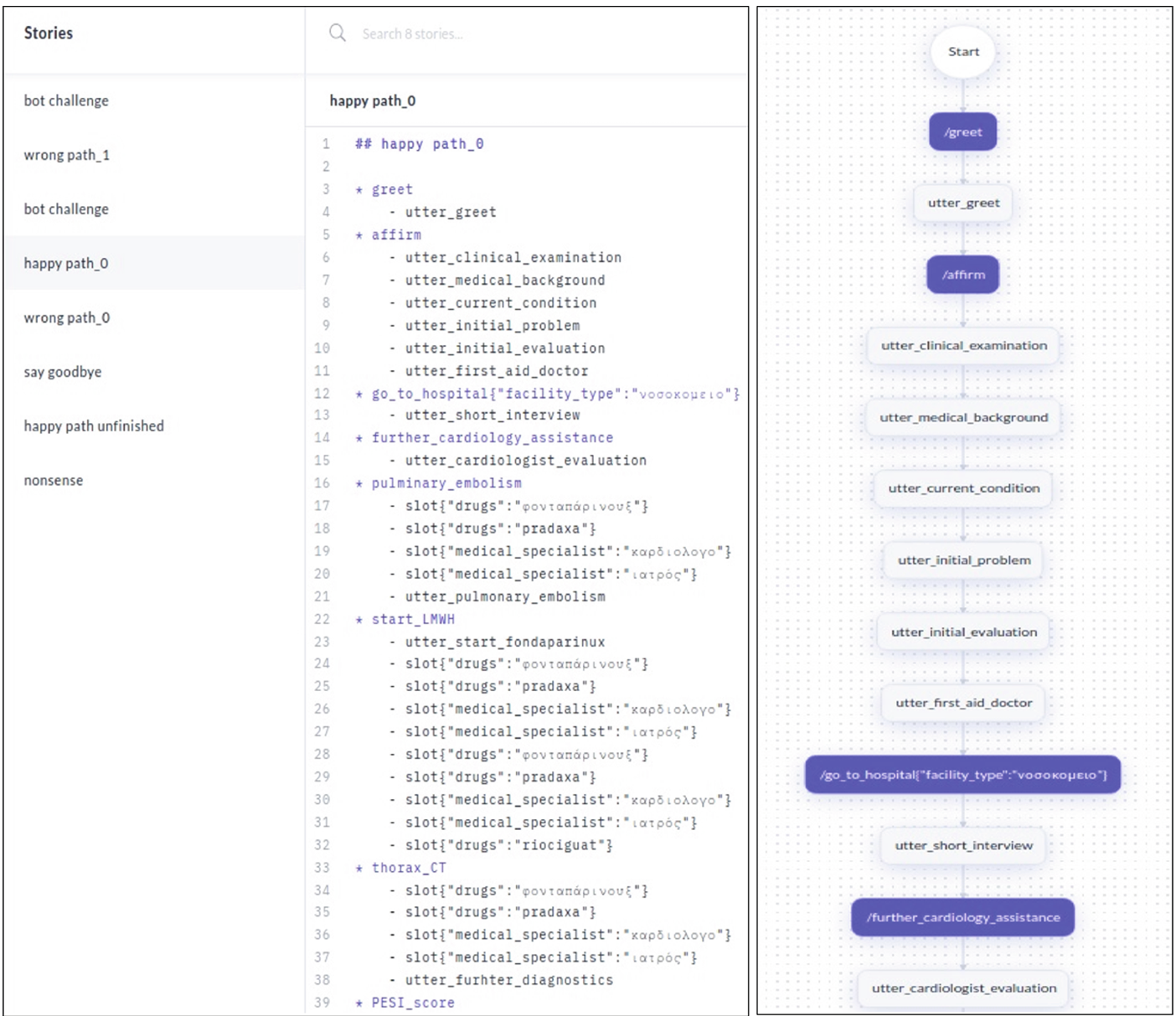 Figure 1: Visual representation of a dialogue story’s flow in the Rasa GUI editor, showing branching logic based on student input.
Why This Matters: SOTA vs. Traditional VPs
Ordinary VPs test Lower-Order Thinking (Remembering and Understanding). In contrast, CVPs target Higher-Order Skills:
- Clinical Reasoning: Students must formulate a diagnostic strategy from scratch.
- Communication Skills: The turn-by-turn interaction allows for training in empathy and patient-centeredness.
- Active Learning: Since there are no buttons to click, the student is the driver of the interaction, not the observer.
Critical Analysis & Conclusion
While this prototype is a major step forward, the authors acknowledge the "terminological challenge." Medical jargon is vast, and mapping all possible synonyms for a condition like "Atrial Fibrillation" requires intensive co-creation with subject matter experts.
The Takeaway: The future of healthcare training isn't found in a textbook or a multiple-choice quiz; it’s found in a dialogue. By using NLP frameworks like Rasa, educators can create risk-free environments where students can fail safely, ask better questions, and ultimately become more effective clinicians.
Future Outlook
The next stage involves Sentiment Analysis. Imagine a virtual patient that becomes frustrated if the student is too blunt, or anxious if the diagnosis is delivered poorly. This would integrate the affective dimension of learning, moving AI agents from mere information retrievers to true social training partners.