
Getting Virtually Personal: The Rise of the Empathetic AI Interviewer
Getting virtually personal: chatbots who actively listen to you and infer your personality
The paper introduces Juji's AI interviewer, a conversational agent designed for one-on-one text-based interviews. It features two core capabilities: "active listening" for empathetic engagement and an automated engine to infer "Big 5" personality traits from conversational text.
TL;DR
In the landscape of conversational AI, "understanding" usually refers to intent recognition. Juji researchers are pushing the boundary further by introducing an AI Interviewer that practices Active Listening and performs Real-time Personality Inference. By combining a hybrid rule/deep-learning engine with psychological modeling, this system doesn't just process data—it reads "between the lines" to understand who you are.
Problem & Motivation: The Empathy Gap in LLMs' Ancestors
Before the era of massive LLMs, chatbots were largely transactional or rigidly script-based. The authors identify a significant "Empathy Gap" in automated interviewing:
- Complexity of Open-Endedness: Answering "What's your biggest challenge?" can result in infinite linguistic variations.
- Lack of Validation: Humans feel ignored when a bot jumps to the next question without acknowledging the previous answer.
- Invisible Insight: Traditional bots treat every user as a generic persona, failing to capture latent traits like Intellectual Curiosity or Extraversion that are vital for recruitment.
Methodology: The Hybrid Intelligence
The core of the paper lies in its Hybrid Conversation Engine. Instead of relying solely on a "black box" model, the authors propose a structured interplay between human design and machine learning.
1. The Active Listening Loop
The engine uses LDA (Latent Dirichlet Allocation) to analyze training data and identify semantic themes. These themes are then used to train classifiers that allow the bot to summarize user input (e.g., "It sounds like you've faced many technical hurdles..."), mimicking human active listening.
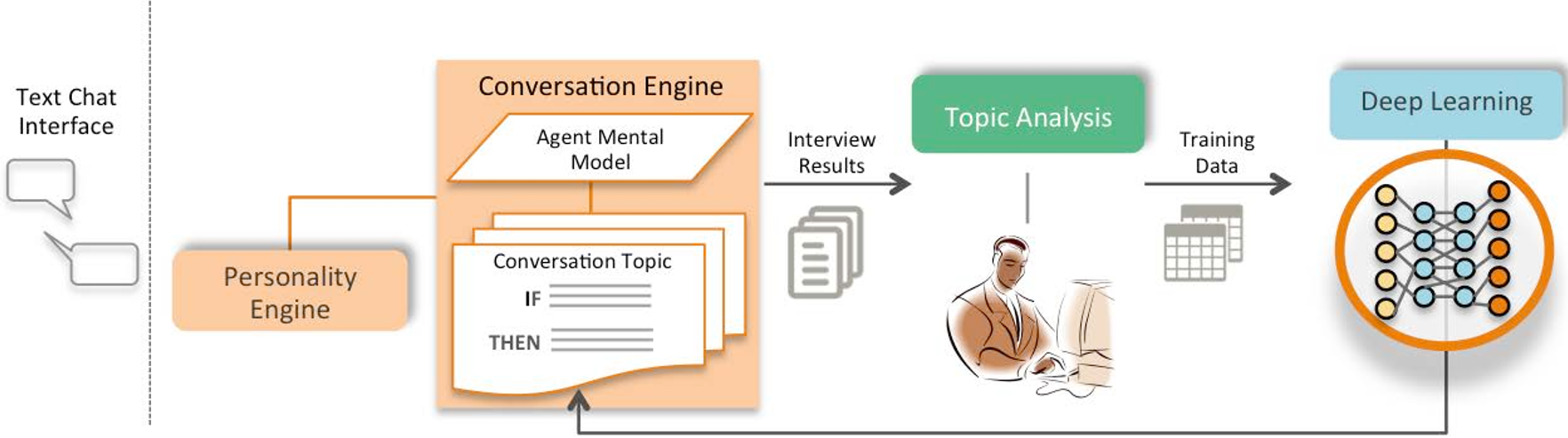 Figure 2: The architecture shows a continuous feedback loop where rules bootstrap the bot, and data-driven models refine it.
2. The Personality Engine
While the conversation progresses, a secondary engine analyzes the language patterns to map the user against the Big 5 Personality Traits (Openness, Conscientiousness, Extraversion, Agreeableness, and Neuroticism). This isn't just for a final report; the bot can use these traits to dynamically adjust its questioning strategy.
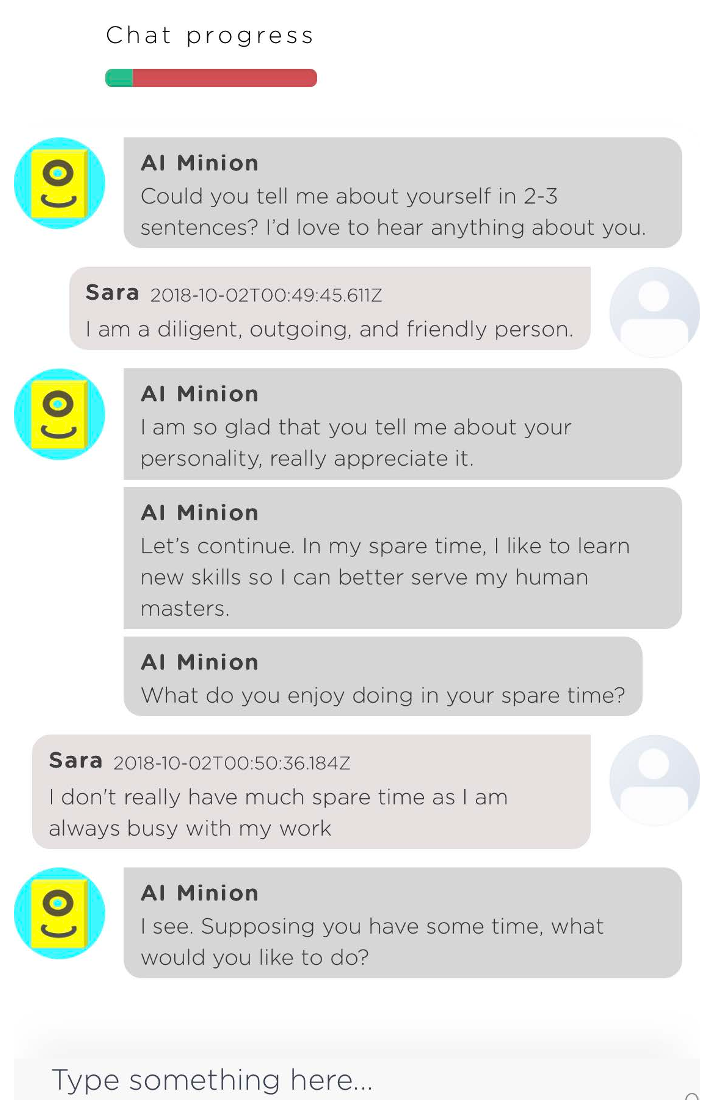 Figure 1: A live interview where the AI "Minion" interacts with a user named Sara, illustrating the text-based interface.
Experiments & Real-World Impact
The researchers demonstrated several use cases:
- Recruitment: Sifting through candidates by assessing personality fit alongside technical skills.
- Market Research: Getting deeper insights by making respondents feel more comfortable through empathetic prompts.
- Personalized Recommendation: Suggesting travel or food options based on the inferred personality (e.g., suggesting a quiet retreat for an introvert).
The "Continuous Enhancement" model is the standout feature: as more users interact with the bot, the labeled training data grows, allowing the text classification models to handle increasingly "edge-case" user inputs.
Critical Insight & Conclusion
This paper, originally presented at IUI '19, foreshadowed the current obsession with "System 2" thinking in AI—moving beyond mere token prediction to understanding the underlying psychological state of the user.
Takeaways:
- Hybrid works: A pure rule-based system is too brittle; a pure DL system is too uncontrollable. Combining them provides a "safe" but flexible interview environment.
- Personality matters: LLMs today (like GPT-4) are great at summarization, but Juji's focus on structured personality inference remains a crucial niche for high-stakes HR and psychological applications.
Limitations: The paper is a "Short-Paper" and lacks a massive quantitative benchmark. Furthermore, the reliance on human annotators to rectify LDA results suggests that at the time of writing, fully unsupervised personality inference was still a "Holy Grail."
Future Work
The next frontier involves moving these capabilities into voice-based agents where tone, pitch, and prosody can provide even deeper evidence for personality inference.