
CHCI: Bridging the Gap Between Human Wisdom and Machines in Digital Heritage
CHCI: A Crowdsourcing Human-computer Interaction Framework for Cultural Heritage Knowledge
The paper introduces CHCI, a Crowdsourcing Human-Computer Interaction framework designed to extract entities and relationships from heterogeneous Cultural Heritage (CH) data. It leverages a three-way collaboration between museum experts, crowdsourced users, and machine learning algorithms to achieve scalable, high-quality knowledge extraction.
TL;DR
The CHCI Framework is a systematic approach to digitizing cultural archives by blending the precision of museum experts, the scalability of crowdsourced volunteers, and the efficiency of AI algorithms. It solves the "scaling vs. accuracy" dilemma in Cultural Heritage (CH) by implementing smart optimization mechanisms like dynamic user scoring and gamified incentives.
Positioning: This work serves as a foundational architecture for Human-in-the-Loop (HITL) knowledge extraction, moving beyond simple data labeling to a complex, multi-layered interaction model tailored for the Digital Humanities.
The "Vicious Cycle" of Heritage Digitization
Museums sit on a goldmine of data—paintings, manuscripts, and artifacts—but this data is "unstructured" and "heterogeneous."
- The Scalability Wall: Museum staff are experts but cannot manually label millions of records.
- The Accuracy Floor: AI algorithms often struggle with the sparse and context-heavy nature of historical data.
- The Engagement Gap: Traditional crowdsourcing often suffers from low-quality contributions and high churn rates.
The authors argue that the only way forward is a collaborative ecosystem where these three entities compensate for each other's weaknesses.
Methodology: The CHCI Interaction Loop
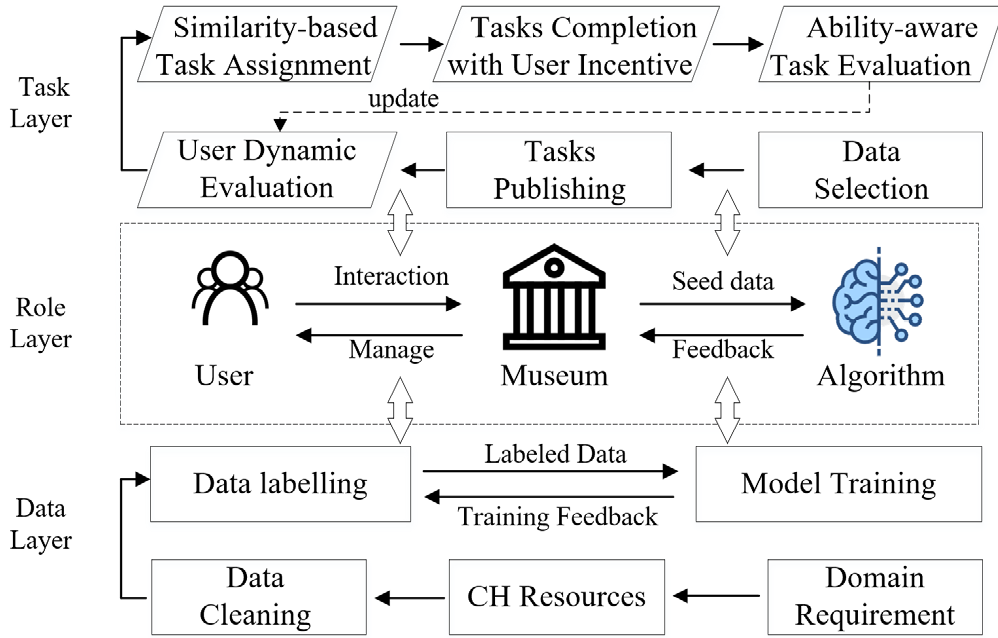
The core of the paper is the Crowdsourcing Human-Computer Interaction (CHCI) framework. It is structured into three distinct layers:
- Data Layer: Handles cleaning and feedback loops.
- Role Layer: Manages the interplay between the "triad" (User, Museum, Algorithm).
- Task Layer: Dictates the workflow—Labeling, Verification, and Linking.
Advanced Optimization Mechanisms
What makes CHCI superior to standard crowdsourcing?
- Dynamic User Evaluation: Instead of a static "trust score," the system uses "Golden Standards" (hidden expert-labeled tasks) to continuously monitor user accuracy.
- Jaccard-based Task Assignment: The system calculates the similarity between a task and a user's previous successful labels, ensuring tasks are routed to "subject matter enthusiasts" rather than random participants.
- Ability-aware Weighting: During the final aggregation, a vote from a high-accuracy user (or a museum expert) carries significantly more weight than a novice's vote, ensuring that the "Majority Voting" doesn't lead to a "tyranny of the mediocre."
From Raw Data to Intelligent Application
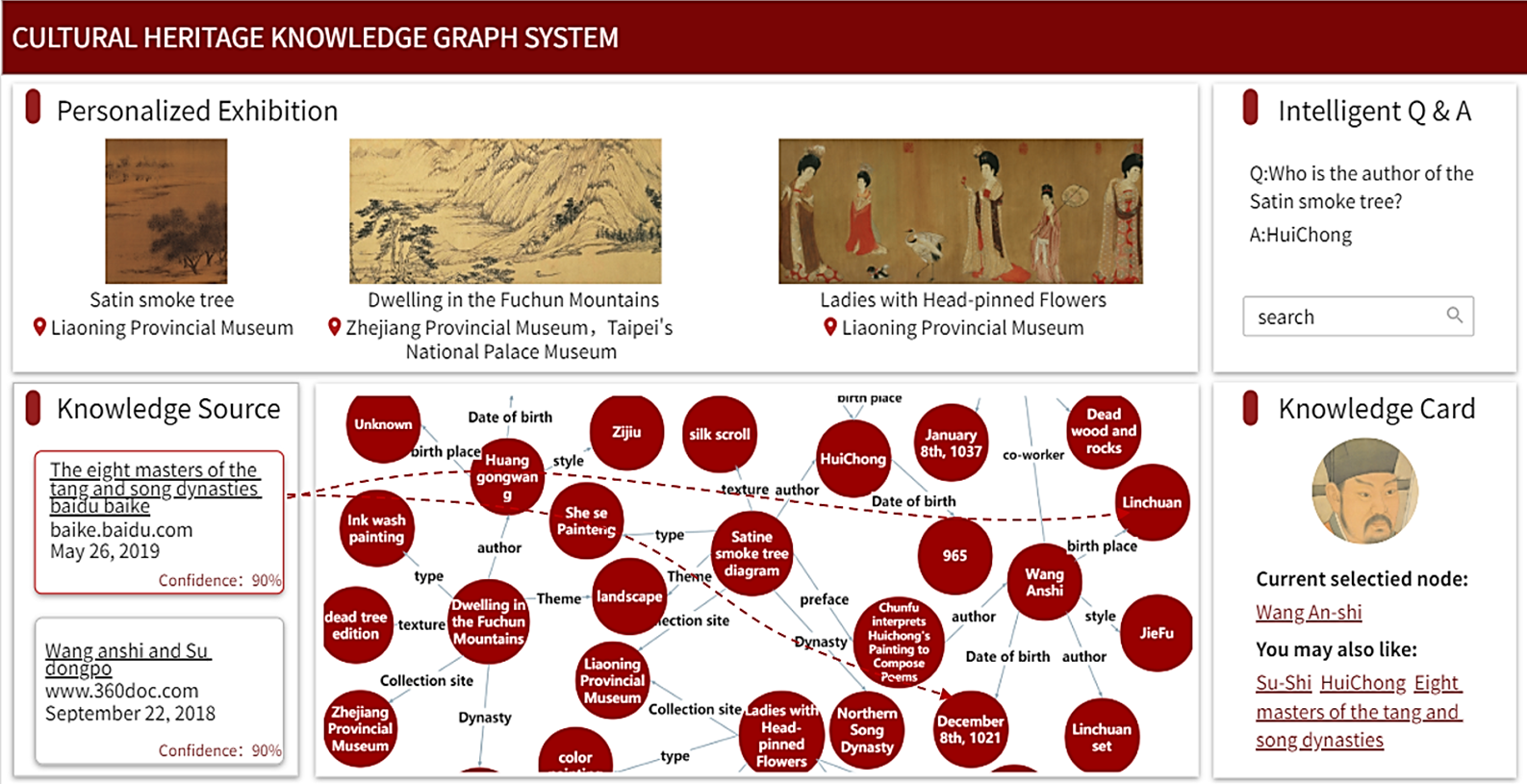
The ultimate byproduct of CHCI is a Knowledge Graph (KG). The paper outlines several high-value downstream applications:
- Personalized Digital Exhibitions: Using semantic relations to recommend artifacts based on browsing history.
- Knowledge Q&A: A specialized chatbot that understands regional history better than a general-purpose AI.
- Traceable Visualization: A transparency layer that shows the source and confidence of every link in the graph—crucial for academic and historical rigor.
Critical Insight & Future Outlook
The CHCI framework effectively addresses the Inductive Bias problem in heritage AI. By injecting human "domain priors" into the algorithmic loop, it prevents the model from hallucinating or misinterpreting rare cultural nuances.
Limitations: The paper primarily focuses on the technical framework. However, the socio-technical aspect—how to maintain a long-term community of volunteers without "burnout"—remains an open question.
Conclusion: As we move into the era of Large Language Models, the CHCI framework provides a blueprint for how specialized domains can "ground" AI models in verified, expert-curated reality.