
Automated Socio-Technical Attacks: How Social Networks Weaponize Information
Cheap and automated socio-technical aacks based on social networking sites
The paper investigates the evolution of social engineering into "Socio-Technical Attacks," leveraging the massive data pools of Social Networking Sites (SNSs). It introduces a conceptual framework for automated, large-scale social spam and phishing campaigns that exploit verified personal data to achieve significantly higher conversion rates than traditional methods.
TL;DR
This seminal paper from Huber et al. explores the transition of social engineering from manual "low-tech" methods to cheap, automated, and large-scale "Socio-Technical Attacks." By exploiting the trust and data visibility inherent in Social Networking Sites (SNSs), attackers can deploy automated bots that use personal context to increase phishing success rates from 16% to a staggering 72%.
Positioning: This work is a foundational security analysis that bridges social science and network security, moving the conversation from "software bugs" to "human authentication bugs."
The Evolution of the "Human Hack"
Historically, social engineering was a boutique craft. If an attacker wanted to impersonate a colleague, they had to physically snoop or engage in "dumpster diving" to find context.
The authors argue that SNSs (Facebook, MySpace, etc.) have inadvertently provided a "One-Stop Shop" for attackers. The problem isn't just that data is public; it's that the data is structured, verified, and relational. This allows for the automation of what was once a highly manual process.
Methodology: The Viral Attack Cycle
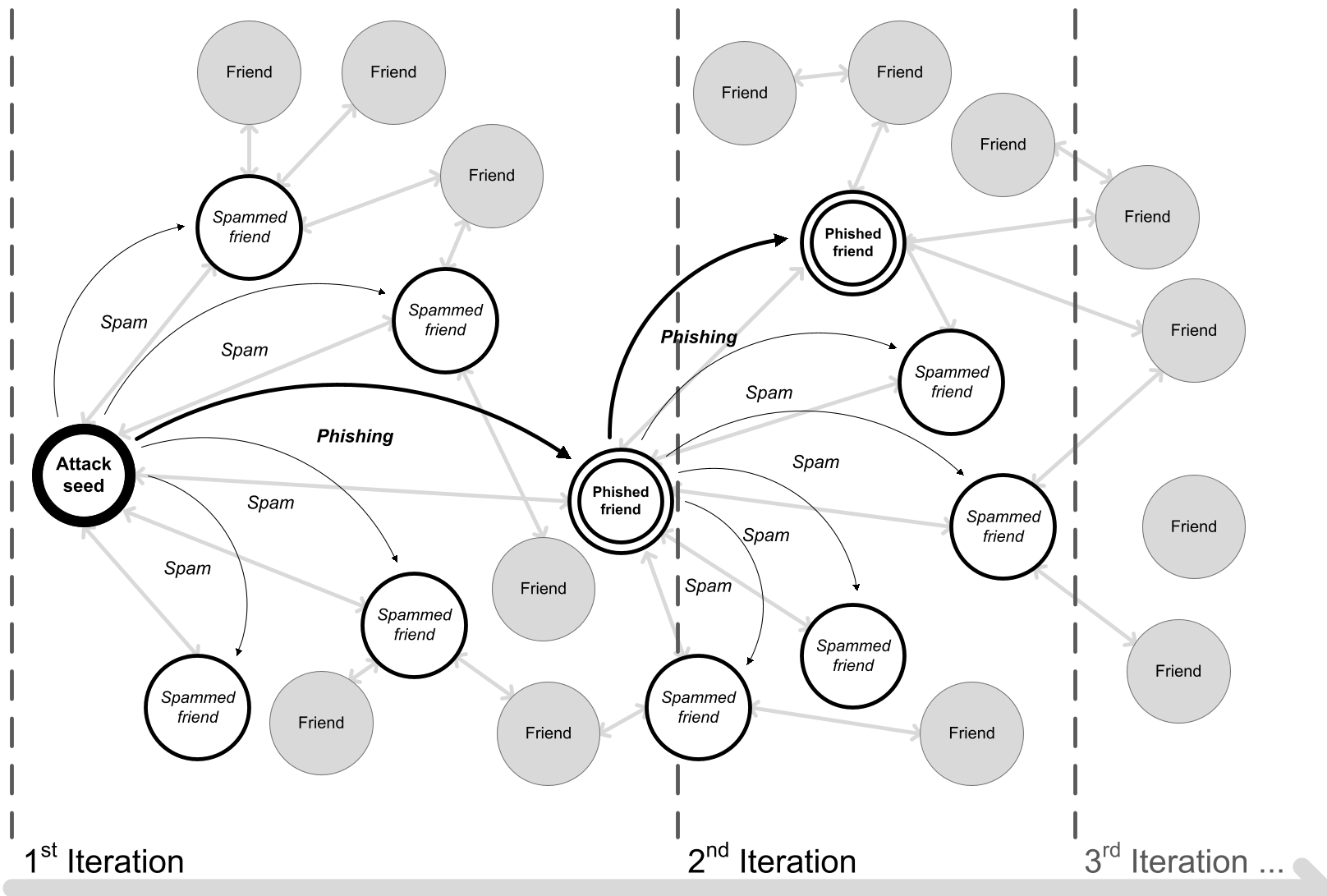
The core of the paper is the "Large-Scale Spam Attack" model. Instead of a simple "blast and pray" spam approach, the authors propose a circular infection logic:
- Compromise a Seed: Hijack one account via session stealing or credential reuse.
- Harvest Context: Automatically scrape the social graph (friends), prior wall posts, and communication style/language.
- Hybrid Execution:
- Send Phishing links to a subset to ensure the "infection" spreads to new clusters.
- Send Spam to the remainder to monetize the current access.
- Persistence: Install third-party apps or add "attacker-controlled" friends to maintain a back-door.
The Logic of Impersonation
The authors use predicate logic to define how access to "Context" () is derived from "Friendship" (). The insight here is that the social network provider acts as the "Truth Provider" for the attacker. If the system says is a friend of , the victim lowers their defensive threshold, making the subsequent (Spam) or (Phish) far more effective.
Context-Awareness is the Force Multiplier
The paper categorizes attacks based on the "level of context" used:
- Relationship-based: "Your friend [Name] recommended this."
- Shared-attribute: "Since we both go to [University]..."
- Automated Social Engineering (ASE) Bots: Utilizing Artificial Conversational Entities (ACEs) to chat with victims in real-time.
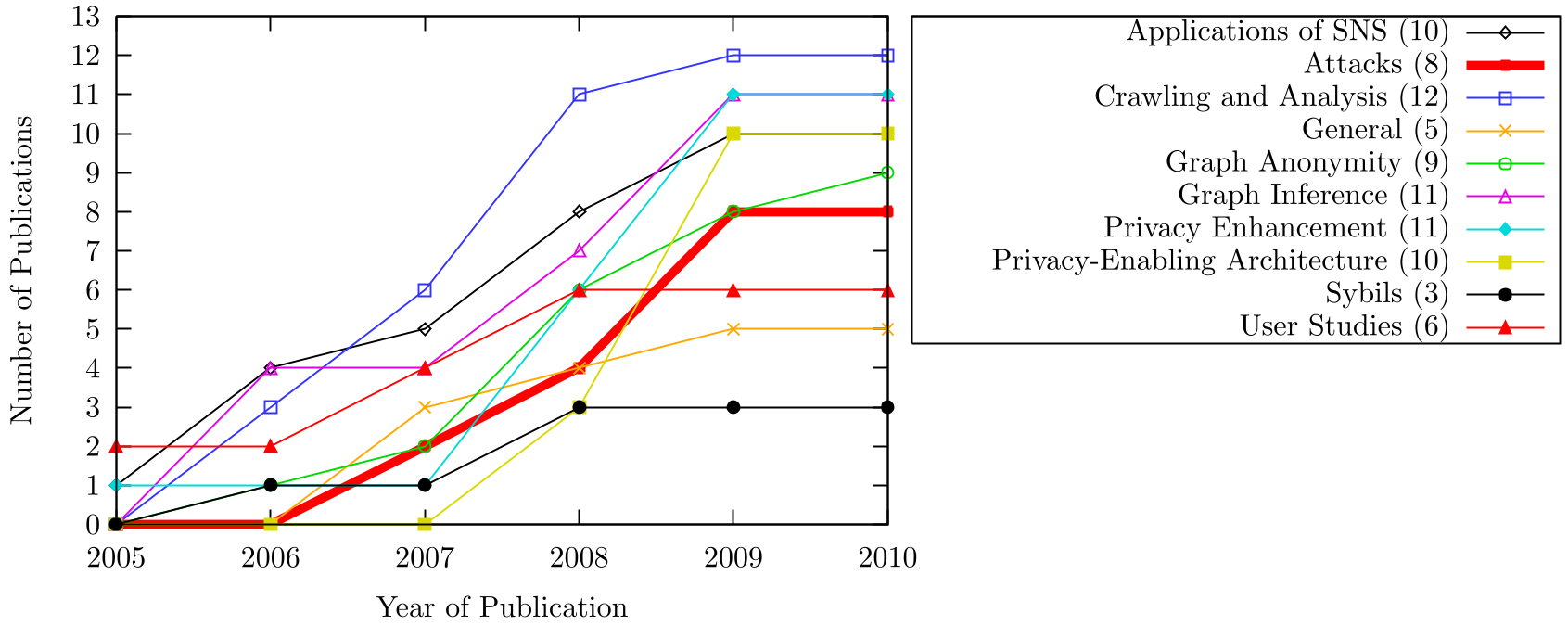 Figure: The paper situates itself within the "Privacy and Security Attacks" sub-field of SNS research.
Critical Insight & Future Outlook
The most chilling takeaway is the unlimited scalability of these attacks. When the "human element" can be modeled via social graphs and simulated via AI chatterbots, the cost of an attack drops to near zero while the conversion rate sky-rockets.
Limitations: Written in 2010, the paper focuses on browser-based credential theft and simple chat-bots. In the modern era, we must consider LLMs (Large Language Models) which can generate even more convincing, linguistically perfect "Social Phishing" messages at a scale the authors could only theorize about.
Conclusion: Technical security layers (firewalls, encryption) are useless if the "Authorized User" is manipulated into granting access. Security researchers must move toward "Context-Aware Defense" to counter "Context-Aware Attacks."