
Viral Marketing: Is "Massive and Cheap" Reality or Social Science Fiction?
2853_Cheap, easy, and massively effective viral marketing in social networks truth or fiction
Summary
Problem
Method
Results
Takeaways
Abstract
This paper investigates the "Cost-effective, Fast, and Massive" (CFM) viral marketing problem in online social networks, introducing the VirAds algorithm to minimize seeding costs under limited-hop propagation. The study proves that achieving rapid, network-wide influence requires a seeding set proportional to the network size, challenging the "cheap and easy" myth of viral marketing.
## TL;DR
While viral marketing is often touted as a "free" alternative to traditional advertising, this paper reveals a sobering reality: if you want to reach a massive audience **quickly** (within limited hops), you must pay a significant "seeding" price. The authors introduce **VirAds**, a scalable algorithm that outperforms traditional degree-based heuristics, proving that optimization is the only way to make fast-spreading campaigns affordable.
## The Motivation: The "Two-Hop" Reality Check
The prevailing academic narrative of viral marketing assumes that information will eventually ripple through an entire network given enough time. However, reality tells a different story. Studies on Flickr and Facebook suggest that social influence rarely travels beyond a few hops—often stopping at direct friends or "friends of friends."
This creates a massive problem for time-sensitive campaigns (like product launches or political movements). If propagation is locally bounded, how do we reach the whole network without bankrupting our marketing budget on initial influencers? This is the core of the **CFM (Cost-effective, Fast, and Massive)** problem.
## Methodology: Tracking Influence Without Excessive Complexity
The paper utilizes a **Locally Bounded Diffusion Model**. A node activates if a fraction $\rho$ of its neighbors are active within $d$ propagation rounds.
### The VirAds Algorithm
The challenge in finding the minimum seed set for a network like Orkut (with hundreds of millions of edges) is the computational "explosion" of greedy searches. A naive greedy approach would require $O(n^2(m+n))$ time.
**VirAds** optimizes this by:
1. **Metric-Driven Selection**: It prioritizes nodes based on "Effectiveness"—a combination of potential new active edges and the proximity to the activation threshold of neighbors.
2. **Lazy Updates**: Instead of recalculating the whole network after every seed selection, it uses a max-priority queue and only updates effectiveness when "necessary."
3. **Bellman-Ford Intuition**: It uses a queue-based update system similar to shortest-path algorithms to track how influence rounds change as new seeds are added.
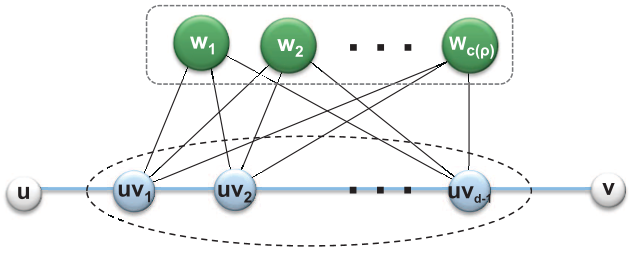
*Figure 1: The "Transmitter" gadget used in the paper's hardness proofs to demonstrate how 1-hop influence can be mapped to d-hop complexity.*
## Experiments: Scaling to 220 Million Edges
The authors tested VirAds against **Max Degree** (targeting the most popular users) and **Random Seeding** on networks like Physics (arXiv), Facebook, and Orkut.
### Key Findings:
* **Scalability**: On the Orkut dataset (3.07M nodes, 223M edges), VirAds finished in **less than 12 minutes**. The traditional "Exhaustive Update" greedy method couldn't even finish in 2 days.
* **Effectiveness**: In Facebook and Orkut, Max Degree required **60% to 70% more seeds** compared to VirAds to achieve the same network coverage.
* **The Cost of Speed**: The research proves that to reach the network within limited rounds $d$, the seed set must be $\Omega(n)$—a constant fraction of the network. This confirms that massive viral marketing is never truly "cheap."
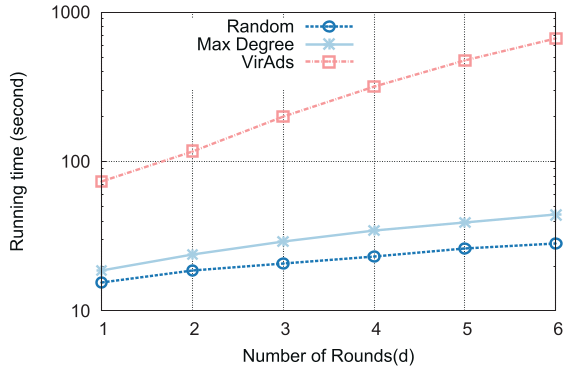
*Figure 2: Seeding size comparison. VirAds (red line) consistently requires fewer seeds than degree centrality (blue) or random (green) heuristics.*
## Critical Analysis & Takeaways
The work provides a rigorous mathematical defense for why marketing budgets often fail to produce "viral" results: **The Power-Law paradox.** Because social networks are sparse and distributed according to power laws, reaching the "long tail" of users requires a much larger initial investment than previously estimated.
### Limitations
While the model is robust, it treats all connections as equal. In real-world scenarios, the "weight" of a link (e.g., family vs. casual acquaintance) significantly impacts the factor $\rho$. Future work should integrate **link-weight inference** with the VirAds optimization framework.
### Final Insight
For practitioners, the takeaway is clear: **Stop relying solely on "Top-K" influencers.** While degree centrality is a decent long-term strategy, it is highly inefficient for fast, massive reach. Optimization-based targeting is not just a theoretical exercise; it is a budget necessity.