
Branded with a Scarlet “C”: The Social Dynamics of Game Cheaters
Branded with a Scarlet “C”: Cheaters in a Gaming Social Network
This paper presents a large-scale analysis of cheaters within the Steam Community, utilizing data from over 12 million gamers. By analyzing social graphs and in-game interactions, the study uncovers how the "VAC-ban" (the scarlet "C") affects social standing and how cheating behavior propagates through social networks.
TL;DR
Based on a dataset of 12 million Steam users, this study reveals that cheaters are not social outcasts—they are well-embedded in the network but exhibit extreme homophily (cheaters flock together). The paper demonstrates that cheating spreads like a virus through social ties and that being publicly "branded" as a cheater leads to measurable social decay and "social suicide."
The Logic of the Cheat: More Than Just Winning
Online gaming is a multi-billion dollar industry where "fair play" is the foundational currency. When a player uses an "aimbot" or "wallhack," they aren't just breaking code; they are collapsing a shared "play-world." The industry fights back with technical tools like the Valve Anti-Cheat (VAC) system, which brands offenders with a permanent, public mark on their profile.
The researchers set out to answer a fundamental sociological question: Does this public shaming actually work, and how does the "disease" of cheating spread?
Methodology: Mining the Steam Megagraph
The researchers achieved a Herculean data collection feat:
- The Social Graph: 12.5 million accounts and 88.5 million friendship edges.
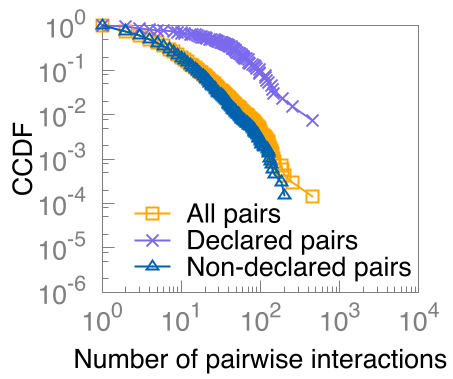
- The Interaction Layer: Logs from a 32-player Team Fortress 2 server to see how people actually behave in-game.
- The Temporal Layer: Tracking the exact moment a player was "branded" to observe the before-and-after social effects.

Core Insight 1: The "Birds of a Feather" Phenomenon
One might assume cheaters are isolated, but the data proves otherwise. While cheaters have roughly the same number of friends as fair players, the composition of those friend lists is vastly different.
- Homophily: Fair players rarely associate with cheaters. Conversely, a cheater’s friend list is often a "cheater hub."
- Predictive Power: The likelihood of a "fair" player becoming a cheater increases significantly as the number of their cheater friends grows. This suggests cheating is a contagion—a behavior learned and normalized through social proximity.
Core Insight 2: The Social Penalty of the Scarlet "C"
What happens when the "ban hammer" drops? The researchers tracked "new" cheaters over a 6-month window and noticed three distinct behaviors:
- Privacy Retreat: 10% of new cheaters immediately set their profiles to "Private," compared to only 3% of fair players. They are literally trying to hide the mark of shame.
- Stagnation: While the average Steam user gains friends over time, cheaters lose them.
- Social Suicide: In extreme cases, branded users delete their entire friend list—an act of social self-destruction following the public exposure of their deviance.
Geo-Social Clusters: The "Culture" of Cheating
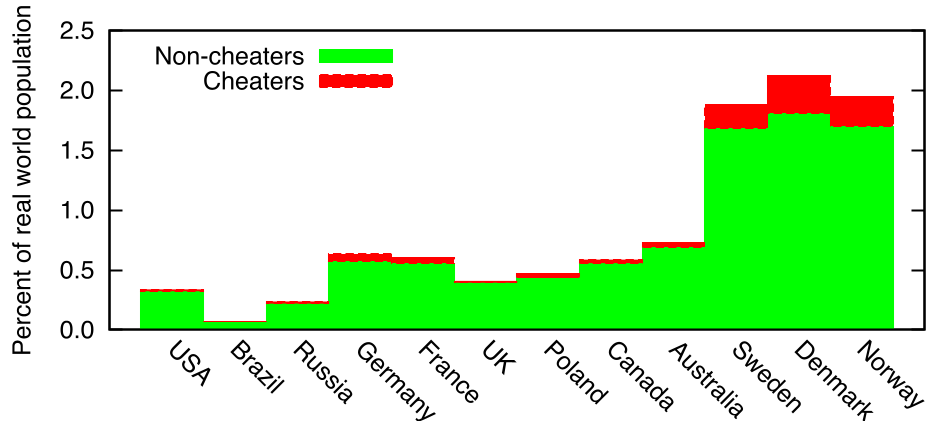
Interestingly, the study found that cheating is not geographically uniform. In some Nordic regions, cheaters make up nearly 12.4% of the player base, compared to 3.9% in the US. This points to the existence of "cheating cultures" where the social taboo of breaking game rules may be lower, or the local community's tolerance higher.
Conclusion: Lessons for the Broader Web
The "Scarlet C" study provides a rare look at how digital communities regulate themselves.
- For Developers: Publicly flagging deviants is more effective than silent bans because it leverages social pressure.
- For Sociologists: Even in virtual worlds, high-latency "friendships" mimic real-world morality; we judge our peers by the "brands" they carry.
The message is clear: in the hyper-connected world of online gaming, you don't just play with your friends—you inherit their reputation.