
Photo-Check: Why Your Shared Photos are Leaking Your Private Locations
Check-ins and Photos: Spatiotemporal Correlation-Based Location Inference Attack and Defense in Location-Based Social Networks
This paper introduces a novel location inference attack based on the spatiotemporal correlation of both check-ins and geo-tagged photos in Location-Based Social Networks (LBSNs). To counter this, the authors propose "photo-check," a decentralized Privacy-Preserving Mechanism (LPPM) that utilizes a randomized greedy dummy generation algorithm to achieve near-optimal privacy.
TL;DR
Even if you hide your check-in location using "dummy" points, a simple photo upload can give you away. This paper reveals that the historical distribution of photos creates a unique signature for locations. The authors propose photo-check, a mechanism that intelligently delays, drops, or generates smart dummies to protect users from spatiotemporal inference attacks, achieving near-optimal privacy with high efficiency.
Background: The Hidden Map in Your Gallery
In the world of Location-Based Social Networks (LBSNs) like Foursquare or Facebook, we often use Location Privacy-Preserving Mechanisms (LPPMs). The standard trick is to send your real location along with "dummy" locations to the server so the platform doesn't know which one is yours.
However, the authors point out a critical flaw: prior work ignores photos. If you share a photo at a location where people rarely take photos, but your dummies are at locations where photos are common, an attacker can easily tell which point is the fake one.
The Problem: Content-Oblivious Inference
The genius of this attack is that the attacker doesn't even need to look at what is in your photo (no Computer Vision required). By simply looking at the Photo Sharing Probability () and Check-in Probability (), an adversary can filter out dummies that are statistically "unlikely" to host a photo event.
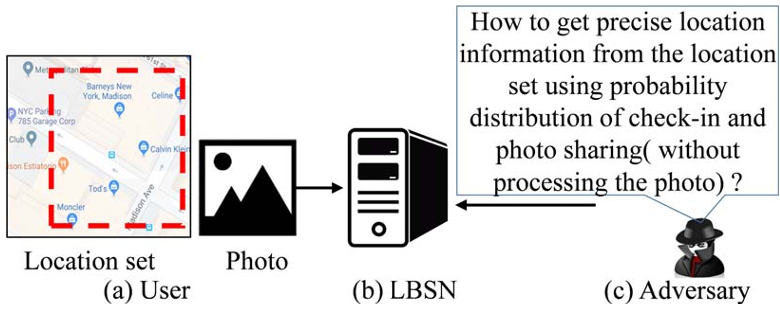
The paper identifies that existing LPPMs suffer from a high "Inference Rate" () because they don't consider the spatiotemporal correlation between a check-in and a subsequent photo.
Methodology: The Photo-Check Defense
To solve this, the authors propose a multi-layered approach that operates directly on the user's device (Decentralized).
1. Spatiotemporal Logic
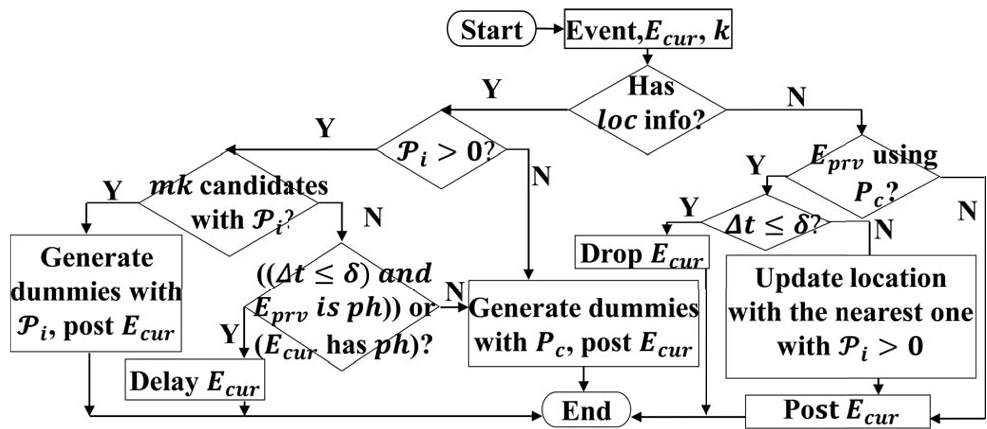
The system doesn't just generate dummies; it makes a strategic decision based on the time difference () between events:
- Post: If the location is safe.
- Delay: If waiting a few minutes makes the location less predictable.
- Drop: If posting the photo would irreversibly compromise the previous check-in's privacy.
- Dummy: If the event can be masked by statistically similar fake locations.
2. Randomized Greedy Dummy Generation
Instead of searching the whole map (which is slow) or picking purely random points (which is easy to crack), the algorithm searches for locations within a distance that have a similar probability profile to the user's real location. It uses a Degree of Privacy () metric based on entropy to ensure that the chosen dummies are as confusing to an attacker as possible.
Experimental Validation
Using real-world data from Foursquare NYC (162 million check-ins), the authors compared photo-check against established baselines like DLS and Random selection.
Privacy Performance
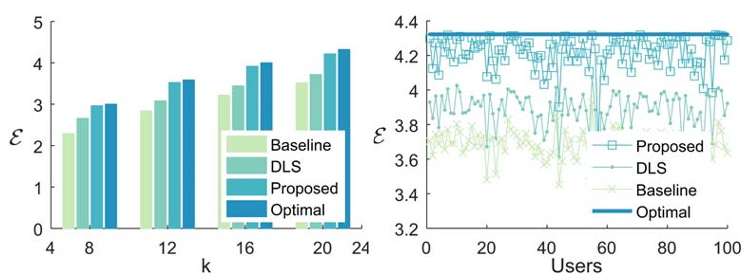
The "Degree of Privacy" measures how much uncertainty an attacker faces. As seen in the results, the proposed method (Red line) remains consistently high across different numbers of dummies (), whereas others fluctuate or underperform.
Efficiency
Computation time is critical for mobile devices. The study shows that while DLS takes ~52ms to generate 20 dummies, the proposed randomized greedy approach takes only ~2.9ms—a ~18x speedup.
Conclusion & Insights
This research highlights a growing trend in privacy: the danger of side-channel spatial data. Even if your primary data (the check-in) is obfuscated, secondary metadata (the fact that a photo exists) acts as a "fingerprint."
The photo-check framework proves that by considering the interaction between different types of social events, we can build significantly more robust defenses without sacrificing the mobile user experience. For future LBSN developers, the takeaway is clear: privacy is not a per-packet feature, but a spatiotemporal narrative that must be protected holistically.