
It’s the Way You Check-in: Unmasking Identity in Geo-Social Networks
It’s the Way you Check-in: Identifying Users in Location-Based Social Networks
The paper presents a comprehensive study on user identification within Location-Based Social Networks (LBSNs) like Foursquare, Gowalla, and Brightkite. It introduces trajectory-based, frequency-based, and hybrid identification strategies to de-anonymize individuals using sparse check-in data.
TL;DR
Is your "anonymized" location history truly private? This research proves it isn't. By analyzing sparse check-in data from Foursquare, Gowalla, and Brightkite, researchers developed a hybrid model that can identify up to 90% of users using as few as 10 data points. The study highlights a chilling reality: the combination of where you go and when you go there forms a digital fingerprint that is nearly impossible to hide.
Context: The Illusion of Social Privacy
Location-Based Social Networks (LBSNs) thrive on transparency. We check into cafes, tag friends at concerts, and broadcast our daily commutes. While platforms may anonymize data for research or sale, this paper argues that "anonymity" is a fragile shield. The authors position this work as a wake-up call, demonstrating that an attacker with access to a public LBSN profile can easily link it to a separate, "de-identified" set of geographic traces.
The Core Challenge: Sparse and Social Data
Identifying a user in a dense GPS stream is one thing, but LBSN data is notoriously "leaky" yet "sparse." You don't record every step; you record specific "check-ins."
- Spatial Uniqueness: In Foursquare, coordinates represent where you actually stood. In Gowalla, they represent the venue center. This difference in "uniqueness" changes how easily you can be tracked.
- Social Ties: If your data is missing, can your friends give you away? The authors test "Social Smoothing"—the idea that your movement is influenced by your social circle.
Methodology: The Hybrid Identification Attack
The researchers didn't rely on a single trick. They combined three distinct mathematical intuitions:
1. Trajectory-Based (The Hausdorff Intuition)
Instead of simple point-matching, they used a Modified Hausdorff Distance. This calculates the average distance between a "query" set of points and a user's historical trajectory. It’s robust because it doesn't care if you visited the points in a different order—it cares about spatial proximity.
2. Frequency-Based (The Bayesian Intuition)
They modeled users using a Multinomial Naïve Bayes approach. If "User A" visits the gym 50% of the time and "User B" visits the library 50% of the time, a single check-in at the gym heavily tips the scales toward User A. They further refined this into a Time-Dependent model, splitting the day into four 6-hour bins to capture "Morning Commuters" vs. "Night Owls."
3. The Hybrid Powerhouse
The crowning achievement is the Hybrid Model, which weighs the trajectory score and the probabilistic frequency score:
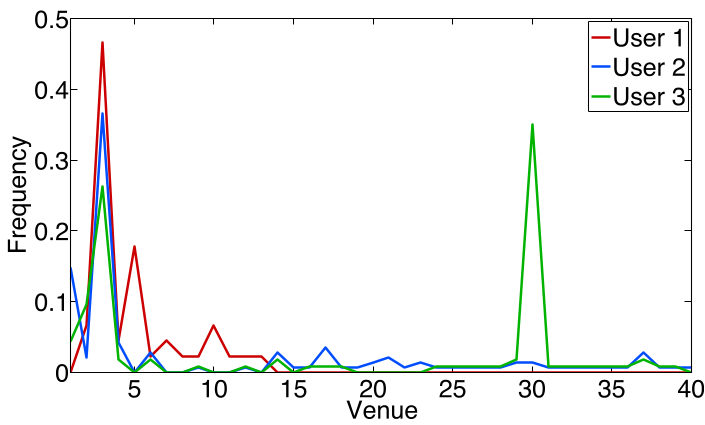 Visualizing check-in frequencies: even in a dense city like San Francisco, user habits are distinct.
Experimental Battleground: SF, NY, and LA
The authors tested their models on users in major hubs. The results were startling:
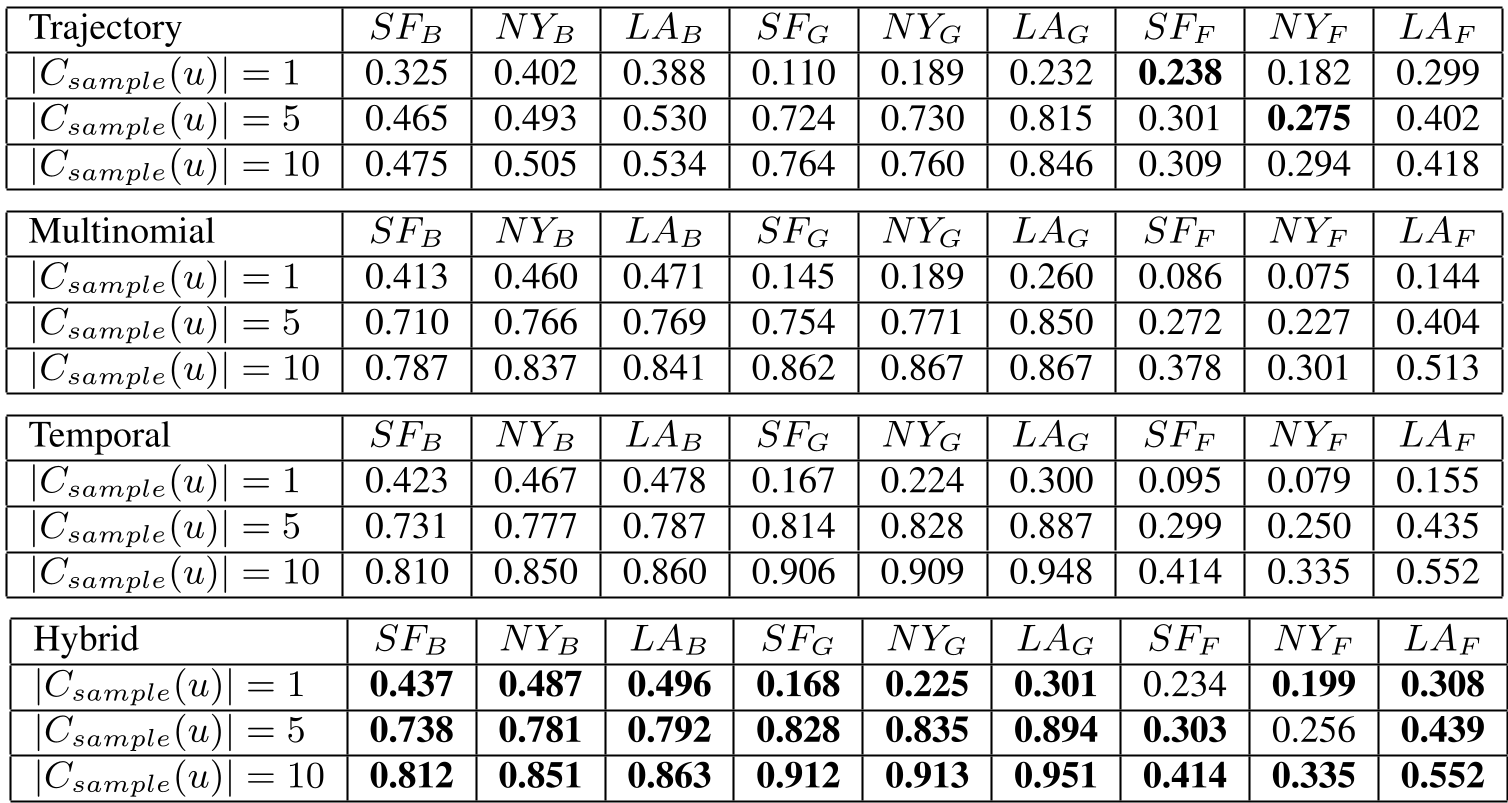 Table 3: Across all cities, the Hybrid and Temporal models consistently dominate.
- High Accuracy: In Gowalla (Los Angeles), the Hybrid model reached 95.1% accuracy with 10 points.
- The Foursquare Edge: Because Foursquare uses precise GPS coordinates (high uniqueness), the trajectory-based method was significantly more effective there than in Brightkite or Gowalla when only 1-2 points were known.
- Social Influence: Interestingly, "Social Smoothing" (using friends' data) helped slightly in Foursquare but actually hurt accuracy in Gowalla, suggesting that for short-distance urban movements, our friends' habits are more "noise" than "signal."
Critical Insight: Complexity Measurement
The authors introduced a new metric: Identification Complexity , based on Jensen-Shannon Divergence.
- If , all users look identical (maximum privacy).
- If , every user is perfectly unique (zero privacy). Their findings showed that Foursquare is "complex" (harder to crack) due to its larger venue density, while Brightkite is the "easiest" to de-anonymize.
Conclusion & Future Outlook
This paper serves as a seminal warning for the "Big Data" era. It proves that our movements are not just points on a map; they are temporal signatures.
Key Takeaways:
- Quantity is not everything: You don't need a year of data. 10 check-ins are enough.
- The Hybrid Threat: Attackers don't use one method; they combine spatial distance with behavioral frequency.
- Policy Implications: Current anonymization is insufficient. Future systems must move toward Differential Privacy or advanced obfuscation to truly protect identity in a geo-social world.
The next time you "check-in" to your favorite local spot, remember: you're not just sharing a location; you're signing your name.