
CheckInside: Solving the "Indoor Blind Spot" of Location-Based Social Networks
CheckInside: a fine-grained indoor location-based social network
CheckInside is a fine-grained indoor Location-Based Social Network (LBSN) that utilizes multi-modal crowd-sensed data (WiFi, inertial sensors, sound, and images) to identify specific sub-building venues. It outperforms traditional LBSNs like Foursquare by mapping "semantic fingerprints" to physical locations, achieving a 99% accuracy in placing the correct venue within the top five results.
TL;DR
While we rely on apps like Foursquare or Facebook Places to "check-in," these services often fail the moment we step indoors. CheckInside is a research breakthrough that uses the sensors already in your pocket—WiFi, accelerometer, microphone, and camera—to identify exactly which store you are in with 99% accuracy (Top-5), even when GPS is completely dead.
The Problem: The 84-Meter Failure
Most Location-Based Social Networks (LBSNs) are designed for the outdoors. Once you enter a multi-story mall, GPS signal drops, and cellular localization becomes a blunt instrument with errors spanning hundreds of meters.
The authors' study revealed a frustrating reality:
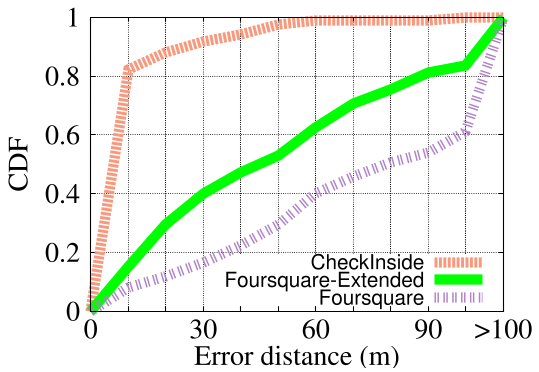
- Distance Error: The median error for indoor venues in Foursquare is 84 meters.
- Ranking Nightmare: In 47% of cases, the actual venue you are standing in isn't even in the top 30 suggested results.
- Granularity Mismatch: Instead of "Starbucks," the app might just label everything as "Mall Food Court."
Methodology: The Semantic Fingerprint
CheckInside doesn't just try to find your X-Y coordinates; it tries to understand the "soul" of the venue through a Semantic Fingerprint.
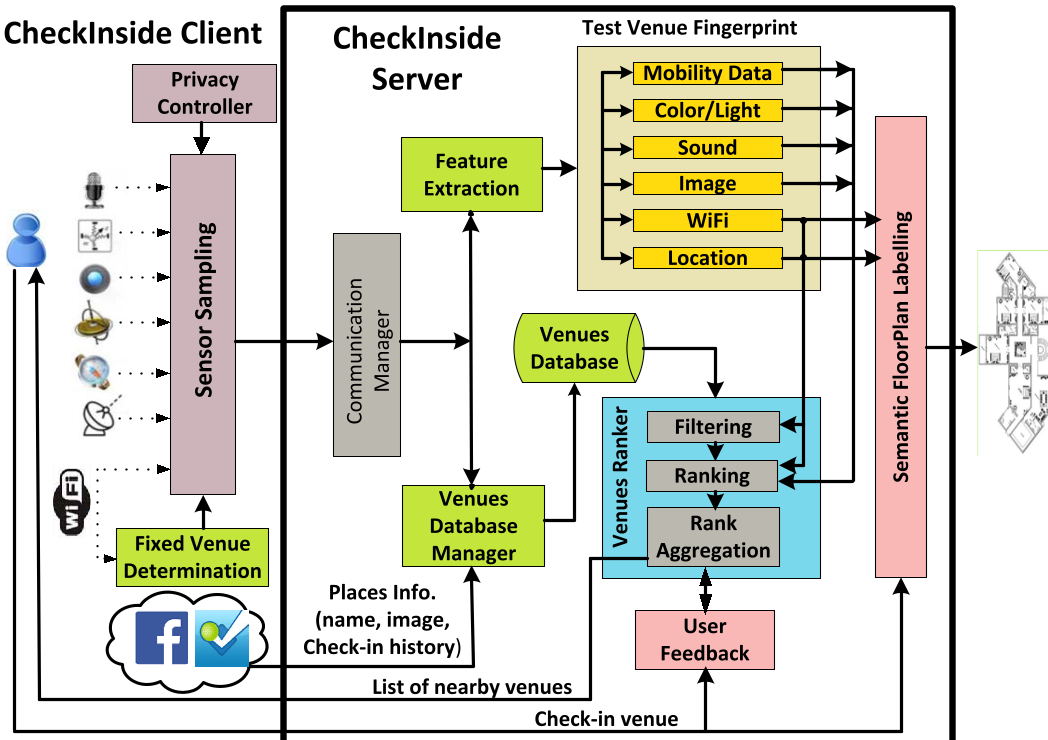
1. Multi-Modal Fusion
The system extracts features across several dimensions:
- Mobility: Are you sitting (restaurant), browsing (clothing store), or walking (grocery)?
- WiFi: Using a modified Jaccard similarity to match MAC address distributions.
- Acoustics & Visuals: Captures ambient noise (e.g., quiet libraries vs. loud arcades) and thematic colors/textures (e.g., McDonald's red & yellow).
2. Smart Ranking & Feedback
Instead of a simple "average," the system uses Borda’s order-based aggregation to combine results from different sensor rankers. Crucially, it leverages implicit user feedback: when a user selects a venue from the list, the system learns which sensors were most reliable in that specific environment and updates its weights accordingly.
3. Cleaning the Data: Outlier Detection
People lie or make mistakes. Some check-in to a bar while they are still in the parking lot. CheckInside uses an unsupervised hierarchical clustering algorithm to find the "consensus" location of a venue, effectively filtering out "erroneous check-ins."
Performance: Precision at Scale
The evaluation across four malls and 711 stores proves the power of this approach. While Foursquare struggled to hit the top of the list, CheckInside dominated.
- Accuracy: 83% for the exact venue (vs. 17% for Foursquare).
- Top-5 Accuracy: A near-perfect 99%.
- Coverage: Discovered 25.4% more venues than existing databases by recognizing "fingerprint" patterns of retail chains.
Critical Insight & Future Outlook
The genius of CheckInside lies in its ubiquity. It doesn't require malls to install expensive Bluetooth beacons or ultra-wideband hardware. It transforms the "noisy" nature of crowdsourcing into a self-correcting, high-precision map.
However, there are limitations. Privacy remains a hurdle; while the authors offer a "Privacy Mode" (disabling mic/camera), the performance drops. Furthermore, as malls change layouts frequently, the temporal stability of these fingerprints—especially sound and visual themes—will require continuous, high-frequency crowdsensing to remain valid.
Conclusion: CheckInside provides the blueprint for the next generation of "Hyper-Local" services, moving us from "I am at the Mall" to "I am standing in the third aisle of the H&M on the second floor."